
Free Safe Operating Procedure (Screen Printing) Template
Download our free Safe Operating Procedure (Screen Printing) template to formalise safe work methods for your printing operations. Get your DOCX and PDF now.
Free Safe Operating Procedure (Screen Printing) Template
DOCX • 126 KB + PDF
Updated Oct 2026
No signup required
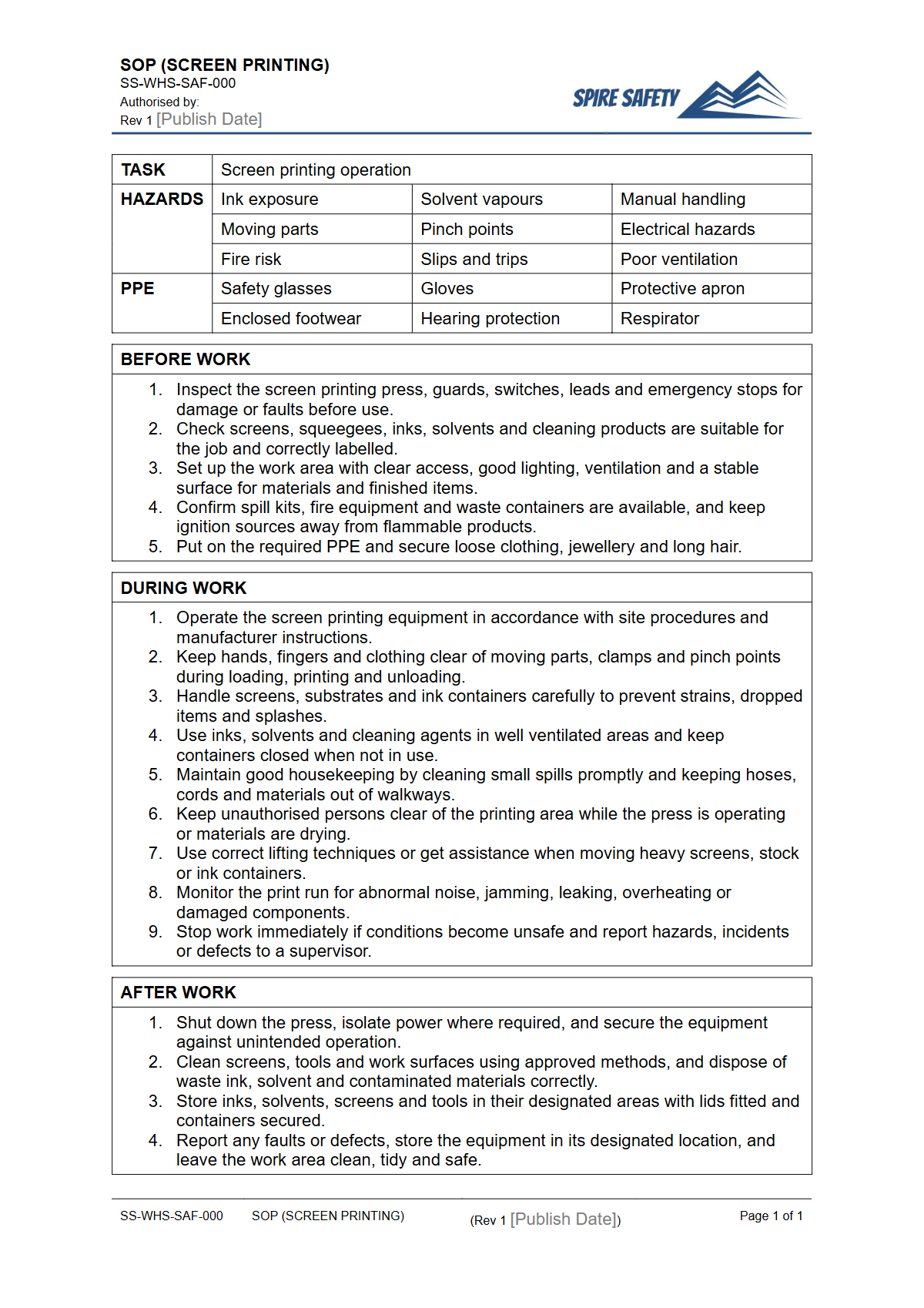
Purpose of the Free Safe Operating Procedure (Screen Printing) Template
Screen printing involves a unique combination of machinery, chemicals, and manual tasks, each presenting distinct workplace health and safety risks. This Free Safe Operating Procedure (Screen Printing) Template provides a structured framework to help your organisation document and standardise the steps for performing this work safely.
Using this SOP helps manage hazards, train employees effectively, and demonstrate a systematic approach to risk management as required under Australian WHS law.
A comprehensive Safe Operating Procedure (SOP) is a key administrative control measure. It formalises pre-operational checks, step-by-step operating instructions, and post-operational cleaning and shutdown procedures.
By clearly outlining these processes, you can reduce the risk of incidents related to chemical exposure, machine entanglement, and ergonomic injuries. Integrating this document into your broader safety framework is a critical step in building a robust system, which is the core principle behind formal WHS management systems.
Key Hazards in Screen Printing
An effective screen printing SOP should address the specific hazards present in your workshop. These commonly include:
- Chemical Hazards: Exposure to inks, solvents, screen cleaners, and emulsions. Risks include skin irritation, dermatitis, respiratory issues, and long-term health effects from vapours. The SOP must specify correct handling, storage, and required Personal Protective Equipment (PPE).
- Mechanical Hazards: Moving parts on manual and automatic carousels or presses can create pinch points and entanglement risks. The procedure should include checks for machine guarding and emergency stops. Some setups use compressed air for cleaning or pneumatic functions, requiring specific safety protocols like those outlined in a Free Air Compressor SOP.
- Ergonomic Hazards: Repetitive movements, awkward postures while applying ink, and manual handling of heavy screens or stock can lead to musculoskeletal disorders. The SOP should encourage good posture and task rotation.
- Physical Hazards: Noise from machinery, UV light from exposure units, and heat from curing ovens or flash dryers all require specific controls.
Video walkthrough
How to use the Free Safe Operating Procedure (Screen Printing) Template
This resource is available as a DOCX file for easy editing and a PDF for straightforward printing and distribution. To use it effectively, download the DOCX version and meticulously adapt it to your specific workplace.
This involves adding details about your exact machinery (make and model), the specific chemicals in use (referencing their Safety Data Sheets), and your workshop's layout and emergency procedures.
Important: This document is a template and must be customised. We are not familiar with your specific operations, so you must add, remove, and amend the content to reflect your site's unique processes and risks.
A competent person with knowledge of screen printing operations and WHS principles should review the final document before it is implemented. If you require assistance with this customisation process, consider engaging external WHS consulting services.
Once finalised, the SOP should be used as a primary training document for all relevant personnel. It should be kept in a location easily accessible to operators, such as near the screen printing equipment itself.
When to use it
A Safe Operating Procedure for screen printing should be developed and implemented before any worker is permitted to operate the equipment. It serves as a foundational document for several key business activities:
- Induction and Training: Use the SOP to train new employees on the safe method of work.
- Refresher Training: Periodically review the SOP with experienced staff to prevent complacency and reinforce safe habits.
- Risk Assessments: The SOP serves as a reference when conducting or reviewing a risk assessment for specific tasks.
- Incident Investigations: Following an incident or near-miss, the SOP should be reviewed to determine if the procedure was adequate and if it was followed correctly.
In larger production environments, printed materials may move from the press to a drying area via automated systems. If your workflow includes this, you may also need a FREE Conveyer System SOP to manage associated risks.
Who should use it
This Safe Operating Procedure is intended for use by multiple roles within an organisation:
- Workers/Operators: To understand and follow the approved, safe method for completing their tasks.
- Supervisors and Managers: To train staff, monitor performance, and ensure that work is being conducted in line with established safety standards.
- WHS Officers and PCBUs: To meet their duty of care by providing safe systems of work and adequate instruction for employees.
The SOP is a living document that forms part of your organisation's safety records. Regular reviews are essential to ensure it remains current with any changes in equipment, chemicals, or processes.
This process of periodic review is a fundamental component of WHS compliance auditing, helping to verify that your safety systems are effective and up to date.
Common mistakes
Common mistakes to avoid
- Using generic procedures that don't reflect the specific inks, solvents, and equipment in use.
- Providing inadequate ventilation, leading to harmful exposure to chemical fumes and vapours.
- Failing to enforce the use of specified PPE, especially chemical-resistant gloves and safety glasses.
- Neglecting ergonomic risks associated with manual handling of screens and repetitive pulling or pushing of squeegees.
Legal references
Legal considerations
The following legal requirements may be relevant to this type of work.
- Work Health and Safety Act (Harmonised) — Provides the primary duties for protecting workers and other people from work health and safety risks.
- Work Health and Safety Regulations (Harmonised) — Sets out requirements supporting the management of workplace hazards and risks.
The following codes may be relevant to this type of work.
- Managing WHS Risks Code of Practice — Provides practical guidance on identifying hazards, assessing risks and applying effective controls.
- Work Health and Safety Consultation, Cooperation and Coordination Code of Practice — Provides practical guidance on consulting workers and coordinating with other duty holders.
- Managing the Work Environment and Facilities Code of Practice — Provides practical guidance on safe work environments, workplace facilities and related controls.
Did you know
Ventilation is Critical
Many screen printing solvents contain Volatile Organic Compounds (VOCs). Without proper mechanical ventilation, VOC levels can quickly build up in a workshop, posing significant short-term and long-term health risks to workers.
Ergonomic Risk
A study on screen printers found that musculoskeletal pain, particularly in the shoulders, neck, and upper back, was a common complaint. This highlights the importance of designing the workstation and tasks to minimise repetitive strain.
FAQ
Frequently asked questions
01What hazards should be included in a screen printing SOP?
02How often should a screen printing Safe Operating Procedure be reviewed?
03Is a screen printing SOP legally required in Australia?
04Can this template be used for both manual and automatic screen printing presses?
Share this resource
Free Safe Operating Procedure (Screen Printing) Template
Browse Categories
How To Use It
- 1Download and open in Word or PDF.
- 2Replace the placeholders with your business details.
- 3Get it reviewed by a WHS specialist before rollout.
Need it customised?
Our WHS consultants can adapt this template to your site, run a gap analysis, or audit what you already have in place.
Book a Free Consultation WHS consulting servicesor call 1300 156 382
Related templates
- Free Safe Operating Procedure (Screening Plant Operation) Template
- Free Safe Operating Procedure (Screw Gun) Template
- Free Safe Operating Procedure (Scroll Saw) Template
- Free Safe Operating Procedure (Scrubber Dryer) Template
- Free Safe Operating Procedure (Sealant Application) Template
- Free Safe Operating Procedure (Seaming Machine) Template