
Free Safe Operating Procedure (Sausage Filler) Template
Download our free Safe Operating Procedure (Sausage Filler) template to document safe work methods. Customise this DOCX or PDF to suit your workplace needs.
Free Safe Operating Procedure (Sausage Filler) Template
DOCX • 126 KB + PDF
Updated Oct 2026
No signup required
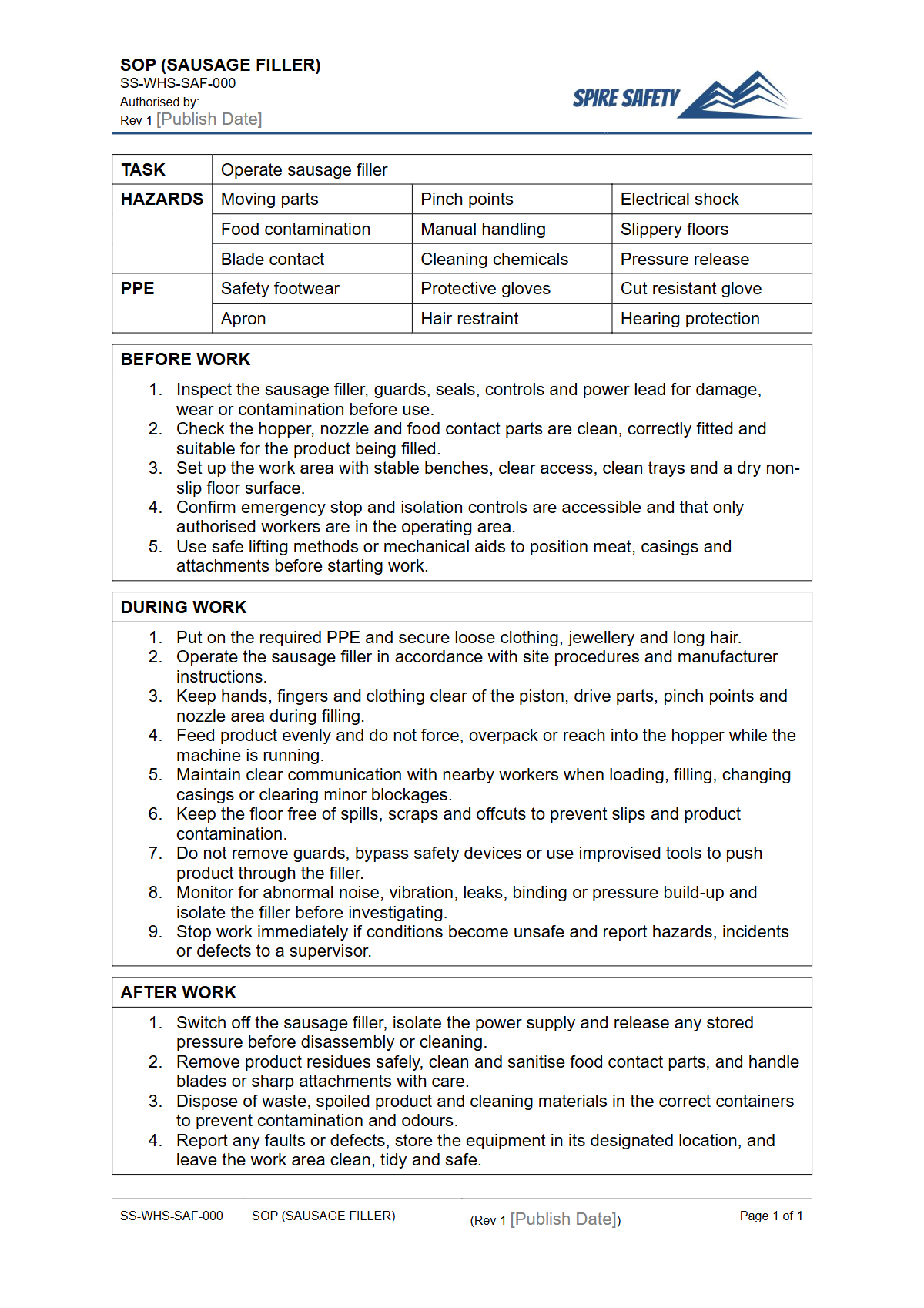
Purpose of the Free Safe Operating Procedure (Sausage Filler) Template
Operating a sausage filler, whether in a butchery, food processing plant, or commercial kitchen, involves specific risks that must be managed to ensure worker safety. This Free Safe Operating Procedure (Sausage Filler) Template provides a structured format to document the safest way to perform this task.
An effective SOP is a fundamental tool for risk management, outlining step-by-step instructions for pre-operational checks, operation, cleaning, and maintenance. It serves as a key training document, ensures procedural consistency, and demonstrates your organisation's commitment to providing a safe system of work.
By clearly defining the process, you can significantly reduce the risk of injuries from mechanical parts, electrical faults, and poor hygiene.
Key Hazards of Sausage Filler Operation
Before using the template, it's vital to understand the common hazards associated with sausage fillers. A thorough risk assessment should be conducted to identify controls for:
- Mechanical Hazards: The primary risk involves entanglement or crushing from the auger, piston, or other moving parts. Nip points between gears and belts can cause severe injuries if guards are missing or defeated.
- Electrical Hazards: Faulty wiring, damaged cords, or exposure to water during operation or cleaning can lead to electric shock or electrocution.
- Manual Handling: Lifting heavy machine components for cleaning, moving the unit, or handling large batches of product can cause musculoskeletal injuries.
- Hygiene and Biological Hazards: Improper cleaning can lead to bacterial growth and food contamination, posing a risk to both workers and consumers. The chemicals used for cleaning can also present their own hazards.
Documenting procedures for related equipment, such as creating an SOP for a deep fryer, helps build a comprehensive safety framework in any food preparation environment.
Video walkthrough
How to use the Free Safe Operating Procedure (Sausage Filler) Template
This document is a starting point designed for customisation. To implement it effectively, follow these steps:
- Download: Choose either the DOCX or PDF format. The DOCX version is fully editable.
- Consult: Involve the workers who operate the sausage filler. Their hands-on experience is invaluable for identifying practical steps and potential risks that might otherwise be overlooked.
- Customise: Adapt the template to your specific circumstances. It is crucial to remember that this is a template, not a finished document. We have provided a structured starting point, but you must customise every section to reflect the specific sausage filler model, tasks, and risks present in your workplace.
- Train: Use the finalised SOP to train all relevant operators. Ensure they understand every step and have an opportunity to ask questions. Keep a record of this training.
- Review: Schedule regular reviews of the SOP (e.g., annually) or whenever a change occurs—such as new equipment, a change in process, or after an incident.
Integrating SOPs like this one is a core component of implementing a comprehensive WHS management system, helping to standardise safe practices across your entire operation.
Customisation Checklist
When tailoring this template, ensure you include the following site-specific details:
- The exact make and model of the sausage filler.
- Required Personal Protective Equipment (PPE), such as cut-resistant gloves for cleaning, non-slip footwear, and eye protection.
- Location and testing procedure for the emergency stop button.
- Step-by-step Lockout/Tagout (LOTO) procedures for cleaning and maintenance.
- A list of approved cleaning chemicals and their safe handling instructions.
- Specific instructions for machine assembly and disassembly.
For more complex production lines, you may also need to develop an SOP for conveyer systems that feed into or out of the processing area.
When to use this Safe Operating Procedure
An SOP for a sausage filler should be a living document that is used consistently. It is essential during key phases of the equipment's lifecycle, including the initial commissioning and setup.
It forms the backbone of all operator training, for both new team members and for periodic refresher sessions for experienced staff. The SOP should also be referenced during incident investigations to determine if procedural gaps contributed to the event.
Furthermore, it serves as a critical piece of evidence during a WHS compliance audit to demonstrate that safe work systems are in place and being followed.
Who should use this Safe Operating Procedure
Responsibility for the SOP is shared across the organisation. The Person Conducting a Business or Undertaking (PCBU) holds the primary duty of care to provide safe work systems, which includes ensuring SOPs are developed and implemented.
Supervisors and managers are responsible for training workers on the SOP, ensuring it is followed, and conducting reviews. Finally, workers have a responsibility to follow the procedures outlined in the SOP and to report any hazards or procedural issues they identify.
If you require assistance developing and embedding these documents, seeking guidance from a WHS consultant can help ensure your processes are robust and effective. Similar procedures are vital for other common workplace equipment, as detailed in our air compressor SOP.
By properly developing, implementing, and reviewing this Safe Operating Procedure, you create a safer environment for everyone. Explore our extensive library of free WHS resources for more templates to support your safety management system.
Common mistakes
Common mistakes to avoid
- Using a generic template without customising it for the specific machine model and workplace.
- Failing to train workers on the SOP and confirm their understanding before they operate the machine.
- Storing the SOP in an office, rather than making it easily accessible near the equipment.
- Neglecting to include specific instructions for cleaning, maintenance, and lockout/tagout procedures.
Legal references
Legal considerations
The following legal requirements may be relevant to this type of work.
- Work Health and Safety Act (Harmonised) — Provides the primary duties for protecting workers and other people from work health and safety risks.
- Work Health and Safety Regulations (Harmonised) — Sets out requirements supporting the management of workplace hazards and risks.
The following codes may be relevant to this type of work.
- Managing WHS Risks Code of Practice — Provides practical guidance on identifying hazards, assessing risks and applying effective controls.
- Work Health and Safety Consultation, Cooperation and Coordination Code of Practice — Provides practical guidance on consulting workers and coordinating with other duty holders.
- Managing the Work Environment and Facilities Code of Practice — Provides practical guidance on safe work environments, workplace facilities and related controls.
Did you know
Nip Point Dangers
The moving parts inside a sausage filler, like the auger, create powerful 'nip points' that can cause severe amputation or crushing injuries. This is why guards and interlocks are critical safety features that should never be bypassed.
Consultation is Key
Involving the workers who actually operate the sausage filler when you write the SOP is not just good practice—it's a requirement under model WHS laws. They often have the most practical insight into the real-world risks.
FAQ
Frequently asked questions
01Is a Safe Operating Procedure a legal requirement for a sausage filler in Australia?
02How often should a sausage filler SOP be reviewed?
03What is the difference between an SOP and a SWMS?
04Can I use this template for both commercial and domestic sausage fillers?
Share this resource
Free Safe Operating Procedure (Sausage Filler) Template
Browse Categories
How To Use It
- 1Download and open in Word or PDF.
- 2Replace the placeholders with your business details.
- 3Get it reviewed by a WHS specialist before rollout.
Need it customised?
Our WHS consultants can adapt this template to your site, run a gap analysis, or audit what you already have in place.
Book a Free Consultation WHS consulting servicesor call 1300 156 382
Related templates
- Free Safe Operating Procedure (Saw Horse) Template
- Free Safe Operating Procedure (Sawmill Carriage) Template
- Free Safe Operating Procedure (Scaffold Hoist) Template
- Free Safe Operating Procedure (Scoreboard Cleaning) Template
- Free Safe Operating Procedure (Screen Printing) Template
- Free Safe Operating Procedure (Screening Plant Operation) Template