
Free Safe Operating Procedure (Sauna Cleaning) Template
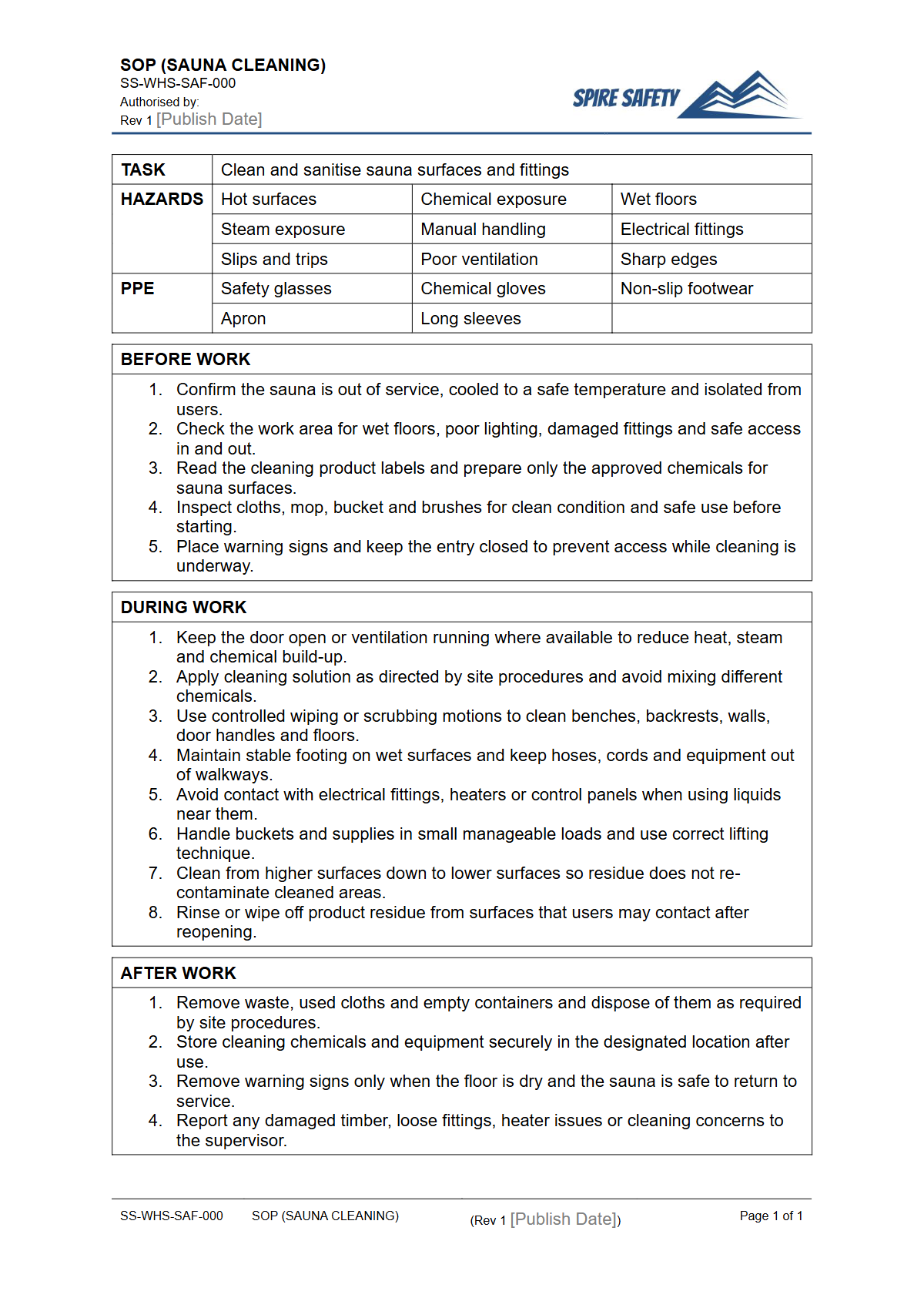
Download our free Safe Operating Procedure for sauna cleaning to document and standardise your processes. This customisable template helps you manage risks.
Free Safe Operating Procedure (Sauna Cleaning) Template
DOCX • 126 KB + PDF
Updated Oct 2026
No signup required
Purpose of the Free Safe Operating Procedure (Sauna Cleaning) Template
A Safe Operating Procedure (SOP) is a critical document that provides step-by-step instructions on how to perform a task safely. This Free Safe Operating Procedure (Sauna Cleaning) Template is designed to help businesses in the wellness, fitness, and hospitality industries establish and formalise their cleaning protocols.
Using a structured SOP helps your organisation meet its primary duty of care under WHS legislation by minimising risks for workers.
Cleaning a sauna involves several potential hazards that must be managed effectively. These include exposure to cleaning chemicals, slips and trips on wet surfaces, manual handling injuries, and potential burns from hot surfaces or steam.
This template provides a framework for identifying these risks and outlining the necessary control measures, such as specifying required Personal Protective Equipment (PPE), ensuring adequate ventilation, and detailing correct chemical handling and emergency procedures.
Key Hazards in Sauna Cleaning
A comprehensive sauna cleaning SOP should address several specific hazards:
- Chemical Hazards: Exposure to cleaning agents through inhalation, skin contact, or ingestion. The procedure must reference Safety Data Sheets (SDS) for all chemicals used.
- Slips, Trips, and Falls: Wet floors are an obvious and significant risk. The SOP should outline measures like using non-slip footwear and appropriate signage.
- Thermal Hazards: Contact with hot surfaces, rocks, or residual steam if the sauna has not cooled sufficiently before cleaning begins.
- Electrical Hazards: Risk of electric shock from heaters or lighting if water comes into contact with electrical components. Procedures should include protocols for isolating power where necessary.
- Ergonomic Hazards: Awkward postures, repetitive motions, and forceful exertions during scrubbing or cleaning can lead to musculoskeletal injuries.
Properly documenting these steps not only protects your workers but also ensures a consistent and hygienic standard of cleaning. Implementing robust procedures is a cornerstone of effective WHS management systems, demonstrating a proactive approach to safety.
Video walkthrough
How to use the Free Safe Operating Procedure (Sauna Cleaning) Template
This resource is available for download in both DOCX and PDF formats. The DOCX version is fully editable, allowing you to tailor the content to the specific equipment, chemicals, and environment of your workplace.
The PDF version can be used as a reference or for immediate printing and use if it aligns with your existing processes.
Customisation is Essential
Please note: This is a template, not a finished document. To be effective, you must customise it to reflect the unique circumstances of your workplace.
We provide this as a starting point, but it is your responsibility as the PCBU (Person Conducting a Business or Undertaking) to ensure the final procedure is comprehensive and specific to your site.
Key areas for customisation include:
- Site and Equipment Details: List the specific sauna models, locations, and associated equipment.
- Chemicals and PPE: Replace generic placeholders with the exact names of your approved cleaning chemicals and list the specific PPE required for their use (e.g., 'nitrile gloves', 'safety glasses with side shields').
- Step-by-Step Instructions: Modify the cleaning sequence to match your operational workflow, including pre-cleaning checks and post-cleaning inspections. Similar to how a deep fryer cleaning SOP must detail specific steps for oil draining and degreasing, your sauna SOP must be equally specific.
- Emergency Procedures: Detail your site's specific emergency contacts and procedures for chemical spills, first aid, or other incidents.
When to use it
The completed Safe Operating Procedure for sauna cleaning should be used as a primary reference document in several scenarios. It should be readily accessible to all workers responsible for the task.
Use it during the induction and training of new employees to ensure they understand the approved, safe method from the outset. The SOP is also a vital tool for conducting refresher training for existing staff to prevent complacency and reinforce safe work habits.
Furthermore, this procedure should be reviewed and referenced during routine safety inspections or after any workplace incident or near-miss related to sauna cleaning. Regular reviews are also a key component of any WHS compliance auditing program, helping to verify that documented procedures are being followed in practice and remain effective.
Who should use it
This Safe Operating Procedure should be used by anyone involved in the cleaning, supervision, or management of saunas within a commercial setting. This includes:
- Cleaning and Maintenance Staff: The primary users who perform the task and must follow the instructions to ensure their own safety and the safety of others.
- Supervisors and Team Leaders: Responsible for ensuring their team members are trained on the SOP and follow it correctly. They use it as a tool for instruction, monitoring, and performance management.
- Facility and Operations Managers: Accountable for implementing safe work systems across the facility. They use the SOP to ensure a consistent and safe standard is maintained.
- WHS Managers and Representatives: Use the SOP as part of the overall safety management system to identify risks, implement controls, and provide a basis for risk assessments and incident investigations. For expert assistance in developing and integrating these documents, consider engaging professional WHS consulting services.
Explore our complete free WHS resources library for more templates and guides to support your safety management efforts.
Common mistakes
Common mistakes to avoid
- Using the template without customising it for specific site hazards and chemicals.
- Failing to provide or consult the Safety Data Sheets (SDS) for all cleaning products.
- Not ensuring adequate ventilation is in place during and after cleaning with volatile chemicals.
- Neglecting to train workers on the procedure and verify their understanding before they perform the task.
Legal references
Legal considerations
The following legal requirements may be relevant to this type of work.
- Work Health and Safety Act (Harmonised) — Provides the primary duties for protecting workers and other people from work health and safety risks.
- Work Health and Safety Regulations (Harmonised) — Sets out requirements supporting the management of workplace hazards and risks.
The following codes may be relevant to this type of work.
- Managing WHS Risks Code of Practice — Provides practical guidance on identifying hazards, assessing risks and applying effective controls.
- Work Health and Safety Consultation, Cooperation and Coordination Code of Practice — Provides practical guidance on consulting workers and coordinating with other duty holders.
- Managing the Work Environment and Facilities Code of Practice — Provides practical guidance on safe work environments, workplace facilities and related controls.
Did you know
Thermal Shock
Cleaning a hot sauna with cold water can cause thermal shock, which may crack surfaces like tiles or glass doors, creating a sharp projectile and cutting hazard.
Toxic Chemical Cocktails
Never mix different cleaning chemicals, particularly those containing bleach and ammonia. This combination creates toxic chloramine gas, which can cause severe respiratory damage.
FAQ
Frequently asked questions
01What are the main hazards when cleaning a sauna?
02Does this SOP cover specific cleaning chemicals?
03How often should a Safe Operating Procedure for sauna cleaning be reviewed?
04Is an SOP a legal requirement for sauna cleaning in Australia?
Share this resource
Free Safe Operating Procedure (Sauna Cleaning) Template
Browse Categories
How To Use It
- 1Download and open in Word or PDF.
- 2Replace the placeholders with your business details.
- 3Get it reviewed by a WHS specialist before rollout.
Need it customised?
Our WHS consultants can adapt this template to your site, run a gap analysis, or audit what you already have in place.
Book a Free Consultation WHS consulting servicesor call 1300 156 382
Related templates
- Free Safe Operating Procedure (Sausage Filler) Template
- Free Safe Operating Procedure (Saw Horse) Template
- Free Safe Operating Procedure (Sawmill Carriage) Template
- Free Safe Operating Procedure (Scaffold Hoist) Template
- Free Safe Operating Procedure (Scoreboard Cleaning) Template
- Free Safe Operating Procedure (Screen Printing) Template