
Free Safe Operating Procedure (Sandpit Raking) Template
Formalise the process for safely raking and maintaining sandpits with our structured SOP template. Download your free DOCX and PDF to get started now.
Free Safe Operating Procedure (Sandpit Raking) Template
DOCX • 126 KB + PDF
Updated Oct 2026
No signup required
Purpose of the Free Safe Operating Procedure (Sandpit Raking) Template
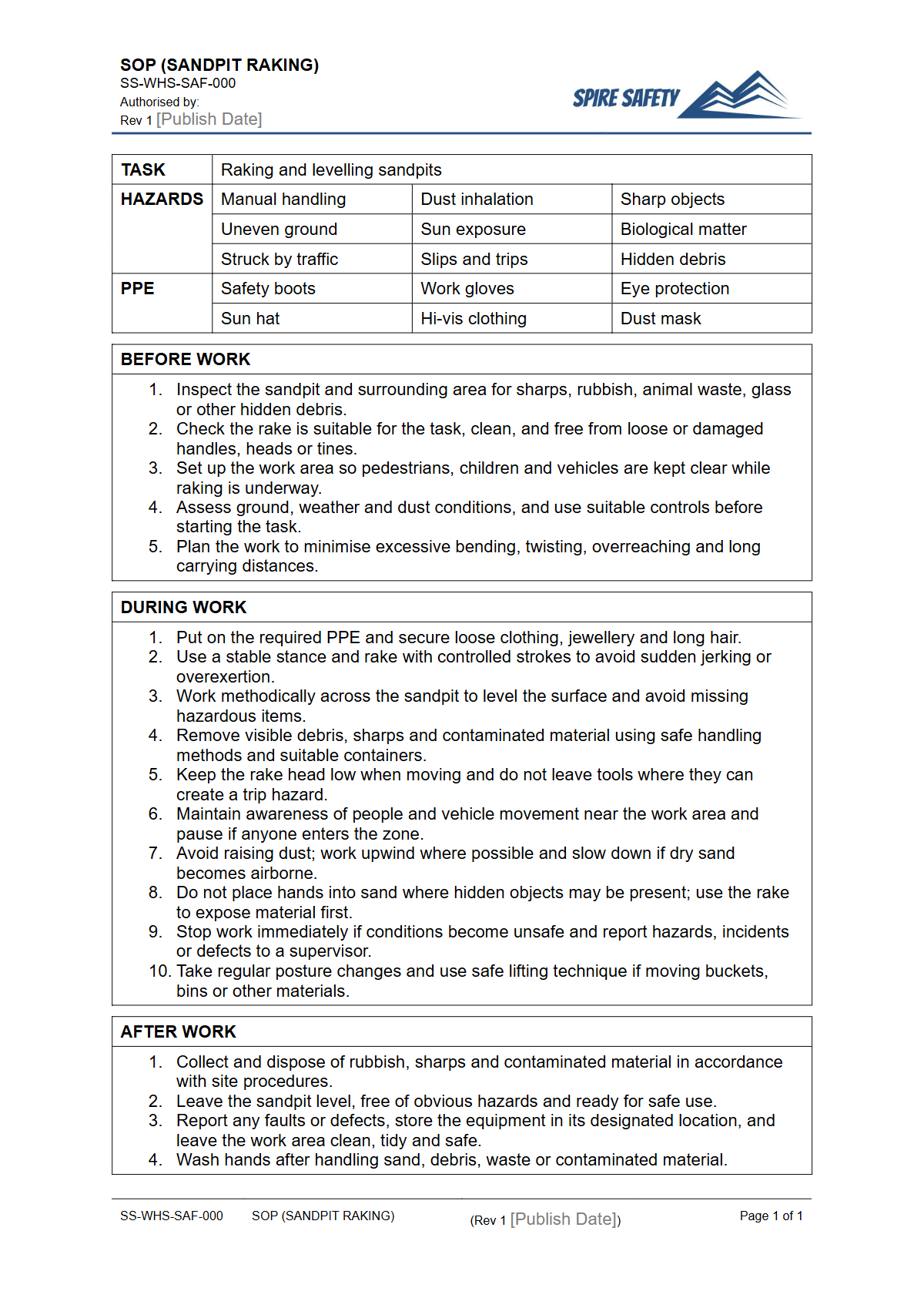
This Free Safe Operating Procedure (Sandpit Raking) Template provides a structured framework for documenting the risks and required controls for maintaining sandpits in schools, childcare centres, parks, and other public areas. The primary purpose is to establish a clear, repeatable process that minimises health and safety risks for workers and the public.
Raking a sandpit, while seemingly simple, presents several hazards including ergonomic injuries from repetitive motion, exposure to sharp objects like glass or needles, and biological contaminants from animals.
Using a documented Safe Operating Procedure (SOP) helps a Person Conducting a Business or Undertaking (PCBU) fulfil their primary duty of care under Australian WHS legislation. It provides clear instruction to workers, ensures consistency in how the task is performed, and acts as a critical training tool.
This template is designed as a starting point, aligned with Australian WHS principles, to help your organisation manage risks effectively.
Video walkthrough
How to use the Free Safe Operating Procedure (Sandpit Raking) Template
To use this template, simply download the DOCX file and open it in your preferred word processor. The document is structured with key sections that you must populate with information specific to your workplace and the particular task.
This includes identifying specific hazards at your location, listing the required Personal Protective Equipment (PPE), and detailing step-by-step instructions from pre-start checks to clean-up and waste disposal. The PDF version is also included for easy distribution once finalised.
IMPORTANT: This is a template, not a finished document. To be effective, you must customise it with your specific site details, equipment (e.g., type of rake, sieve, sharps container), PPE requirements, and emergency procedures.
We recommend a competent person reviews and approves the final SOP before it is implemented. The completed procedure should then be used to train workers and be made easily accessible at the point of work.
Key Steps in Sandpit Raking
A comprehensive sandpit raking SOP should break the task into logical phases to ensure no steps are missed. While you will need to customise these for your site, a typical workflow includes:
- Preparation and Pre-Start Checks: Gathering all necessary tools and PPE, such as puncture-resistant gloves, enclosed footwear, a suitable rake, a sieve, and a sharps container. Inspecting tools for damage before use.
- Site Inspection: Conducting a careful visual scan of the sandpit and surrounding area for obvious hazards (e.g., broken equipment, visible sharps, animal faeces) before entering.
- Raking and Sifting: Detailing the correct ergonomic technique for raking to minimise back strain. This includes instructions on how to systematically rake the entire area and sift the sand to a sufficient depth to uncover buried objects.
- Hazard and Waste Disposal: Providing clear instructions for the safe handling and disposal of any waste or hazardous items found, particularly sharps. This step must align with your organisation's waste management procedures.
- Post-Task Actions: Outlining requirements for cleaning and storing tools, washing hands, and reporting any significant finds or incidents to a supervisor.
Review and Improvement
An SOP is a living document that should be integrated into your overall safety framework. It should be reviewed regularly—typically annually, after any related incident, or when a process or piece of equipment changes.
Regular reviews ensure the procedure remains relevant and effective. These reviews can form part of your internal safety review cycle or be incorporated into a formal WHS compliance auditing program to verify that documented procedures are being followed in practice.
When to use a Safe Operating Procedure for Sandpit Raking
This SOP should be used whenever sandpit maintenance is conducted. It is not just for major clean-ups but should guide routine daily or weekly tasks.
Consistent use ensures that safety checks are never overlooked, even during tasks that may seem mundane. It is particularly important before children are due to use the area, after public holidays or weekends when the area may have been used unsupervised, or after reports of contamination or hazards.
The procedure is also essential when performing less frequent tasks, such as adding new sand to the pit. For related activities involving equipment, you may need additional procedures, such as our FREE Spreader SOP (Safe Operating Procedure) Template if using a mechanical spreader to distribute new sand.
Who should use this SOP
This Safe Operating Procedure is intended for all personnel tasked with cleaning and maintaining sandpits. This can include groundskeepers, maintenance staff, council workers, childcare educators, and school ancillary staff.
Supervisors and managers should also use the document as a benchmark for training, competency assessment, and incident investigation. By providing a clear and authorised set of instructions, it empowers workers to perform the task safely and confidently.
For organisations looking to develop a suite of interconnected safety documents, this SOP serves as a practical example that can be integrated into broader WHS management systems. If you require assistance in adapting this template or developing more complex safety documentation, consider engaging a professional WHS consulting service for tailored advice.
Common mistakes
Common mistakes to avoid
- Raking only the surface without sifting deep enough to find buried objects.
- Failing to wear puncture-resistant gloves and fully enclosed footwear.
- Not having a designated, safe method for disposing of sharp items found in the sand.
- Treating the SOP as a 'set and forget' document instead of reviewing and updating it regularly.
Legal references
Legal considerations
The following legal requirements may be relevant to this type of work.
- Work Health and Safety Act (Harmonised) — Provides the primary duties for protecting workers and other people from work health and safety risks.
- Work Health and Safety Regulations (Harmonised) — Sets out requirements supporting the management of workplace hazards and risks.
The following codes may be relevant to this type of work.
- Managing WHS Risks Code of Practice — Provides practical guidance on identifying hazards, assessing risks and applying effective controls.
- Work Health and Safety Consultation, Cooperation and Coordination Code of Practice — Provides practical guidance on consulting workers and coordinating with other duty holders.
- Managing the Work Environment and Facilities Code of Practice — Provides practical guidance on safe work environments, workplace facilities and related controls.
Did you know
Hidden Dangers
Sandpits can conceal hazardous items like broken glass, sharp plastics, and even discarded needles, making a thorough visual inspection and sifting procedure crucial for safety.
Ergonomic Risk
Repetitive raking involves bending and twisting, which are leading causes of lower back injuries. A proper technique outlined in an SOP can significantly reduce this musculoskeletal risk.
FAQ
Frequently asked questions
01What are the main hazards when raking a sandpit?
02How often should a sandpit SOP be reviewed?
03Is a Safe Operating Procedure a legal requirement for raking a sandpit?
04What PPE is needed for sandpit raking?
Share this resource
Free Safe Operating Procedure (Sandpit Raking) Template
Browse Categories
How To Use It
- 1Download and open in Word or PDF.
- 2Replace the placeholders with your business details.
- 3Get it reviewed by a WHS specialist before rollout.
Need it customised?
Our WHS consultants can adapt this template to your site, run a gap analysis, or audit what you already have in place.
Book a Free Consultation WHS consulting servicesor call 1300 156 382
Related templates
- Free Safe Operating Procedure (Sauna Cleaning) Template
- Free Safe Operating Procedure (Sausage Filler) Template
- Free Safe Operating Procedure (Saw Horse) Template
- Free Safe Operating Procedure (Sawmill Carriage) Template
- Free Safe Operating Procedure (Scaffold Hoist) Template
- Free Safe Operating Procedure (Scoreboard Cleaning) Template