
Free Safe Operating Procedure (Sampling Plant) Template
Formalise your safety protocols for operating sampling plant with our structured template. Download your free DOCX and PDF resource to get started.
Free Safe Operating Procedure (Sampling Plant) Template
DOCX • 126 KB + PDF
Updated Oct 2026
No signup required
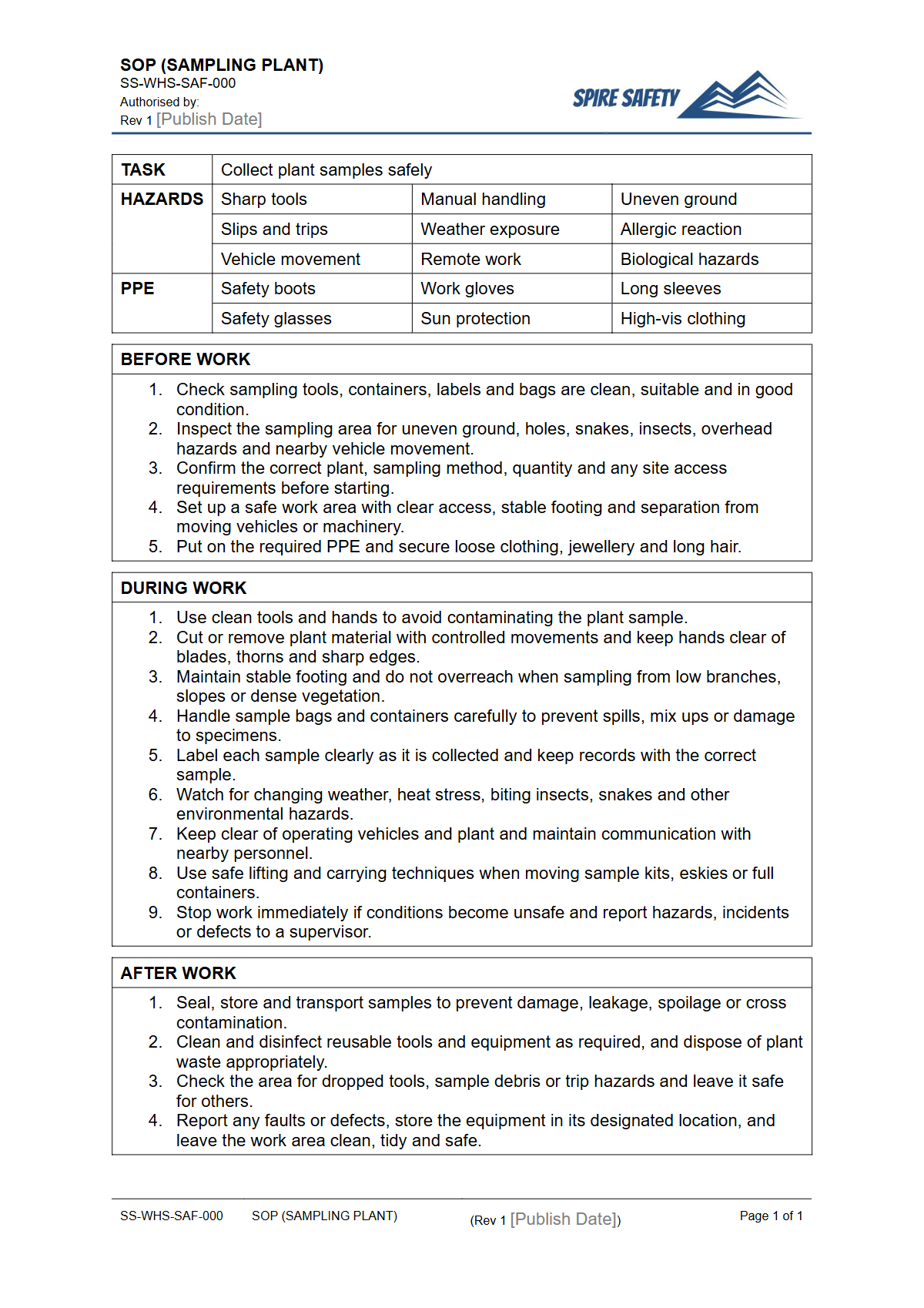
Purpose of the Free Safe Operating Procedure (Sampling Plant) Template
This Free Safe Operating Procedure (Sampling Plant) Template provides a comprehensive framework for documenting the safe use of sampling machinery in industries like mining, agriculture, environmental science, and construction. It is designed to help your organisation meet its duty of care by systematically identifying hazards and detailing clear, step-by-step instructions for operators.
Using this SOP helps manage risks associated with sampling plant, such as entanglement in moving parts, exposure to hazardous dust or materials, and mechanical failures.
By establishing a documented process, you create a consistent standard for all operators, which is crucial for training new staff and reinforcing safe work practices. This structured approach helps in reducing incidents and forms a key part of a proactive safety culture.
A thorough SOP also serves as an essential reference during safety audits and incident investigations. For related processes, our free Conveyer System SOP provides a useful reference for material handling equipment.
Video walkthrough
How to use the Free Safe Operating Procedure (Sampling Plant) Template
Using the Free Safe Operating Procedure (Sampling Plant) Template is straightforward. Simply download the resource in your preferred format—DOCX for easy editing or PDF for stable distribution.
The template is structured with key sections including required personal protective equipment (PPE), pre-operational checks, step-by-step operating instructions, and emergency procedures. Fill in each section with information that is specific to the make and model of your sampling plant and the context of your worksite.
Important: This document is a template and must be adapted to your specific circumstances. We recommend you conduct a thorough risk assessment and consult with equipment operators to ensure the final SOP is comprehensive and practical.
You must customise it to reflect the specific hazards, risks, and control measures relevant to your unique equipment and workplace. Proper implementation is a key part of developing robust WHS management systems.
When to use a Safe Operating Procedure
A Safe Operating Procedure for sampling plant should be a core part of your daily operations and safety management system. It should be used during the induction and training of new operators to ensure they understand the correct and safe methods from the outset.
The SOP also serves as a critical tool for pre-start checks, guiding workers through a systematic inspection of the equipment before each use. It is also an excellent resource for toolbox talks and regular refresher training to reinforce safe behaviour.
Furthermore, the SOP should be readily available near the equipment for quick reference. In the event of a near-miss or incident, the procedure should be reviewed as part of the investigation to determine if it was followed and if any updates are needed.
You may find our Free Thresher SOP useful for similar agricultural or processing equipment.
Who should use this Safe Operating Procedure
This SOP template is designed for a range of personnel within an organisation. WHS Managers and Safety Officers will find it an essential tool for developing and standardising safety documentation across the business.
Site Supervisors and Team Leaders are responsible for implementing the SOP, using it for training, and ensuring their teams adhere to the specified procedures. Finally, the Plant Operators themselves are the primary end-users, relying on the SOP for clear guidance on how to perform their tasks safely.
Involving operators in the customisation process is highly recommended, as their hands-on experience is invaluable for identifying practical hazards and effective controls. The effectiveness of these procedures can be verified through regular WHS compliance auditing to ensure they are being followed correctly. For tasks involving different heavy machinery, you might also require documents like our free Scraper SOP template.
This document is just one of many resources designed to help improve safety in your workplace. By integrating tailored SOPs for all high-risk plant and equipment, you build a stronger, more resilient safety framework.
Be sure to explore our complete free WHS resources library for more templates and guides.
Common mistakes
Common mistakes to avoid
- Using a generic template without customising it for specific plant models and tasks.
- Failing to include emergency procedures, such as shutdown and first aid response.
- Neglecting to train workers on the finalised SOP and verify their understanding.
- Storing the SOP in an office instead of making it easily accessible to operators at the point of use.
Legal references
Legal considerations
The following legal requirements may be relevant to this type of work.
- Work Health and Safety Act (Harmonised) — Provides the primary duties for protecting workers and other people from work health and safety risks.
- Work Health and Safety Regulations (Harmonised) — Sets out requirements supporting the management of workplace hazards and risks.
The following codes may be relevant to this type of work.
- Managing WHS Risks Code of Practice — Provides practical guidance on identifying hazards, assessing risks and applying effective controls.
- Work Health and Safety Consultation, Cooperation and Coordination Code of Practice — Provides practical guidance on consulting workers and coordinating with other duty holders.
- Managing the Work Environment and Facilities Code of Practice — Provides practical guidance on safe work environments, workplace facilities and related controls.
Did you know
Hierarchy of Control
A well-drafted SOP prioritises higher-order controls from the Hierarchy of Control, such as engineering controls (e.g., machine guarding) over administrative controls (like the SOP itself) and PPE.
Consultation is Key
Under model WHS laws, employers have a duty to consult with workers on health and safety matters. Involving operators in the development of the SOP for sampling plant can identify practical hazards and improve worker buy-in.
FAQ
Frequently asked questions
01What is a Safe Operating Procedure for sampling plant?
02Why is a specific SOP for sampling plant necessary?
03How often should a Safe Operating Procedure be reviewed?
04Does using this template guarantee WHS compliance?
Share this resource
Free Safe Operating Procedure (Sampling Plant) Template
Browse Categories
How To Use It
- 1Download and open in Word or PDF.
- 2Replace the placeholders with your business details.
- 3Get it reviewed by a WHS specialist before rollout.
Need it customised?
Our WHS consultants can adapt this template to your site, run a gap analysis, or audit what you already have in place.
Book a Free Consultation WHS consulting servicesor call 1300 156 382
Related templates
- Free Safe Operating Procedure (Sand Screw) Template
- Free Safe Operating Procedure (Sandpit Raking) Template
- Free Safe Operating Procedure (Sauna Cleaning) Template
- Free Safe Operating Procedure (Sausage Filler) Template
- Free Safe Operating Procedure (Saw Horse) Template
- Free Safe Operating Procedure (Sawmill Carriage) Template