
Free Safe Operating Procedure (Sand Screw) Template
Download our Free Safe Operating Procedure (Sand Screw) Template to manage risks in quarrying and mining. Get your free DOCX and PDF template today.
Free Safe Operating Procedure (Sand Screw) Template
DOCX • 126 KB + PDF
Updated Oct 2026
No signup required
Purpose of the Free Safe Operating Procedure (Sand Screw) Template
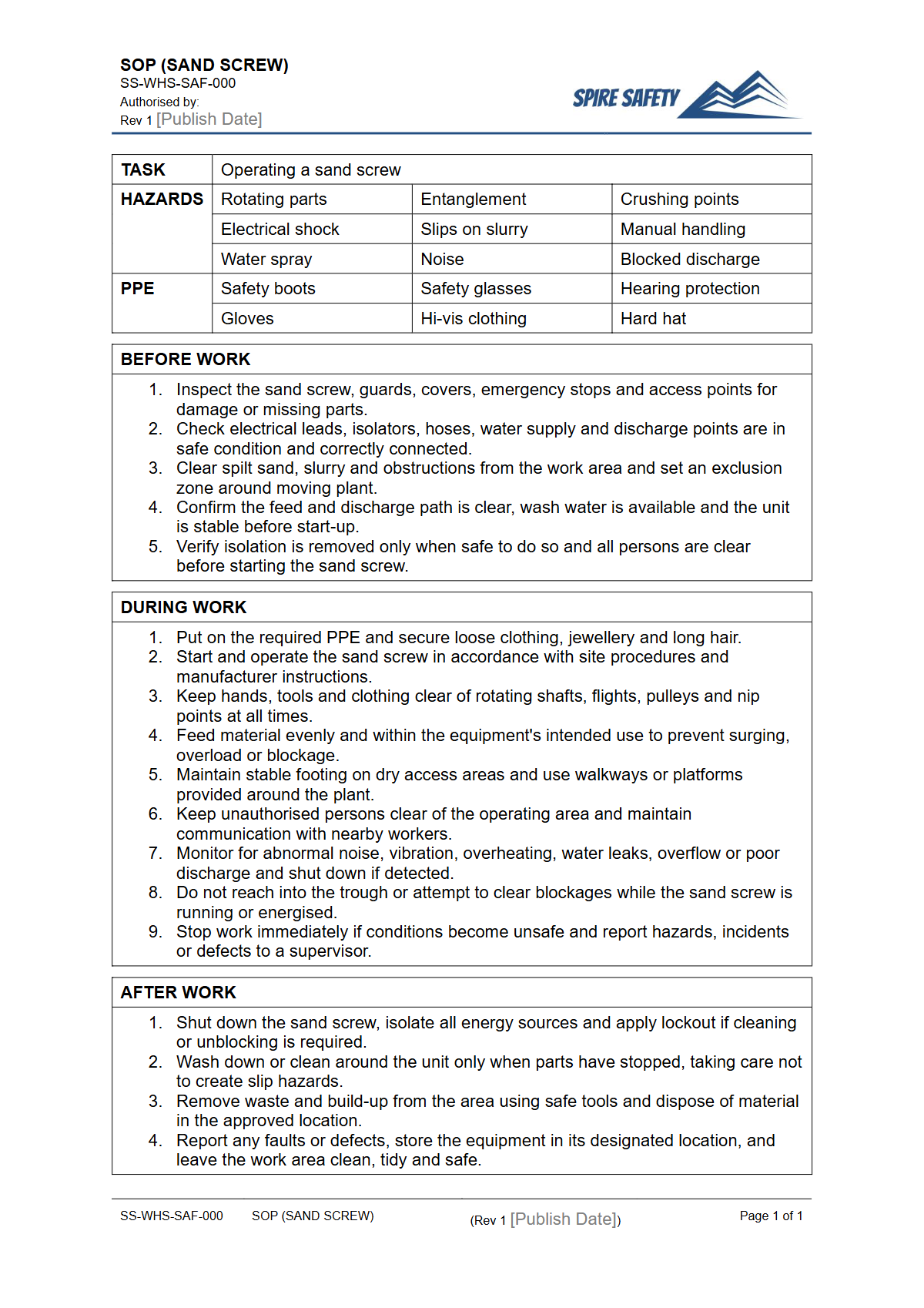
Our Free Safe Operating Procedure (Sand Screw) Template provides a structured starting point for documenting the safe use of sand screws in your workplace. Sand screws, also known as fine material washers, are essential in the quarrying, mining, and sand processing industries, but they also present significant hazards, including entanglement, crushing, and noise exposure.
This SOP helps you outline step-by-step instructions for pre-operational checks, startup, operation, shutdown, and maintenance tasks, ensuring workers have clear guidance on how to perform their duties safely.
A well-documented SOP is a critical control measure for managing risks associated with plant and machinery. Sand screws are frequently integrated into larger processing lines, highlighting the need for consistent safety protocols across all equipment.
For instance, the material processed by a sand screw is often fed to or from other machinery, making a clear procedure like a FREE Conveyer System SOP (Safe Operating Procedure) Template equally important for overall site safety.
Video walkthrough
How to use the Free Safe Operating Procedure (Sand Screw) Template
This Safe Operating Procedure for a Sand Screw is designed to be a comprehensive, adaptable document. To use it, download the DOCX or PDF file and begin by thoroughly reviewing each section.
You will need to add specific details relevant to your workplace, such as the make and model of your sand screw, site-specific hazards, personal protective equipment (PPE) requirements, and emergency contact information.
IMPORTANT: This is a template only. We have no knowledge of the specific machinery, processes, or conditions at your worksite.
You MUST customise this document by incorporating site-specific information, conducting your own risk assessment, and consulting with operators and supervisors to ensure it is accurate and effective for your operational context.
A single SOP is just one component of a safe workplace. For safety documentation to be truly effective, it must be integrated into a holistic framework.
Spire Safety offers expert guidance in developing and implementing robust WHS management systems that embed safety into your organisation's culture and daily operations.
When to use a Safe Operating Procedure
An SOP for a sand screw should be used as a primary reference document throughout the lifecycle of the equipment's use. It is not a document to be filed away and forgotten. It should be actively used for:
- Training and Induction: For new operators or as a refresher for existing staff to ensure they understand the correct, safe methods of operation.
- Pre-operational Checks: As a checklist to guide operators through daily inspections, verifying that all guards, emergency stops, and safety features are in place and functional before starting work.
- Routine Operation: To reinforce correct operating parameters and sequences.
- Maintenance and Cleaning: Providing clear instructions for lockout/tagout (LOTO) procedures to ensure the machine is de-energised and isolated before any maintenance, cleaning, or clearing of blockages is attempted.
- Emergency Situations: Outlining procedures for emergency shutdown and response.
The SOP should also be reviewed and updated whenever there is a change to the equipment, the process, or after an incident or near miss. Maintaining the work area is also critical, and may require procedures for other plant like those found in our FREE Scraper SOP (Safe Operating Procedure) Template.
Who should use this resource
This Safe Operating Procedure is intended for use by multiple roles within an organisation to foster a comprehensive approach to safety:
- Plant Operators: To understand and follow the safe work methods for the sand screw during their daily tasks.
- Supervisors and Managers: To conduct training, supervise work, enforce safety standards, and lead incident investigations.
- Maintenance Personnel: To follow safe isolation and maintenance procedures, ensuring both their safety and the ongoing safe functioning of the equipment.
- WHS Officers and Managers: To use as a tool in risk assessments, safety training programs, and compliance monitoring.
Ensuring that documented procedures are followed in practice is a key part of an organisation's due diligence. The effectiveness of SOPs can be verified through regular workplace inspections and formal WHS compliance auditing, which helps identify gaps between documented procedures and real-world practices.
You can explore our extensive collection of other templates in our free WHS resources library to support your safety management system.
Common mistakes
Common mistakes to avoid
- Failing to adequately guard all rotating parts, including the screw shaft, drive belts, and pulleys.
- Neglecting to perform and document pre-operational checks before starting the machine.
- Attempting to clear blockages or perform maintenance without following proper lockout/tagout (LOTO) isolation procedures.
- Using a generic SOP from another site without customising it for the specific machine and conditions of the workplace.
Legal references
Legal considerations
The following legal requirements may be relevant to this type of work.
- Work Health and Safety Act (Harmonised) — Provides the primary duties for protecting workers and other people from work health and safety risks.
- Work Health and Safety Regulations (Harmonised) — Sets out requirements supporting the management of workplace hazards and risks.
The following codes may be relevant to this type of work.
- Managing WHS Risks Code of Practice — Provides practical guidance on identifying hazards, assessing risks and applying effective controls.
- Work Health and Safety Consultation, Cooperation and Coordination Code of Practice — Provides practical guidance on consulting workers and coordinating with other duty holders.
- Managing the Work Environment and Facilities Code of Practice — Provides practical guidance on safe work environments, workplace facilities and related controls.
Did you know
Alternate Name
Sand screws are also commonly referred to as fine material (FM) washers or screw classifiers, as their primary function is to dewater, wash, and classify fine aggregates like sand.
Entanglement Risk
Rotating shafts, like the one in a sand screw, are a leading cause of entanglement incidents in the mining and quarrying industries. Effective guarding and strict lockout/tagout procedures are critical controls.
FAQ
Frequently asked questions
01What are the main hazards associated with operating a sand screw?
02Is this template enough for WHS compliance?
03How often should a Sand Screw SOP be reviewed?
04Who is responsible for training workers on this SOP?
Share this resource
Free Safe Operating Procedure (Sand Screw) Template
Browse Categories
How To Use It
- 1Download and open in Word or PDF.
- 2Replace the placeholders with your business details.
- 3Get it reviewed by a WHS specialist before rollout.
Need it customised?
Our WHS consultants can adapt this template to your site, run a gap analysis, or audit what you already have in place.
Book a Free Consultation WHS consulting servicesor call 1300 156 382
Related templates
- Free Safe Operating Procedure (Sandpit Raking) Template
- Free Safe Operating Procedure (Sauna Cleaning) Template
- Free Safe Operating Procedure (Sausage Filler) Template
- Free Safe Operating Procedure (Saw Horse) Template
- Free Safe Operating Procedure (Sawmill Carriage) Template
- Free Safe Operating Procedure (Scaffold Hoist) Template