
Free Safe Operating Procedure (Runway Sweeper) Template
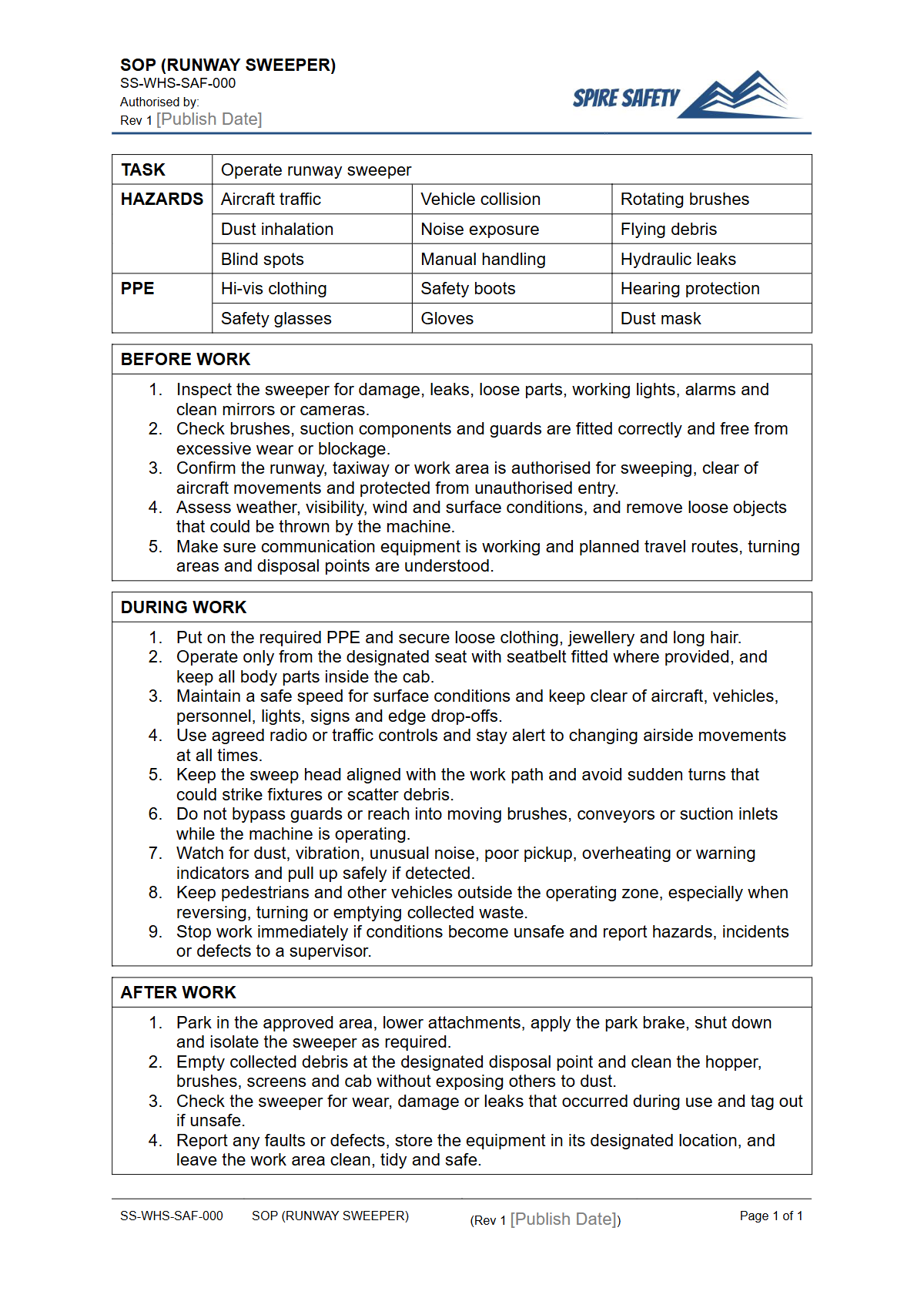
Download our free Safe Operating Procedure (Runway Sweeper) Template to formalise safe work practices. This customisable document helps ensure operator safety.
Free Safe Operating Procedure (Runway Sweeper) Template
DOCX • 126 KB + PDF
Updated Oct 2026
No signup required
Purpose of the Free Safe Operating Procedure (Runway Sweeper) Template
Operating specialised machinery like a runway sweeper requires clear, standardised instructions to manage significant health and safety risks. This Free Safe Operating Procedure (Runway Sweeper) Template provides a structured framework for documenting the required steps to operate this equipment safely.
A well-developed SOP helps prevent incidents by identifying hazards, outlining control measures, and ensuring every operator follows a consistent, safe method of work. It is an essential tool for training, competency assessment, and demonstrating due diligence in managing workplace risks associated with mobile plant.
The primary goal is to control risks such as collisions with aircraft or other vehicles, operator injury from mechanical failure, exposure to dust and noise, and the critical risk of Foreign Object Debris (FOD) on airfields. By formalising pre-start checks, shutdown procedures, and emergency responses, you create a safer environment for everyone.
This document forms a critical part of your overall safety management documentation, ensuring that operational tasks are aligned with your organisation's safety policies. Integrating such procedures is a cornerstone of effective WHS management systems.
Video walkthrough
How to use the Free Safe Operating Procedure (Runway Sweeper) Template
This template is available for download as a DOCX file for easy editing or as a PDF for straightforward printing and distribution. It is designed as a comprehensive starting point, not a final, document.
You must adapt its contents to reflect the specific runway sweeper models used at your workplace, your site's unique environmental conditions, and any state or territory-specific WHS regulations. We have provided a structured layout, but it is your responsibility to populate it with accurate, site-specific details.
To implement this SOP effectively, consult with the machine operators, supervisors, and maintenance personnel who use and service the equipment daily. Their practical experience is invaluable for identifying all relevant hazards and effective control measures.
Once customised, the SOP should be formally approved, and all relevant workers must be trained on its contents. The process is similar for other types of heavy equipment, as detailed in our FREE Grader SOP (Safe Operating Procedure) Template.
When to use a Runway Sweeper SOP
A Safe Operating Procedure for a runway sweeper should be used as a primary reference document in several key situations. It must be integrated into the induction and training process for all new operators before they are authorised to use the machinery.
The SOP also serves as a critical tool for periodic refresher training to ensure that established safety standards are maintained over time. It should be readily accessible in the workplace for quick reference during daily operations.
Furthermore, the SOP must be reviewed and potentially updated following any incident or near-miss involving a runway sweeper. It is also essential to review the procedure when a new model of sweeper is introduced to the workplace, when operational tasks change, or if a risk assessment identifies new hazards.
For organisations seeking external verification of their safety processes, these documents are a key focus during a WHS compliance auditing process.
Who should use this Safe Operating Procedure
This SOP is intended for use by multiple roles within an organisation. Persons Conducting a Business or Undertaking (PCBUs) and management are responsible for ensuring such procedures are developed, implemented, and maintained as part of their duty of care.
Supervisors must use the SOP to train, monitor, and direct operators, ensuring work is performed according to the documented safe method. Most importantly, the operators of the runway sweeper must use the SOP as their guide for safe, day-to-day operation.
Health and safety professionals can use this template as a foundation for developing a suite of procedures for all plant and equipment on site. The principles of identifying hazards, assessing risks, and outlining controls are universal across different types of machinery.
If your business handles various types of earthmoving or material handling equipment, you might find our FREE Scraper SOP (Safe Operating Procedure) Template a useful complementary resource. For expert assistance in tailoring documents to your specific operational needs, consider engaging professional WHS consulting services.
Developing a comprehensive library of SOPs ensures consistency and safety across all operations. You can find more templates for various plant and equipment in our free WHS resources library to build out your safety management system.
Common mistakes
Common mistakes to avoid
- Failing to customise the template for the specific sweeper model and worksite.
- Neglecting to include site-specific traffic management rules for airside operations.
- Not conducting thorough pre-start and post-operation inspections as outlined in the procedure.
- Forgetting to train operators on the contents of the SOP and verify their competency.
Legal references
Legal considerations
The following legal requirements may be relevant to this type of work.
- Work Health and Safety Act (Harmonised) — Provides the primary duties for protecting workers and other people from work health and safety risks.
- Work Health and Safety Regulations (Harmonised) — Sets out requirements supporting the management of workplace hazards and risks.
The following codes may be relevant to this type of work.
- Managing WHS Risks Code of Practice — Provides practical guidance on identifying hazards, assessing risks and applying effective controls.
- Work Health and Safety Consultation, Cooperation and Coordination Code of Practice — Provides practical guidance on consulting workers and coordinating with other duty holders.
- Managing the Work Environment and Facilities Code of Practice — Provides practical guidance on safe work environments, workplace facilities and related controls.
Did you know
FOD Hazard
Runway sweepers are critical for controlling Foreign Object Debris (FOD), which includes any object on an airfield that could damage aircraft. FOD costs the global aviation industry an estimated $4 billion USD per year.
Sweeping Technology
Modern airport sweepers use a combination of methods to clean surfaces, including mechanical brooms, high-power vacuum suction, and controlled air blasts to dislodge and collect debris effectively.
FAQ
Frequently asked questions
01What is a Safe Operating Procedure for a runway sweeper?
02Who is responsible for writing a runway sweeper SOP?
03Does this template cover all models of runway sweepers?
04How often should a runway sweeper SOP be reviewed?
Share this resource
Free Safe Operating Procedure (Runway Sweeper) Template
Browse Categories
How To Use It
- 1Download and open in Word or PDF.
- 2Replace the placeholders with your business details.
- 3Get it reviewed by a WHS specialist before rollout.
Need it customised?
Our WHS consultants can adapt this template to your site, run a gap analysis, or audit what you already have in place.
Book a Free Consultation WHS consulting servicesor call 1300 156 382
Related templates
- Free Safe Operating Procedure (Safety Valve Test) Template
- Free Safe Operating Procedure (Salad Spinner) Template
- Free Safe Operating Procedure (Salamander Grill) Template
- Free Safe Operating Procedure (Salon Chemical Storage) Template
- Free Safe Operating Procedure (Salon Towel Handling) Template
- Free Safe Operating Procedure (Sample Freezer) Template