
Free Safe Operating Procedure (Safety Valve Test) Template
Download our free Safe Operating Procedure (Safety Valve Test) Template to formalise your safety processes. Customise this DOCX or PDF to suit your needs.
Free Safe Operating Procedure (Safety Valve Test) Template
DOCX • 126 KB + PDF
Updated Oct 2026
No signup required
Purpose of the Free Safe Operating Procedure (Safety Valve Test) Template
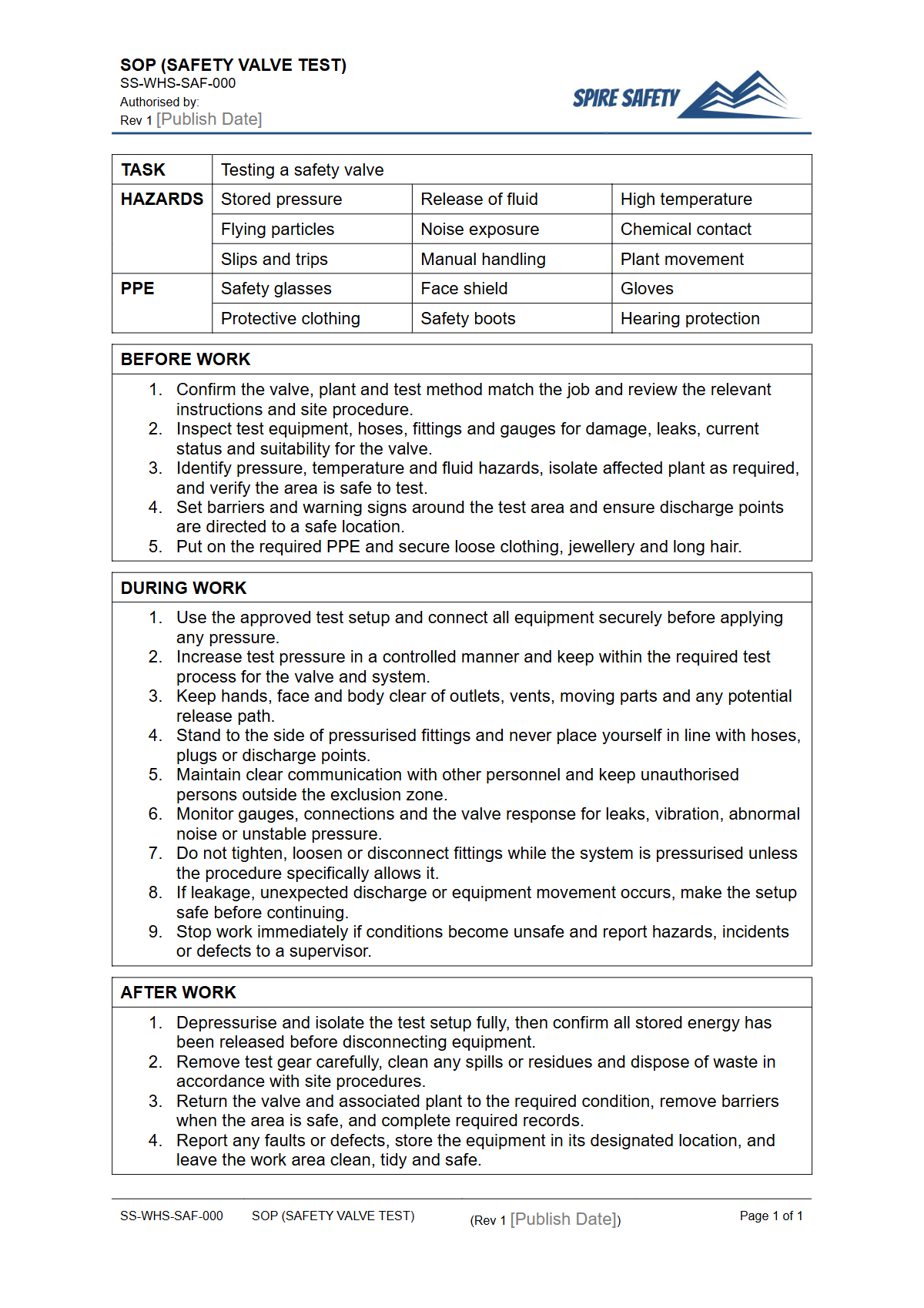
This Free Safe Operating Procedure (Safety Valve Test) Template provides a structured framework for documenting the process of safely testing pressure relief and safety valves. Its purpose is to help your organisation establish a clear, repeatable, and safe method for verifying that this critical safety equipment functions correctly.
By using this SOP, you can minimise risks associated with over-pressurisation events, such as equipment failure, uncontrolled release of hazardous substances, and serious injury to personnel. It guides users through pre-operational checks, step-by-step testing actions, and post-test procedures, forming a vital part of your risk management strategy for pressurised systems. For equipment that frequently utilises such valves, consider integrating this procedure with other relevant documentation, such as a Free Air Compressor SOP.
Video walkthrough
How to use the Free Safe Operating Procedure (Safety Valve Test) Template
To implement this Safe Operating Procedure, download the template in your preferred format (DOCX or PDF). The document is a starting point and must be adapted to your specific operational context.
This involves a competent person reviewing and filling in details specific to your workplace, including the types of safety valves, specific equipment models, required isolation procedures, set pressures, and required personal protective equipment (PPE). We have included prompts to guide you through this customisation.
Once tailored, the SOP should be reviewed with all relevant workers, incorporated into your training programs, and made readily accessible in the work area. This process is a fundamental activity in developing robust WHS management systems that actively control risk.
A Note on Customisation
This document is a template and does not constitute legal advice. It is essential that you customise this Safe Operating Procedure to reflect the specific hazards, risks, equipment, and control measures unique to your workplace.
We are not responsible for any incidents that may occur in connection with your use of this template. You must consult with your workers and other relevant stakeholders during the customisation process to ensure the SOP is practical and effective.
When to Perform a Safety Valve Test
A safety valve test SOP should be used in accordance with manufacturer specifications, regulatory requirements, and your organisation's internal maintenance schedules. Key times to use this procedure include:
- Routine Maintenance: As part of a scheduled preventative maintenance program to ensure ongoing reliability.
- Post-Installation: To verify the correct installation and function of a new or replacement valve.
- After Repairs or Adjustments: To confirm the valve operates at its correct set pressure after any maintenance work.
- As required by Standards: To comply with Australian Standards (e.g., AS/NZS 3788 for in-service inspection of pressure equipment).
- Before returning equipment to service: Ensuring all safety components, like those on large machinery, are operational. This is similar to pre-start checks outlined in a FREE Conveyer System SOP.
Who Should Use This Safe Operating Procedure
This SOP is intended for use by competent and authorised personnel only. This typically includes qualified maintenance technicians, pressure vessel inspectors, and mechanical engineers who have received specific training on the equipment and testing procedures involved.
Supervisors and WHS managers should also be familiar with the procedure to ensure it is being followed correctly. It is the duty of the Person Conducting a Business or Undertaking (PCBU) to verify the competency of any individual assigned to perform these critical safety tasks, just as they would for operators of complex machinery detailed in a FREE Telehandler SOP.
Integrating Your SOP with Workplace Safety Audits
A documented SOP is a key piece of evidence during a safety audit. It demonstrates that your organisation has a formalised process for managing a significant risk. Auditors will look for evidence that the SOP is not just a document on a shelf but is actively used, reviewed, and understood by workers. Regular WHS compliance auditing helps identify gaps between your documented procedures and actual work practices, providing opportunities for continuous improvement. Keeping detailed records of each safety valve test, including the date, personnel involved, test results, and any corrective actions taken, is crucial for demonstrating compliance and due diligence. You can find more templates to support your safety systems in our free WHS resources library.
Common mistakes
Common mistakes to avoid
- Failing to properly isolate the valve or depressurise the system before beginning work.
- Using uncalibrated or incorrect testing equipment, leading to inaccurate pressure readings.
- Neglecting to record test results, creating gaps in maintenance and compliance history.
- Not verifying that the valve has properly reseated and is not leaking after the test is complete.
Legal references
Legal considerations
The following legal requirements may be relevant to this type of work.
- Work Health and Safety Act (Harmonised) — Provides the primary duties for protecting workers and other people from work health and safety risks.
- Work Health and Safety Regulations (Harmonised) — Sets out requirements supporting the management of workplace hazards and risks.
The following codes may be relevant to this type of work.
- Managing WHS Risks Code of Practice — Provides practical guidance on identifying hazards, assessing risks and applying effective controls.
- Work Health and Safety Consultation, Cooperation and Coordination Code of Practice — Provides practical guidance on consulting workers and coordinating with other duty holders.
- Managing the Work Environment and Facilities Code of Practice — Provides practical guidance on safe work environments, workplace facilities and related controls.
Did you know
Invention of the Safety Valve
The safety valve was invented by Denis Papin in 1679 for his steam digester (an early pressure cooker), preventing explosions by automatically releasing excess pressure. This simple invention was a critical development for the industrial revolution and the safe use of steam power.
FAQ
Frequently asked questions
01What is the primary purpose of testing a safety valve?
02How often should safety valves be tested in Australia?
03Who is considered a 'competent person' to test a safety valve?
04What records should be kept for a safety valve test?
Share this resource
Free Safe Operating Procedure (Safety Valve Test) Template
Browse Categories
How To Use It
- 1Download and open in Word or PDF.
- 2Replace the placeholders with your business details.
- 3Get it reviewed by a WHS specialist before rollout.
Need it customised?
Our WHS consultants can adapt this template to your site, run a gap analysis, or audit what you already have in place.
Book a Free Consultation WHS consulting servicesor call 1300 156 382
Related templates
- Free Safe Operating Procedure (Salad Spinner) Template
- Free Safe Operating Procedure (Salamander Grill) Template
- Free Safe Operating Procedure (Salon Chemical Storage) Template
- Free Safe Operating Procedure (Salon Towel Handling) Template
- Free Safe Operating Procedure (Sample Freezer) Template
- Free Safe Operating Procedure (Sampling Plant) Template