
Free Safe Operating Procedure (Salamander Grill) Template
A salamander grill is a common source of workplace burns and fires. This free Safe Operating Procedure (Salamander Grill) Template helps you formalise safety steps.
Free Safe Operating Procedure (Salamander Grill) Template
DOCX • 126 KB + PDF
Updated Oct 2026
No signup required
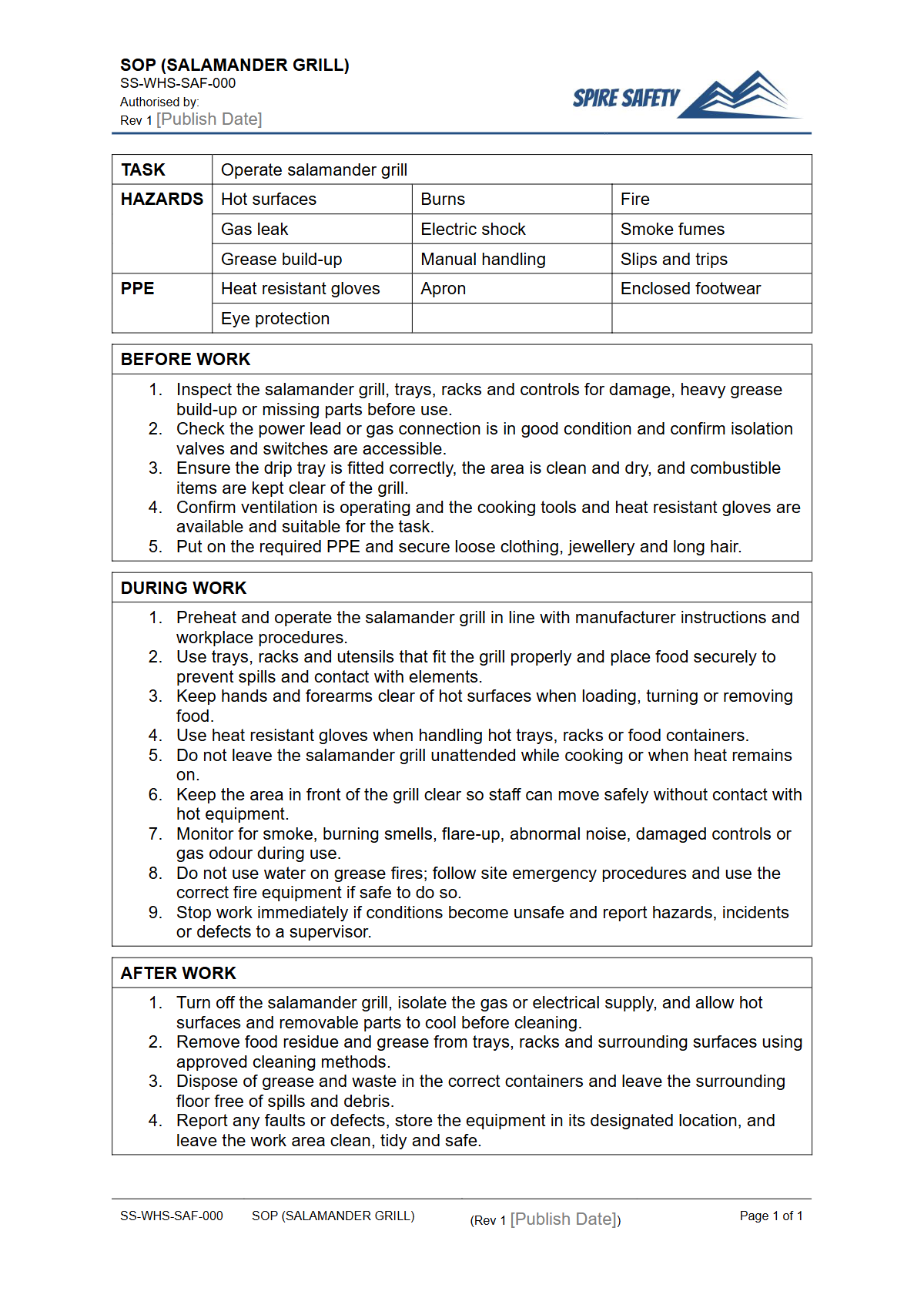
Purpose of the Free Safe Operating Procedure (Salamander Grill) Template
Our Free Safe Operating Procedure (Salamander Grill) Template provides a structured framework for documenting the safe use of this high-temperature cooking equipment. Used in commercial kitchens across Australia, salamander grills pose significant risks, including severe burns, electrical hazards, and fire if not managed correctly.
A documented SOP is a critical tool for training staff and managing these risks effectively.
This template is designed to help your organisation establish and communicate a clear, step-by-step process for operating a salamander grill safely. Its primary purpose is to minimise the risk of injury by outlining pre-operational checks, safe operational steps, and post-use cleaning and shutdown procedures.
Implementing a formal SOP helps demonstrate due diligence in meeting WHS obligations and provides a consistent benchmark for worker training. Integrating SOPs effectively across all high-risk tasks is a fundamental aspect of WHS consulting and system development.
Video walkthrough
How to use the Free Safe Operating Procedure (Salamander Grill) Template
Download the template in your preferred format (DOCX for easy editing or a static PDF) and adapt it to the unique context of your workplace. It is crucial to review every section and modify the content to reflect your specific salamander grill model, kitchen layout, and existing safety protocols.
Consultation with chefs, kitchen hands, and other workers who use the equipment is a vital part of this process.
IMPORTANT: We have provided a comprehensive starting point, but you must customise this document to suit your specific business, equipment, and risks. A well-developed set of SOPs is a cornerstone of effective WHS management systems.
Key Safety Areas Covered
This Safe Operating Procedure template guides you through several critical safety stages to help manage the lifecycle of the task.
Pre-Operational Checks
Before switching the unit on, workers should be prompted to inspect for signs of damage, ensure ventilation is adequate, and check that the surrounding area is free from flammable materials. This includes verifying the integrity of gas lines or electrical cords and ensuring the drip tray is clean and correctly positioned.
Safe Operation
The procedure outlines the correct methods for loading and unloading food, using appropriate heat-resistant personal protective equipment (PPE), and monitoring the cooking process to prevent food from burning and creating a fire risk. It reinforces the importance of never leaving the appliance unattended while in operation. The principles of managing intense heat sources are similar to those in our Free Safe Operating Procedure (Deep Fryer - Standard Operation) Template.
Post-Operational & Cleaning Procedures
After use, the SOP details the correct shutdown and cooling sequence. It provides a checklist for cleaning the grill plates, drip trays, and surrounding surfaces to prevent the build-up of grease and food debris, which is a major contributor to kitchen fires.
Proper maintenance is essential for both safety and equipment longevity.
When to Use This Safe Operating Procedure
An SOP is not a document to be filed away and forgotten. It should be actively used as a primary tool for initial staff training and induction for all new kitchen personnel.
It also serves as a reference for refresher training and competency assessments. The document should be readily accessible in the work area for quick reference.
Furthermore, it is essential to review and update the SOP following any incident or near-miss, or when changes are made to the equipment or work environment. Regular reviews are often checked during a WHS compliance auditing process.
Who Should Use This Template
This resource is intended for any Person Conducting a Business or Undertaking (PCBU) in the hospitality and food service industries. This includes restaurant owners, head chefs, kitchen managers, and supervisors responsible for workplace safety.
WHS officers and consultants can also use this template as a basis for developing customised documentation for their clients. It is designed to be understood and used by the workers who operate the equipment daily, from experienced chefs to apprentices.
Formalising your work methods with this Safe Operating Procedure is a proactive step towards a safer kitchen. By documenting and training your team on safe work practices, you reduce the likelihood of incidents and create a more secure working environment. For more templates covering other equipment and tasks, explore our complete free WHS resources library.
Common mistakes
Common mistakes to avoid
- Using a generic template without customising it for the specific grill model and kitchen environment.
- Failing to adequately train all relevant staff on the finalised SOP, especially casual or new employees.
- Skipping pre-operational checks, leading to the use of faulty or unsafe equipment.
- Allowing grease and food debris to build up, creating a serious fire hazard.
Legal references
Legal considerations
The following legal requirements may be relevant to this type of work.
- Work Health and Safety Act (Harmonised) — Provides the primary duties for protecting workers and other people from work health and safety risks.
- Work Health and Safety Regulations (Harmonised) — Sets out requirements supporting the management of workplace hazards and risks.
The following codes may be relevant to this type of work.
- Managing WHS Risks Code of Practice — Provides practical guidance on identifying hazards, assessing risks and applying effective controls.
- Work Health and Safety Consultation, Cooperation and Coordination Code of Practice — Provides practical guidance on consulting workers and coordinating with other duty holders.
- Managing the Work Environment and Facilities Code of Practice — Provides practical guidance on safe work environments, workplace facilities and related controls.
Did you know
Kitchen Burn Statistics
Burns and scalds are one of the most common injuries in the hospitality industry. A significant portion of these injuries are caused by contact with hot surfaces, equipment, and oil in commercial kitchens.
Salamander's Legend
The grill is named after the mythical salamander, a lizard-like creature believed to live in fire and have a cold body. The name reflects the appliance's ability to withstand and generate intense, fiery heat from above.
FAQ
Frequently asked questions
01What is a Safe Operating Procedure for a salamander grill?
02Are SOPs legally required for kitchen equipment in Australia?
03How often should we review our salamander grill SOP?
04What PPE is typically needed when using a salamander grill?
Share this resource
Free Safe Operating Procedure (Salamander Grill) Template
Browse Categories
How To Use It
- 1Download and open in Word or PDF.
- 2Replace the placeholders with your business details.
- 3Get it reviewed by a WHS specialist before rollout.
Need it customised?
Our WHS consultants can adapt this template to your site, run a gap analysis, or audit what you already have in place.
Book a Free Consultation WHS consulting servicesor call 1300 156 382
Related templates
- Free Safe Operating Procedure (Salon Chemical Storage) Template
- Free Safe Operating Procedure (Salon Towel Handling) Template
- Free Safe Operating Procedure (Sample Freezer) Template
- Free Safe Operating Procedure (Sampling Plant) Template
- Free Safe Operating Procedure (Sand Screw) Template
- Free Safe Operating Procedure (Sandpit Raking) Template