
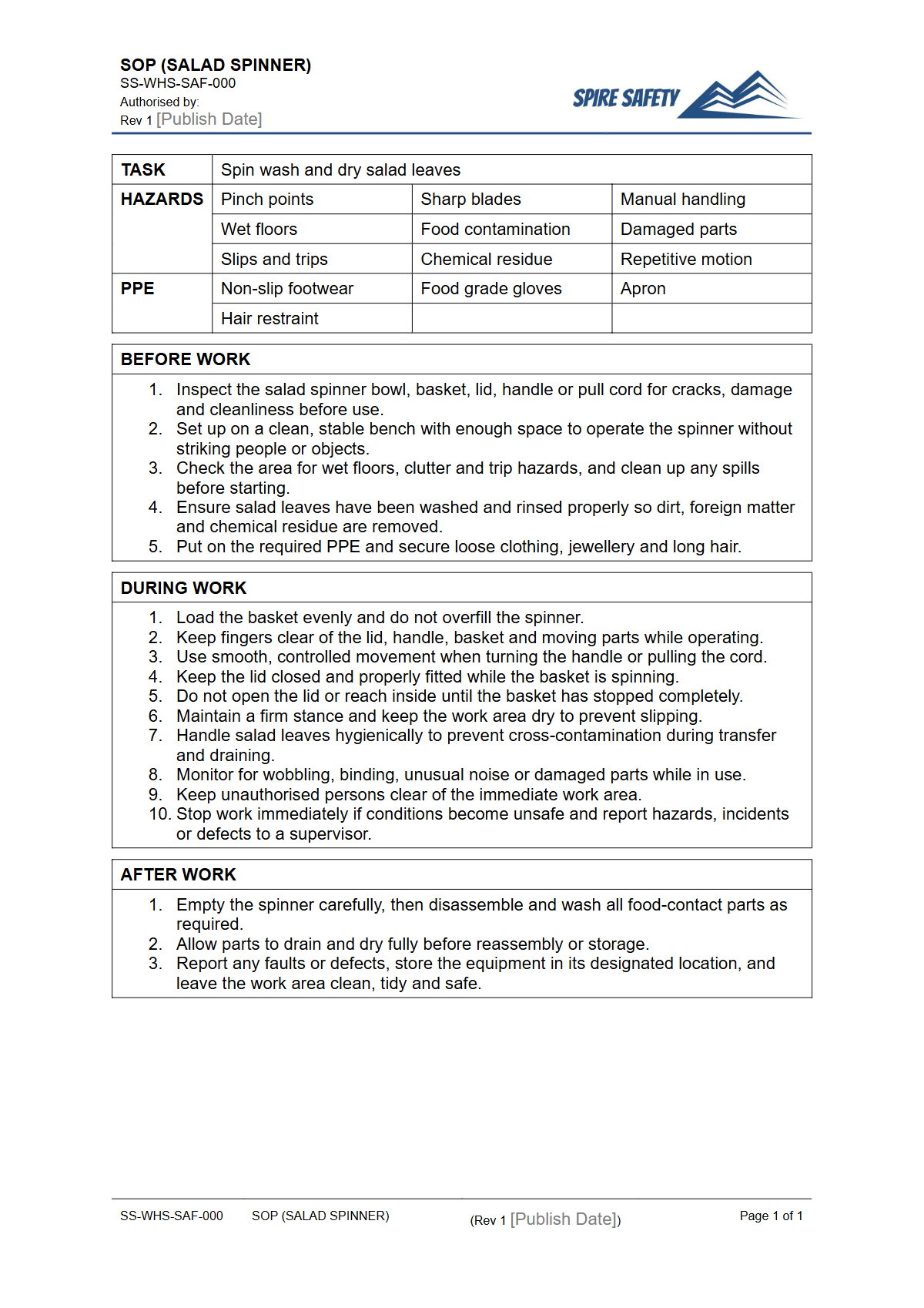
Free Safe Operating Procedure (Salad Spinner) Template
Download our free Safe Operating Procedure (Salad Spinner) template to manage risks in your kitchen. This customisable DOCX and PDF helps you start now.
Free Safe Operating Procedure (Salad Spinner) Template
DOCX • 126 KB + PDF
Updated Oct 2026
No signup required
Purpose of the Free Safe Operating Procedure (Salad Spinner) Template
A commercial salad spinner, while a common kitchen tool, presents workplace hazards that require management. This Free Safe Operating Procedure (Salad Spinner) Template provides a structured starting point for documenting the safe use, cleaning, and maintenance of this equipment.
Its purpose is to standardise tasks to minimise risks such as entanglement, manual handling injuries, and poor hygiene. By formalising these steps, you create a clear, repeatable process that protects your workers and ensures food safety standards are consistently met.
Implementing documented procedures like this SOP is a fundamental part of building robust WHS management systems. It helps demonstrate that as a Person Conducting a Business or Undertaking (PCBU), you are taking proactive steps to identify hazards and control risks in your workplace, aligning with Australian WHS expectations.
Video walkthrough
How to use the Free Safe Operating Procedure (Salad Spinner) Template
This document is a template, not a finished procedure. To be effective, you must customise it to reflect the specific equipment and environment in your workplace.
Download the DOCX or PDF and work through each section, consulting with the staff who operate the salad spinner. A critical step is to conduct a specific risk assessment on your model, considering its placement, power source, capacity, and condition.
Use your risk assessment findings to detail the required Personal Protective Equipment (PPE), pre-operational safety checks, step-by-step operating instructions, and cleaning protocols. For example, your procedure should specify exactly how to load the spinner to prevent ergonomic strain and what to check for before turning it on. The same principles of customisation apply to other kitchen equipment, such as when creating an SOP for a deep fryer.
Once you have tailored the content, ensure it is reviewed by a supervisor and understood by all relevant workers. We strongly recommend that any safety document you create is customised to your specific needs.
If you require assistance in developing procedures tailored to your operations, consider engaging professional WHS consulting services for expert guidance.
When to use a Safe Operating Procedure
A Safe Operating Procedure for a salad spinner should be used as a primary training tool for new kitchen staff, apprentices, or anyone unfamiliar with the specific model in use. It also serves as a benchmark for competency and a reference for refresher training.
The SOP should be reviewed and updated regularly, particularly after any incident or near-miss, if the equipment is modified, or if new information about a hazard becomes available. It is a living document that supports a consistent safety culture in the kitchen.
In larger food production environments, this principle extends to more complex machinery. Standardising processes is key, whether for a simple spinner or a full conveyer system SOP, ensuring every operator follows the same safe method.
Who should use this SOP Template
This template is designed for use by anyone responsible for safety in a commercial kitchen or food preparation environment. This includes kitchen managers, head chefs, supervisors, and business owners.
Health and Safety Representatives (HSRs) will also find it a valuable tool for collaborating on risk controls. Most importantly, the final, customised SOP is for the workers who operate the salad spinner daily.
It must be readily accessible to them in the work area, not filed away in an office, to serve as a practical guide for safe work.
This document is one of many tools available to help businesses manage their WHS obligations. For more templates and guides covering a wide range of tasks and equipment, explore our complete free WHS resources library.
Common mistakes
Common mistakes to avoid
- Using the generic template without customising it for the specific make, model, and location of the salad spinner.
- Failing to adequately train workers on the finalised SOP or verify their understanding.
- Not reviewing and updating the SOP after an incident, near-miss, or when equipment is changed.
- Storing the SOP in an office instead of making it easily accessible to staff in the kitchen area.
Legal references
Legal considerations
The following legal requirements may be relevant to this type of work.
- Work Health and Safety Act (Harmonised) — Provides the primary duties for protecting workers and other people from work health and safety risks.
- Work Health and Safety Regulations (Harmonised) — Sets out requirements supporting the management of workplace hazards and risks.
The following codes may be relevant to this type of work.
- Managing WHS Risks Code of Practice — Provides practical guidance on identifying hazards, assessing risks and applying effective controls.
- Work Health and Safety Consultation, Cooperation and Coordination Code of Practice — Provides practical guidance on consulting workers and coordinating with other duty holders.
- Managing the Work Environment and Facilities Code of Practice — Provides practical guidance on safe work environments, workplace facilities and related controls.
Did you know
Food Safety Link
Inconsistent or improper cleaning of salad spinners is a known cause of cross-contamination in commercial kitchens, potentially leading to outbreaks of foodborne illness.
Entanglement Risk
Even seemingly slow-moving kitchen equipment can generate enough force to cause serious entanglement injuries if loose clothing, hair, or jewellery gets caught in moving parts.
FAQ
Frequently asked questions
01Why do I need an SOP for something as simple as a salad spinner?
02Is this salad spinner SOP template compliant with Australian WHS law?
03What hazards are associated with a commercial salad spinner?
04Who is responsible for writing the Safe Operating Procedure?
Share this resource
Free Safe Operating Procedure (Salad Spinner) Template
Browse Categories
How To Use It
- 1Download and open in Word or PDF.
- 2Replace the placeholders with your business details.
- 3Get it reviewed by a WHS specialist before rollout.
Need it customised?
Our WHS consultants can adapt this template to your site, run a gap analysis, or audit what you already have in place.
Book a Free Consultation WHS consulting servicesor call 1300 156 382
Related templates
- Free Safe Operating Procedure (Salamander Grill) Template
- Free Safe Operating Procedure (Salon Chemical Storage) Template
- Free Safe Operating Procedure (Salon Towel Handling) Template
- Free Safe Operating Procedure (Sample Freezer) Template
- Free Safe Operating Procedure (Sampling Plant) Template
- Free Safe Operating Procedure (Sand Screw) Template