
Free Safe Operating Procedure (Route Sheet Handover) Template
Standardise your logistics and transport handovers with our customisable Safe Operating Procedure for route sheet management. Download the DOCX and PDF today.
Free Safe Operating Procedure (Route Sheet Handover) Template
DOCX • 126 KB + PDF
Updated Oct 2026
No signup required
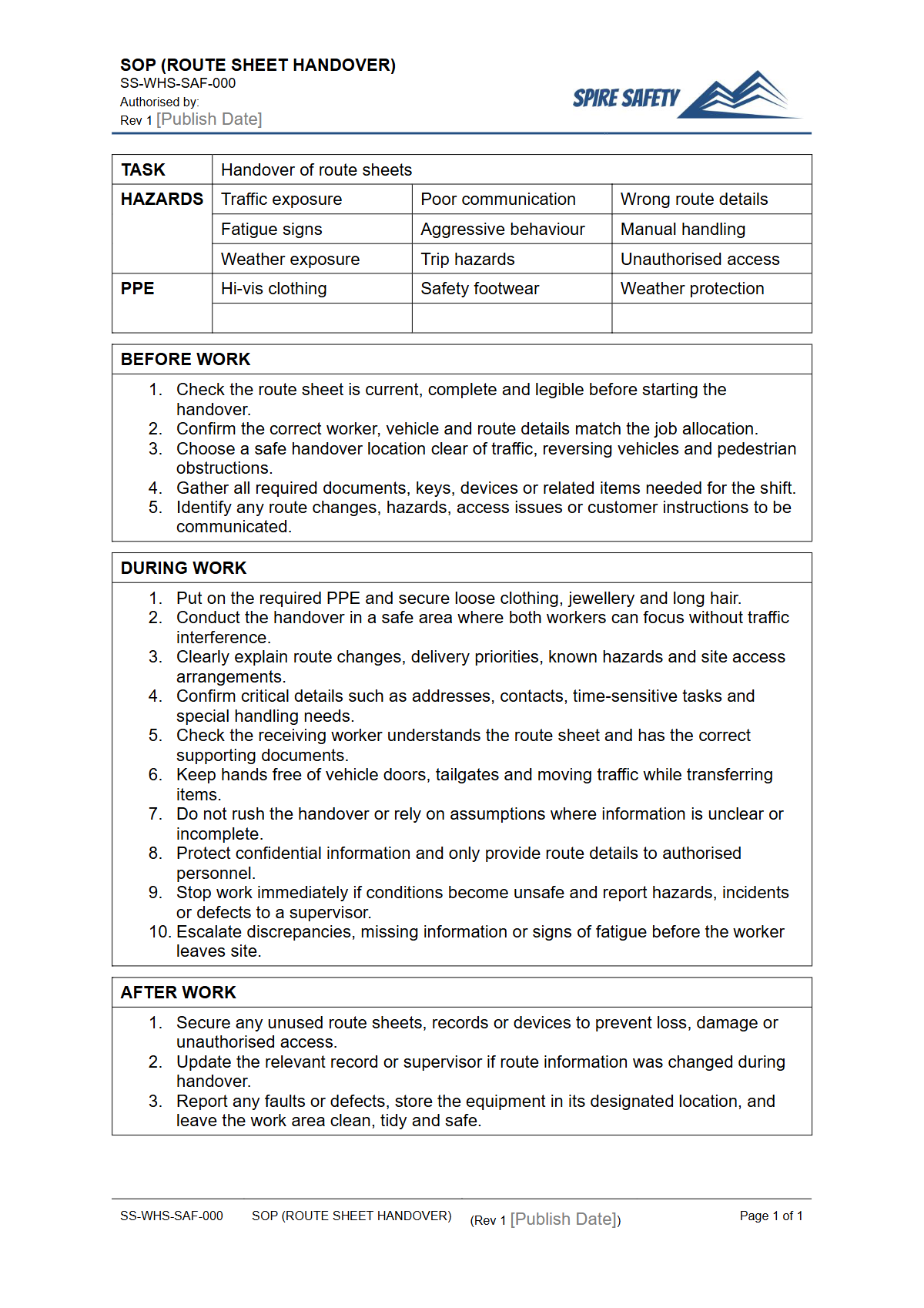
Purpose of the Free Safe Operating Procedure (Route Sheet Handover) Template
A clear and consistent handover process is critical in any transport or logistics operation. This Free Safe Operating Procedure (Route Sheet Handover) Template provides a structured framework for managing the transfer of information and responsibility between drivers, dispatchers, and managers.
Its primary purpose is to minimise errors, miscommunication, and safety risks associated with vehicle and route changeovers. By formalising this process, your organisation can ensure that critical details about the vehicle's condition, load security, route hazards, and delivery schedules are accurately communicated every time.
Using a standardised SOP helps establish a clear chain of responsibility, which is a key principle in Australian work health and safety legislation. It creates an auditable record that demonstrates due diligence in managing transport-related risks.
A well-implemented procedure supports fatigue management, ensures pre-start checks are completed, and contributes to a more efficient and safer operational workflow. This document forms a vital component of broader WHS management systems, integrating seamlessly with other operational safety documents.
Video walkthrough
How to use the Free Safe Operating Procedure (Route Sheet Handover) Template
This template is provided in both DOCX and PDF formats to serve as a robust starting point. The DOCX file is fully editable, allowing for complete customisation to align with your specific operational needs. To effectively implement this Safe Operating Procedure, follow these steps:
- Download and Customise: Open the DOCX template and insert your company name, logo, and relevant site or department details.
- Detail the Procedure: Review each section and adapt the steps to match your exact workflow. Include specifics about the types of vehicles used, the software or paperwork involved, and the exact information that must be handed over.
- Identify Hazards and Controls: Use the built-in risk assessment matrix to list potential hazards specific to your handover process (e.g., incomplete vehicle checks, poor communication, time pressure) and detail the control measures to mitigate them.
- Consult with Workers: Involve your drivers, warehouse staff, and logistics coordinators in the review process. Their frontline experience is invaluable for creating a practical and effective procedure.
- Train and Implement: Once finalised, provide training to all relevant personnel to ensure they understand their roles and responsibilities within the SOP. Post the procedure in visible locations such as driver break rooms, dispatch offices, and loading bays.
IMPORTANT: We have provided this template as a guide. You must customise it to reflect the specific hazards, equipment, and operational context of your workplace.
Regular reviews, especially after an incident or system change, are essential for maintaining effectiveness and can be verified through a formal WHS compliance auditing process.
When to use this Safe Operating Procedure
This SOP should be used every time responsibility for a vehicle or a planned route is transferred from one person to another. This includes, but is not limited to:
- Shift Changes: When one driver finishes their shift and another takes over the same vehicle.
- Dispatcher to Driver Handovers: At the start of a journey when a logistics coordinator or dispatcher issues a route sheet to a driver.
- Cross-Docking or Depot Handovers: In situations where a load is transferred to a different driver or vehicle part-way through its journey.
- End-of-Day Procedures: When a driver returns a vehicle to the depot, documenting its condition and any issues for the maintenance team or the next day's operator.
Consistent use in these scenarios is vital for tasks involving mobile plant, where a telehandler SOP might govern loading activities before the handover even begins.
Who should use it
This Safe Operating Procedure is designed for use by all personnel involved in the management and execution of transport operations. Key roles include:
- Transport Managers and Supervisors: Responsible for implementing, reviewing, and enforcing the procedure.
- Logistics Coordinators and Dispatchers: Responsible for preparing route information and conducting the initial handover to drivers.
- Vehicle Operators and Drivers: The primary users of the SOP, responsible for following the steps during both outgoing and incoming handovers.
- Maintenance Personnel: Who may receive information from the completed handover forms regarding vehicle defects or required servicing.
- WHS Officers: Who use the documented procedures as part of safety audits and incident investigations.
The principles within this SOP apply broadly, from couriers in urban environments to operators of heavy machinery on large sites. For personnel operating specific mobile plant, supplementary documents like a Grader SOP template would be used in conjunction with this handover process.
This template is just one part of our extensive free WHS resources library designed to support Australian businesses.
Common mistakes
Common mistakes to avoid
- Assuming verbal handovers are sufficient without a written or digital record.
- Failing to update the SOP when routes, vehicles, or depot procedures change.
- Not formally including a pre-start vehicle inspection as a mandatory part of the handover.
- Forgetting to get sign-off or acknowledgement from both the outgoing and incoming personnel.
Legal references
Legal considerations
The following legal requirements may be relevant to this type of work.
- Work Health and Safety Act (Harmonised) — Provides the primary duties for protecting workers and other people from work health and safety risks.
- Work Health and Safety Regulations (Harmonised) — Sets out requirements supporting the management of workplace hazards and risks.
The following codes may be relevant to this type of work.
- Managing WHS Risks Code of Practice — Provides practical guidance on identifying hazards, assessing risks and applying effective controls.
- Work Health and Safety Consultation, Cooperation and Coordination Code of Practice — Provides practical guidance on consulting workers and coordinating with other duty holders.
- Managing the Work Environment and Facilities Code of Practice — Provides practical guidance on safe work environments, workplace facilities and related controls.
Did you know
Chain of Responsibility
Under Australia's Chain of Responsibility (CoR) laws, parties throughout the supply chain, including dispatchers and managers, can be held legally liable for safety breaches that occur on the road.
Communication is Key
Investigations into workplace incidents in high-risk industries like transport consistently find that a significant percentage of events can be traced back to a failure in communication during handover periods.
FAQ
Frequently asked questions
01What should be included in a route sheet handover SOP?
02Why is a formal route sheet handover process important for WHS?
03How often should a Safe Operating Procedure for route handovers be reviewed?
04Can a digital app replace a paper-based route sheet handover SOP?
Share this resource
Free Safe Operating Procedure (Route Sheet Handover) Template
Browse Categories
How To Use It
- 1Download and open in Word or PDF.
- 2Replace the placeholders with your business details.
- 3Get it reviewed by a WHS specialist before rollout.
Need it customised?
Our WHS consultants can adapt this template to your site, run a gap analysis, or audit what you already have in place.
Book a Free Consultation WHS consulting servicesor call 1300 156 382
Related templates
- Free Safe Operating Procedure (Rugby Post Inspection) Template
- Free Safe Operating Procedure (Runway Sweeper) Template
- Free Safe Operating Procedure (Safety Valve Test) Template
- Free Safe Operating Procedure (Salad Spinner) Template
- Free Safe Operating Procedure (Salamander Grill) Template
- Free Safe Operating Procedure (Salon Chemical Storage) Template