
Free Safe Operating Procedure (Roughness Tester) Template
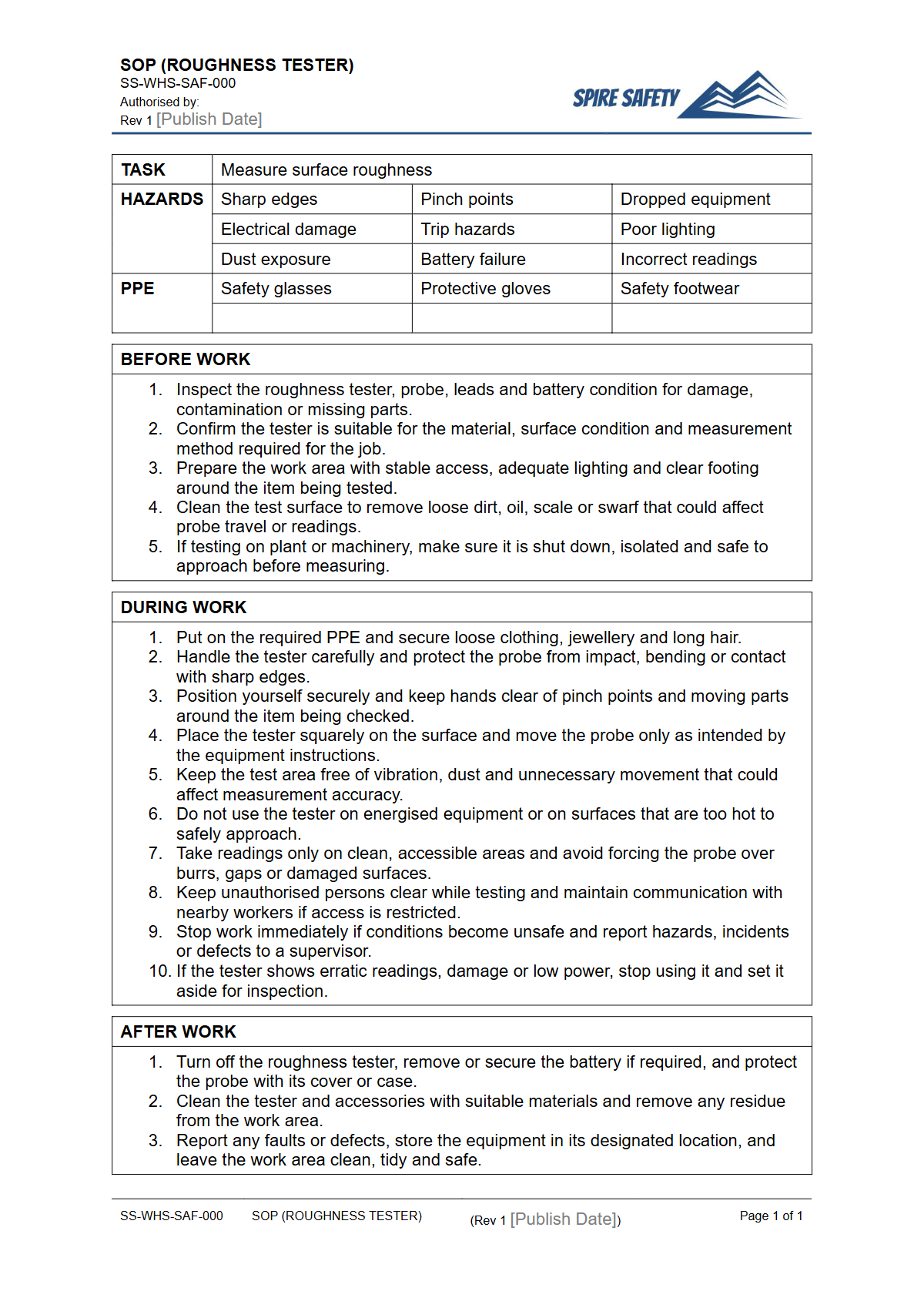
Our free Safe Operating Procedure (Roughness Tester) template provides a solid foundation for documenting safe work practices. Download the DOCX and PDF today.
Free Safe Operating Procedure (Roughness Tester) Template
DOCX • 126 KB + PDF
Updated Oct 2026
No signup required
Purpose of the Free Safe Operating Procedure (Roughness Tester) Template
A roughness tester is a precision instrument used to measure the surface texture or finish of a material. While not heavy machinery, its operation still presents hazards that must be controlled.
This free Safe Operating Procedure (Roughness Tester) template provides a structured starting point for your organisation to document the required safety protocols for using this equipment. Formalising these steps helps ensure consistent, safe operation, minimises the risk of injury, and protects the delicate instrument from damage.
By clearly defining pre-operational checks, operating steps, and post-use tasks, you create a reliable reference for training and daily work.
A documented SOP is a critical component of a proactive safety culture. It demonstrates a commitment to managing workplace risks and serves as an auditable record of your control measures.
Integrating this procedure is an essential part of your broader WHS management systems, helping to fulfil your primary duty of care under Australian WHS legislation.
Key Elements of a Roughness Tester SOP
A comprehensive SOP for this equipment should cover several key areas. These include identifying potential hazards like electrical shock, ergonomic strain from repetitive tasks, or pinch points in moving parts.
The procedure must also outline specific control measures, such as ensuring proper electrical tagging, maintaining correct posture, and keeping hands clear of the stylus arm during operation. Furthermore, it should list the required Personal Protective Equipment (PPE), detail maintenance and calibration schedules, and provide clear instructions for emergencies.
Video walkthrough
How to use the Free Safe Operating Procedure (Roughness Tester) Template
This template is designed for easy adoption and customisation. Download the DOCX file to edit the content directly, adding or removing sections to match your specific operational context.
The PDF version is also available for quick printing and distribution. The goal is to create a document that accurately reflects your workplace's unique environment, the specific model of roughness tester in use, and your internal safety protocols.
This process is similar for other equipment-specific procedures, like our Free Air Compressor SOP, where site-specific details are crucial.
Customising Your SOP
Important: We have provided this template as a starting point. You must customise it to reflect the specific equipment, environment, and regulations of your workplace.
Generic procedures are insufficient for managing risk effectively. Involve operators and supervisors in the customisation process to ensure the final document is practical and comprehensive.
Once finalised, the SOP should be reviewed, approved, and its effectiveness periodically validated through a thorough WHS compliance auditing process.
When to use it
A Safe Operating Procedure for a roughness tester should be a constant reference point, not just a document filed away. It must be used during the initial training and competency assessment of all new operators.
It should also be readily available at the point of use for operators to consult before starting work, especially if they use the equipment infrequently. The SOP is also a key document for supervisors conducting safety observations and for maintenance personnel performing scheduled servicing. Regular toolbox talks can be held to review the SOP and reinforce key safety behaviours, a practice applicable when operating machinery like that covered in our FREE Circular Saw SOP.
Who should use it
This SOP is intended for a range of personnel within an organisation. Quality control technicians, machinists, engineers, and laboratory staff who directly operate the roughness tester are the primary users. WHS managers and safety officers will use the SOP to establish safety standards, conduct risk assessments, and deliver training. Supervisors and team leaders are responsible for ensuring their teams follow the documented procedures. When operations involve multiple steps, it's vital that procedures are established for all equipment, including items used alongside a production line like that detailed in the FREE Conveyer System SOP. If you lack the internal expertise to develop or review technical safety documents, you can seek advice from a qualified WHS consulting professional. For more templates and safety resources, feel free to browse our complete free WHS resources library.
Common mistakes
Common mistakes to avoid
- Using a generic SOP without adding site-specific details for the exact model and work area.
- Failing to check stylus condition and equipment calibration status before use.
- Neglecting to properly document training and competency for all operators.
- Not including clear procedures for cleaning, maintenance, and emergency shutdown.
Legal references
Legal considerations
The following legal requirements may be relevant to this type of work.
- Work Health and Safety Act (Harmonised) — Provides the primary duties for protecting workers and other people from work health and safety risks.
- Work Health and Safety Regulations (Harmonised) — Sets out requirements supporting the management of workplace hazards and risks.
The following codes may be relevant to this type of work.
- Managing WHS Risks Code of Practice — Provides practical guidance on identifying hazards, assessing risks and applying effective controls.
- Work Health and Safety Consultation, Cooperation and Coordination Code of Practice — Provides practical guidance on consulting workers and coordinating with other duty holders.
- Managing the Work Environment and Facilities Code of Practice — Provides practical guidance on safe work environments, workplace facilities and related controls.
Did you know
Surface Finish Units
The most common unit for surface roughness, 'Ra', represents the arithmetic average of the absolute values of the roughness profile deviations from a mean line. It provides a general description of the surface texture.
Stylus Precision
The diamond stylus on a profilometer-style roughness tester is incredibly delicate and precisely engineered. It can be easily damaged by impact or improper handling, leading to inaccurate readings and costly repairs.
FAQ
Frequently asked questions
01What are the main hazards when using a roughness tester?
02Who is qualified to operate a roughness tester?
03How often should a roughness tester SOP be reviewed?
04Is this template enough for WHS compliance on its own?
Share this resource
Free Safe Operating Procedure (Roughness Tester) Template
Browse Categories
How To Use It
- 1Download and open in Word or PDF.
- 2Replace the placeholders with your business details.
- 3Get it reviewed by a WHS specialist before rollout.
Need it customised?
Our WHS consultants can adapt this template to your site, run a gap analysis, or audit what you already have in place.
Book a Free Consultation WHS consulting servicesor call 1300 156 382
Related templates
- Free Safe Operating Procedure (Route Sheet Handover) Template
- Free Safe Operating Procedure (Rugby Post Inspection) Template
- Free Safe Operating Procedure (Runway Sweeper) Template
- Free Safe Operating Procedure (Safety Valve Test) Template
- Free Safe Operating Procedure (Salad Spinner) Template
- Free Safe Operating Procedure (Salamander Grill) Template