
Free Safe Operating Procedure (Rotisserie Loading) Template
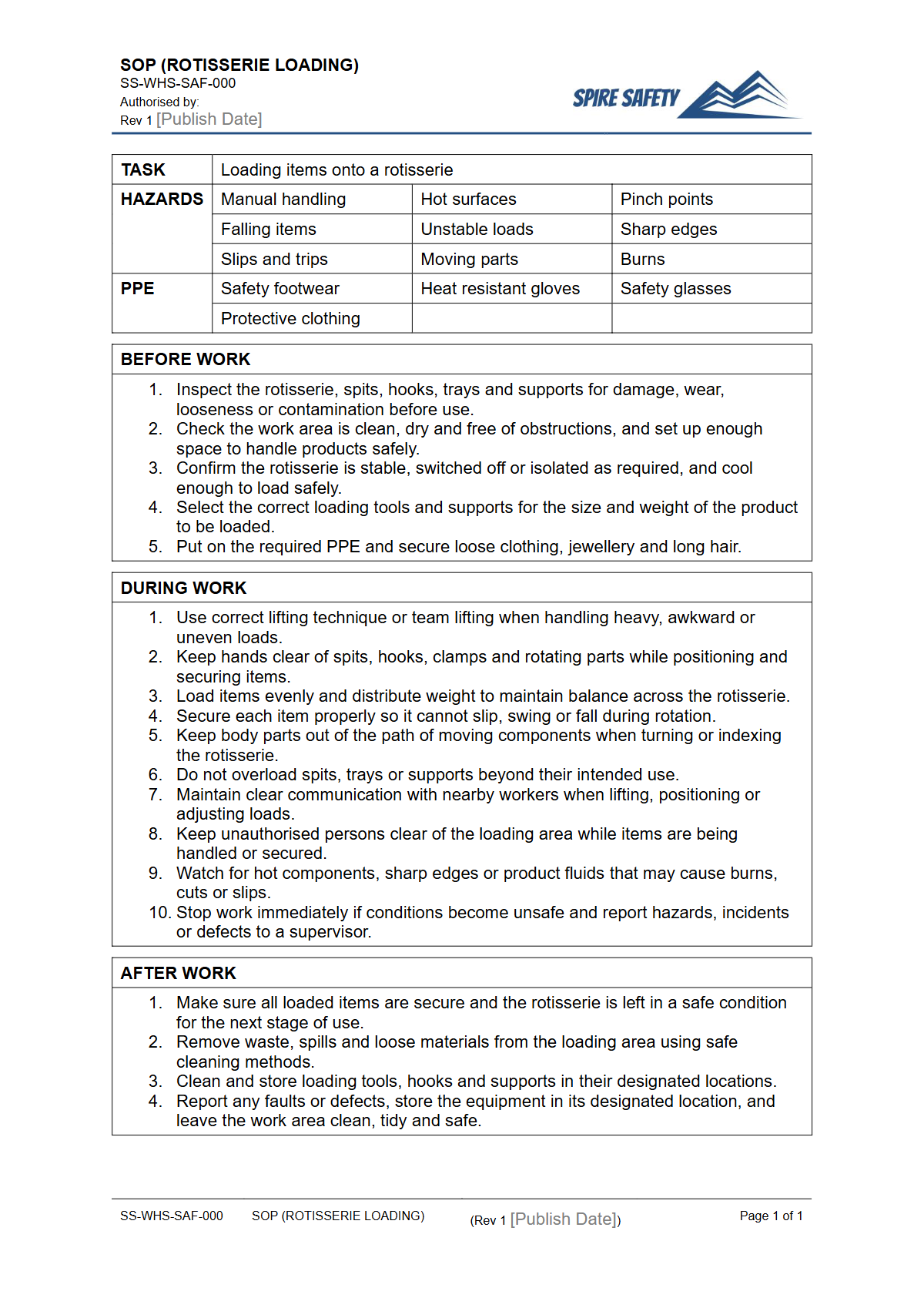
Streamline your kitchen safety with our free Safe Operating Procedure (Rotisserie Loading) template.
Free Safe Operating Procedure (Rotisserie Loading) Template
DOCX • 126 KB + PDF
Updated Oct 2026
No signup required
Purpose of the Free Safe Operating Procedure (Rotisserie Loading) Template
A Safe Operating Procedure (SOP) is a foundational WHS document that provides clear, step-by-step instructions on how to perform a task safely. This free Safe Operating Procedure (Rotisserie Loading) template is designed to help persons conducting a business or undertaking (PCBUs) in the food service and hospitality industries manage the risks associated with operating commercial rotisseries.
By formally documenting the process for loading, operating, and cleaning the equipment, you create a consistent standard that minimises the risk of injuries such as burns, cuts, and musculoskeletal disorders.
Implementing a documented procedure ensures all workers, from new starters to experienced chefs, understand the recognised hazards and the required control measures. It serves as a critical training tool and a reference point for daily operations, reinforcing safe work behaviour.
A well-drafted SOP is a key part of demonstrating proactive risk management, similar to how a specific Safe Operating Procedure for deep fryer operation is essential for managing hazards associated with hot oil and complex cleaning cycles.
Video walkthrough
How to use the Free Safe Operating Procedure (Rotisserie Loading) Template
This document is a starting point designed for customisation. While it is aligned with Australian WHS principles, it is not a complete, out-of-the-box solution.
To use it effectively, download the DOCX file and adapt it to your specific circumstances.
Key Customisation Steps:
- Equipment Specifics: Detail the make, model, and unique features of the rotisserie used in your kitchen. Refer to the manufacturer’s operating manual for critical safety warnings and instructions.
- Task Details: Break down the loading process into specific steps relevant to your workflow, from preparing the meat to securing it on the skewers and placing it in the machine.
- Site-Specific Hazards: Identify hazards unique to your workplace, such as confined spaces, slippery floors, or poor lighting around the equipment area.
- PPE Requirements: List the mandatory Personal Protective Equipment (PPE), such as heat-resistant gloves, aprons, and non-slip footwear.
- Emergency Procedures: Outline the steps to take in case of an emergency, including power failure, fire, or injury.
Remember, we have created this template to be a helpful guide, but you must take responsibility for ensuring it reflects the realities of your workplace. Integrating this SOP into your broader safety framework is crucial for its success.
Robust procedures are a cornerstone of effective WHS management systems, helping to embed a culture of safety throughout your organisation.
When to use a Rotisserie Loading SOP
A Safe Operating Procedure for rotisserie loading should be a living document used consistently throughout your operations. It is not a file-and-forget document. Key times to use the SOP include:
- Worker Induction and Training: Use the SOP as a primary training document for any new staff member who will operate or work near the rotisserie.
- Pre-Operational Checks: Operators should reference the procedure as part of their daily startup routine to ensure the equipment is safe to use.
- Refresher Training: Conduct periodic refresher training sessions for all relevant staff to prevent complacency and reinforce safe practices.
- After an Incident or Near Miss: Following any incident, the SOP should be reviewed and updated to incorporate any lessons learned and prevent a recurrence. This review is a common action item identified during WHS compliance audits.
Who should use this Safe Operating Procedure
This SOP is intended for several key roles within a commercial kitchen or food production environment:
- Workers and Operators: Kitchen hands, cooks, and chefs who are directly responsible for loading and operating the rotisserie must be trained in and follow the procedure.
- Supervisors and Managers: Kitchen supervisors are responsible for ensuring workers are trained, competent, and consistently adhere to the SOP. They also lead its review and updates.
- WHS Representatives and Officers: Safety personnel use the SOP to assist with risk assessments, workplace inspections, and incident investigations related to the equipment. The principles of documenting safe processes apply to all workplace equipment, including items like those covered in our free Air Compressor SOP template that may be used for maintenance or cleaning tasks.
By defining clear responsibilities and instructions, this Safe Operating Procedure helps everyone in the workplace understand their role in maintaining a safe environment. For more templates to support your safety management system, you can browse our complete free WHS resources library.
Common mistakes
Common mistakes to avoid
- Using a generic SOP without customising it for the specific rotisserie make and model.
- Failing to train staff on the procedure and verify their understanding before they operate the equipment.
- Neglecting to include instructions for safe cleaning and maintenance, which are high-risk tasks.
- Forgetting to specify the exact type of Personal Protective Equipment (PPE) required, such as the thermal rating for gloves.
Legal references
Legal considerations
The following legal requirements may be relevant to this type of work.
- Work Health and Safety Act (Harmonised) — Provides the primary duties for protecting workers and other people from work health and safety risks.
- Work Health and Safety Regulations (Harmonised) — Sets out requirements supporting the management of workplace hazards and risks.
The following codes may be relevant to this type of work.
- Managing WHS Risks Code of Practice — Provides practical guidance on identifying hazards, assessing risks and applying effective controls.
- Work Health and Safety Consultation, Cooperation and Coordination Code of Practice — Provides practical guidance on consulting workers and coordinating with other duty holders.
- Managing the Work Environment and Facilities Code of Practice — Provides practical guidance on safe work environments, workplace facilities and related controls.
Did you know
Manual Handling Risk
Lifting and loading heavy, awkward meat products onto rotisserie skewers is a leading cause of musculoskeletal injuries for kitchen staff, accounting for a significant number of workers' compensation claims in the hospitality sector.
Burn Severity
Contact burns from commercial rotisserie surfaces can occur in less than a second. The external surfaces can easily exceed 200°C during operation, posing a severe and immediate risk to workers.
FAQ
Frequently asked questions
01What hazards should be included in a rotisserie loading SOP?
02How often should a Safe Operating Procedure for a rotisserie be reviewed?
03Is a Safe Operating Procedure a legal requirement for commercial kitchens in Australia?
04Can this rotisserie SOP template be used for any brand of equipment?
Share this resource
Free Safe Operating Procedure (Rotisserie Loading) Template
Browse Categories
How To Use It
- 1Download and open in Word or PDF.
- 2Replace the placeholders with your business details.
- 3Get it reviewed by a WHS specialist before rollout.
Need it customised?
Our WHS consultants can adapt this template to your site, run a gap analysis, or audit what you already have in place.
Book a Free Consultation WHS consulting servicesor call 1300 156 382
Related templates
- Free Safe Operating Procedure (Rotisserie Oven) Template
- Free Safe Operating Procedure (Rotor Safety) Template
- Free Safe Operating Procedure (Roughness Tester) Template
- Free Safe Operating Procedure (Route Sheet Handover) Template
- Free Safe Operating Procedure (Rugby Post Inspection) Template
- Free Safe Operating Procedure (Runway Sweeper) Template