
Free Safe Operating Procedure (Rotating Laser) Template
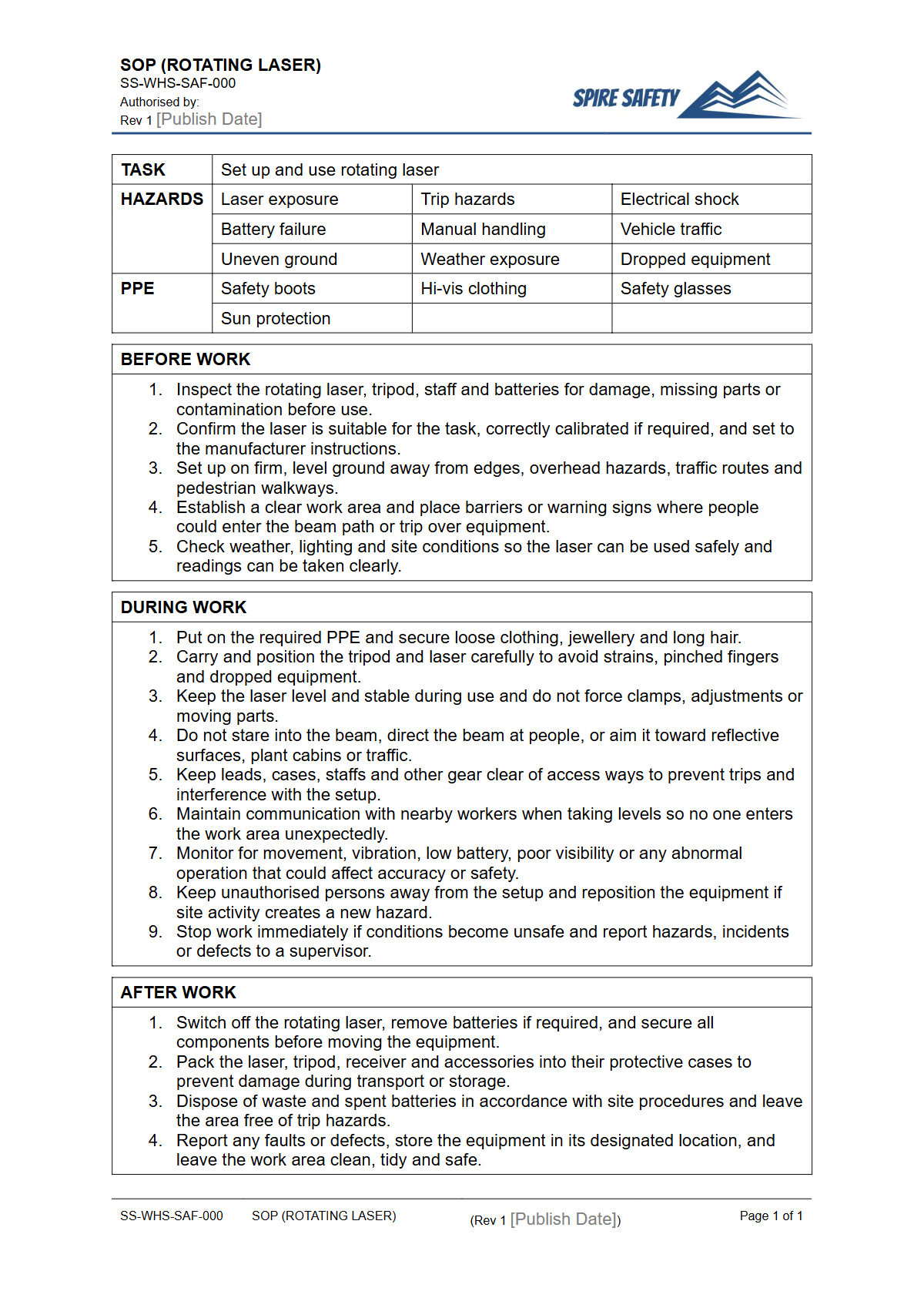
Download our free Safe Operating Procedure for Rotating Lasers to guide your team. Customise this template to manage laser safety risks in your workplace.
Free Safe Operating Procedure (Rotating Laser) Template
DOCX • 126 KB + PDF
Updated Oct 2026
No signup required
Purpose of the Free Safe Operating Procedure (Rotating Laser) Template
Using a rotating laser on a work site requires clear, documented safety protocols to prevent serious injuries, particularly to the eyes. This Free Safe Operating Procedure (Rotating Laser) Template provides a structured starting point for your organisation to formalise safe work practices.
A documented SOP is a critical tool for risk management, helping you to identify hazards, implement control measures, and ensure all workers follow a consistent, safe method for every task. By standardising procedures, you minimise the risk of operator error and create a safer environment. A well-implemented SOP also serves as vital training material and demonstrates a commitment to workplace safety, forming a key part of broader comprehensive WHS management systems.
Video walkthrough
How to use the Free Safe Operating Procedure (Rotating Laser) Template
This template is available as a DOCX file for easy customisation and a PDF for quick reference. To use it effectively, you must adapt the content to the specific context of your workplace.
A generic procedure is not sufficient; safety depends on site-specific details.
Note: We have designed this template to be a comprehensive starting point. You must customise this document to reflect the specific laser models you use, your unique site conditions, the tasks being performed, and the control measures identified in your risk assessment.
Add your company branding, specific personnel responsibilities, and review dates to finalise the procedure. It's one of many specific procedures your business may need, much like our free Circular Saw SOP for power tool safety.
When to use it
A Safe Operating Procedure for rotating lasers should be developed, implemented, and communicated to workers before any related work begins. It is an essential document for any task involving laser levelling or alignment, common in industries like construction, surveying, civil works, and interior fit-outs.
The SOP should be readily available at the worksite for reference by operators and supervisors. It becomes particularly important on busy sites where multiple activities occur simultaneously, helping to establish clear exclusion zones and prevent accidental exposure to laser beams from other machinery operations, such as those covered in our free Trencher SOP template.
Who should use it
This template is designed for use by managers, supervisors, safety officers, or the Person Conducting a Business or Undertaking (PCBU). These roles are responsible for ensuring that safe work methods are established, documented, and followed.
Once customised, the final SOP is a critical tool for workers and operators who will be setting up and using the rotating laser. It forms the basis of their training and serves as a practical, on-the-job reference guide.
The existence and proper use of such SOPs are often a key focus during a WHS compliance auditing process.
Key Elements of a Laser Safety SOP
A robust SOP for rotating lasers should address several key areas to be effective. Ensure your customised document includes the following sections:
Hazard Identification
Detail all potential hazards associated with the task. This includes the obvious risk of eye injury from direct or reflected beam exposure, but also other risks like trip hazards from power cords, equipment instability on uneven ground, and risks from other mobile plant in the area, which may require separate procedures like our FREE Telehandler SOP Template.
Control Measures
List the specific actions taken to mitigate identified risks. For lasers, this includes selecting the lowest class of laser suitable for the job, ensuring the beam path is set above or below head height, establishing clearly marked exclusion zones, and using non-reflective surfaces where possible. If your team needs guidance on complex risk assessments, consider engaging specialist WHS consulting services.
Personal Protective Equipment (PPE)
Specify the required PPE based on your risk assessment. While many rotating lasers used in construction are Class 2 and may not require specific laser eyewear, this must be confirmed.
Other required PPE, such as high-visibility clothing, safety boots, and hard hats, should also be listed.
Training and Competency
Outline the training requirements for any person operating the laser. This section should state that only trained and competent individuals are authorised to use the equipment.
It's a good practice to document how competency is verified and recorded. For a wider selection of safety documents, browse our free WHS resources library.
Common mistakes
Common mistakes to avoid
- Failing to establish and signpost exclusion zones around the operating area.
- Setting the laser's rotating beam at a height where it can directly enter people's eyes.
- Allowing untrained or unauthorised personnel to set up or operate the equipment.
- Neglecting pre-use checks for equipment damage or calibration errors.
Legal references
Legal considerations
The following legal requirements may be relevant to this type of work.
- Work Health and Safety Act (Harmonised) — Provides the primary duties for protecting workers and other people from work health and safety risks.
- Work Health and Safety Regulations (Harmonised) — Sets out requirements supporting the management of workplace hazards and risks.
The following codes may be relevant to this type of work.
- Managing WHS Risks Code of Practice — Provides practical guidance on identifying hazards, assessing risks and applying effective controls.
- Work Health and Safety Consultation, Cooperation and Coordination Code of Practice — Provides practical guidance on consulting workers and coordinating with other duty holders.
- Managing the Work Environment and Facilities Code of Practice — Provides practical guidance on safe work environments, workplace facilities and related controls.
Did you know
Laser Classification
Lasers are classified by their potential to cause harm, from Class 1 (safest) to Class 4 (most hazardous). Most construction lasers are Class 2 or 3R, which are considered safe when handled correctly but can still pose a risk with direct eye exposure.
Not Just Red
While red beam lasers are common and inexpensive, green beam lasers are becoming more popular. The human eye is more sensitive to green light, making green laser lines appear brighter and more visible, especially over long distances or in bright daylight.
FAQ
Frequently asked questions
01What is a Safe Operating Procedure for a rotating laser?
02Are rotating lasers dangerous to the eyes?
03Who is responsible for developing a rotating laser SOP in Australia?
04How often should a rotating laser SOP be reviewed?
Share this resource
Free Safe Operating Procedure (Rotating Laser) Template
Browse Categories
How To Use It
- 1Download and open in Word or PDF.
- 2Replace the placeholders with your business details.
- 3Get it reviewed by a WHS specialist before rollout.
Need it customised?
Our WHS consultants can adapt this template to your site, run a gap analysis, or audit what you already have in place.
Book a Free Consultation WHS consulting servicesor call 1300 156 382
Related templates
- Free Safe Operating Procedure (Rotisserie Loading) Template
- Free Safe Operating Procedure (Rotisserie Oven) Template
- Free Safe Operating Procedure (Rotor Safety) Template
- Free Safe Operating Procedure (Roughness Tester) Template
- Free Safe Operating Procedure (Route Sheet Handover) Template
- Free Safe Operating Procedure (Rugby Post Inspection) Template