
Free Safe Operating Procedure (Root Ball Handling) Template
Effectively manage risks associated with landscaping and nursery tasks with our free root ball handling SOP. Download the customisable template today.
Free Safe Operating Procedure (Root Ball Handling) Template
DOCX • 126 KB + PDF
Updated Oct 2026
No signup required
Purpose of the Free Safe Operating Procedure (Root Ball Handling) Template
Handling large tree root balls is a high-risk activity common in landscaping, construction, and nursery operations. The sheer weight, awkward shape, and instability of root balls present significant hazards, from musculoskeletal injuries to serious crush incidents.
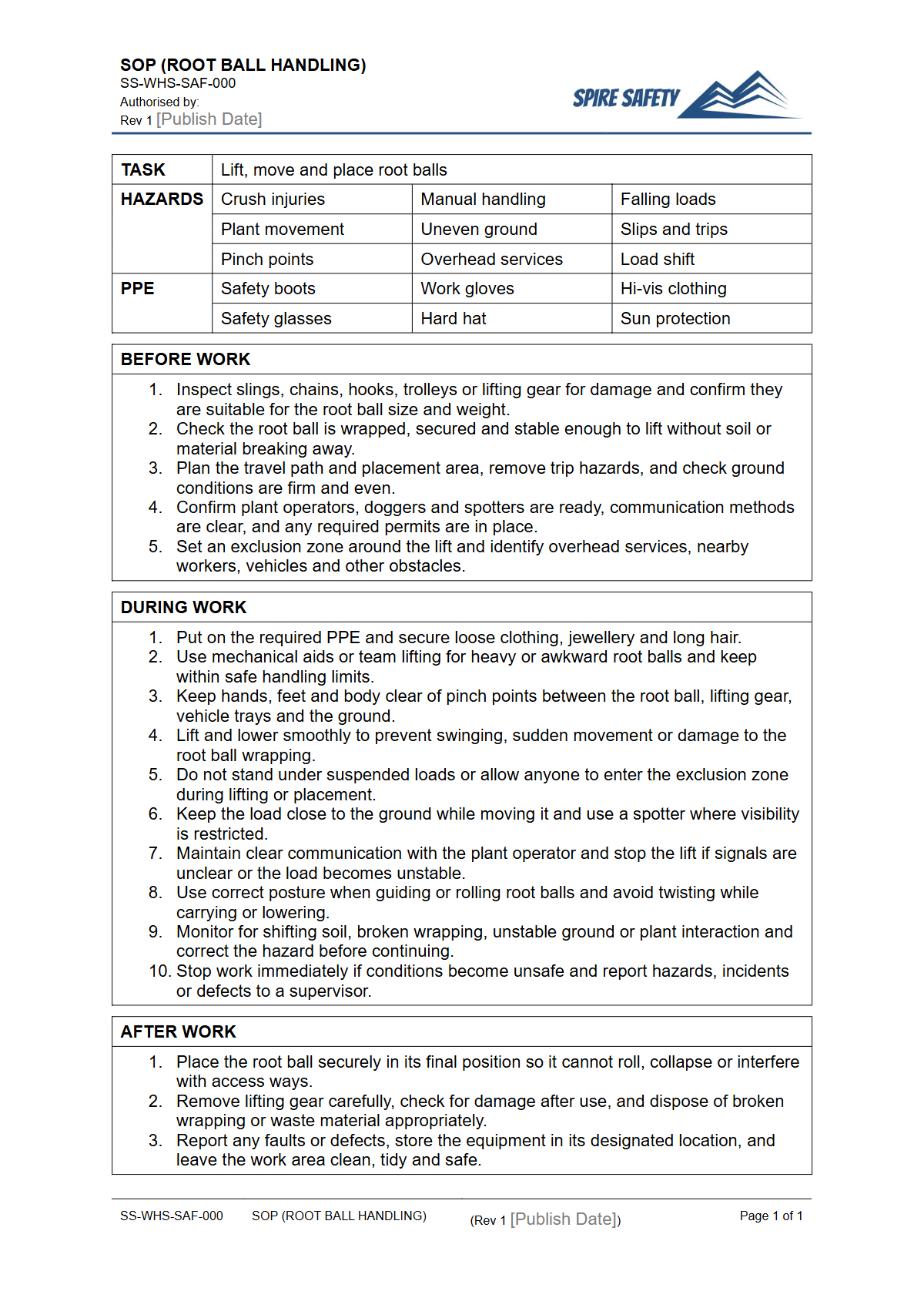
This free Safe Operating Procedure (Root Ball Handling) Template provides a structured framework for documenting a safe system of work for these tasks. It helps organisations identify the specific risks involved in moving, transporting, and planting large trees and outline the necessary control measures to protect workers.
By formalising your process, you create a clear, repeatable guide that reduces the likelihood of incidents. This SOP is designed to prompt consideration of equipment selection, personnel competency, site conditions, and emergency planning.
A well-defined procedure is particularly critical when using machinery, which may require its own documented process, such as those covered in our free Telehandler SOP template for mechanically assisted lifts.
Video walkthrough
How to use the Free Safe Operating Procedure (Root Ball Handling) Template
This resource is available for download as a DOCX file for easy editing and as a PDF for straightforward distribution. After downloading, you must adapt the content to your specific operational context.
It is crucial to understand that this document is a template, not a finished product. We have designed it as a starting point, and you must customise it to reflect the specific machinery, environment, site-specific hazards, and processes used in your workplace.
This involves a thorough risk assessment of your own root ball handling tasks.
We strongly recommend customising this SOP in consultation with the workers who will be performing the task, as well as supervisors and any other relevant stakeholders. This collaborative approach ensures the procedure is practical, accurate, and effective.
Integrating customised SOPs into broader WHS management systems is key to fostering and maintaining a safe work environment across your organisation.
When to use this Safe Operating Procedure
A Safe Operating Procedure for root ball handling should be developed, implemented, and referenced for any task involving the mechanical or manual movement of large, balled trees. Key scenarios include:
- Large-scale commercial and residential landscaping projects.
- Nursery and horticultural operations where mature trees are moved.
- Civic and council projects involving tree transplantation.
- Construction site preparation and land clearing.
The SOP should be used as a primary training document for new employees or those unfamiliar with the task. It should also be readily available on-site as a reference for workers and supervisors before and during the operation, especially when preparing the ground with equipment like that detailed in our free Trencher SOP template.
Who should use it
This procedure is intended for a range of personnel involved in the planning and execution of root ball handling tasks. This includes:
- Landscapers and gardeners
- Arborists and horticulturalists
- Nursery workers
- Mobile plant operators (e.g., crane, telehandler, and excavator operators)
- Site supervisors and project managers
- WHS officers and advisors
Supervisors are responsible for ensuring the procedures outlined are understood and followed by all team members. Regular reviews, often part of a formal WHS compliance auditing process, ensure the SOP remains relevant to current site practices and aligned with legislative requirements.
Key Hazards in Root Ball Handling
The template guides you to identify and control common hazards associated with this task, such as:
- Manual Handling: Strains, sprains, and back injuries from attempting to lift or move heavy loads improperly.
- Crush Injuries: Being caught between the root ball and another object, or injury from the ball rolling or toppling.
- Equipment-Related Incidents: Instability of lifting equipment, failure of slings or attachments, or collisions with mobile plant.
- Underground Services: Risk of striking gas lines, water pipes, or electrical cables during excavation for planting.
- Environmental Factors: Unstable or sloped ground, poor visibility, and adverse weather conditions increasing risk.
Your risk assessment should also account for sequential tasks. For example, post-planting activities like using equipment covered in a free Spreader SOP template introduce their own set of risks to consider in the overall job planning.
Control Measures
Effective controls are essential for mitigating the identified hazards. The SOP template prompts you to detail specific control measures, including:
- Prioritising mechanical lifting aids over manual handling wherever possible.
- Selecting the correct lifting equipment (e.g., cranes, excavators with sling attachments) with adequate load capacity.
- Ensuring all lifting gear is inspected, tagged, and fit for purpose.
- Establishing exclusion zones around the lifting area.
- Confirming the location of all underground services before any digging begins.
- Providing workers with appropriate personal protective equipment (PPE), such as high-visibility clothing, steel-capped boots, hard hats, and gloves.
Using this template helps ensure these critical safety steps are not overlooked. To see more procedural documents for other high-risk tasks, you can browse our entire free WHS resources library for more templates and guides that support your safety management system.
Common mistakes
Common mistakes to avoid
- Underestimating the weight, instability, and centre of gravity of the root ball.
- Failing to use or incorrectly using mechanical lifting aids and certified lifting gear.
- Neglecting to conduct a thorough site assessment, including checking for underground services before digging.
- Using personnel who are not trained or competent in the specific lifting task or equipment operation.
Legal references
Legal considerations
The following legal requirements may be relevant to this type of work.
- Work Health and Safety Act (Harmonised) — Provides the primary duties for protecting workers and other people from work health and safety risks.
- Work Health and Safety Regulations (Harmonised) — Sets out requirements supporting the management of workplace hazards and risks.
The following codes may be relevant to this type of work.
- Managing WHS Risks Code of Practice — Provides practical guidance on identifying hazards, assessing risks and applying effective controls.
- Work Health and Safety Consultation, Cooperation and Coordination Code of Practice — Provides practical guidance on consulting workers and coordinating with other duty holders.
- Managing the Work Environment and Facilities Code of Practice — Provides practical guidance on safe work environments, workplace facilities and related controls.
Did you know
Deceptive Weight
The weight of a root ball is often underestimated. A root ball with a 1-metre diameter can easily exceed 750kg, depending on soil type and moisture content, making mechanical lifting essential.
Industry Injury Stats
Musculoskeletal disorders resulting from hazardous manual tasks are a leading cause of serious workers' compensation claims in the agriculture, forestry, and landscaping industries in Australia.
FAQ
Frequently asked questions
01What PPE is required for handling root balls?
02Can this SOP be used for all types of trees?
03How often should a Safe Operating Procedure for root ball handling be reviewed?
04Does this SOP cover the use of cranes for lifting root balls?
Share this resource
Free Safe Operating Procedure (Root Ball Handling) Template
Browse Categories
How To Use It
- 1Download and open in Word or PDF.
- 2Replace the placeholders with your business details.
- 3Get it reviewed by a WHS specialist before rollout.
Need it customised?
Our WHS consultants can adapt this template to your site, run a gap analysis, or audit what you already have in place.
Book a Free Consultation WHS consulting servicesor call 1300 156 382
Related templates
- Free Safe Operating Procedure (Rope Grab) Template
- Free Safe Operating Procedure (Rose Pruning) Template
- Free Safe Operating Procedure (Rotary Hammer) Template
- Free Safe Operating Procedure (Rotary Ironer) Template
- Free Safe Operating Procedure (Rotating Laser) Template
- Free Safe Operating Procedure (Rotisserie Loading) Template