
Free Safe Operating Procedure (Rose Pruning) Template
Formalise your safety protocols for garden maintenance with our comprehensive Safe Operating Procedure for rose pruning. Download your free template today.
Free Safe Operating Procedure (Rose Pruning) Template
DOCX • 126 KB + PDF
Updated Oct 2026
No signup required
Purpose of the Free Safe Operating Procedure (Rose Pruning) Template
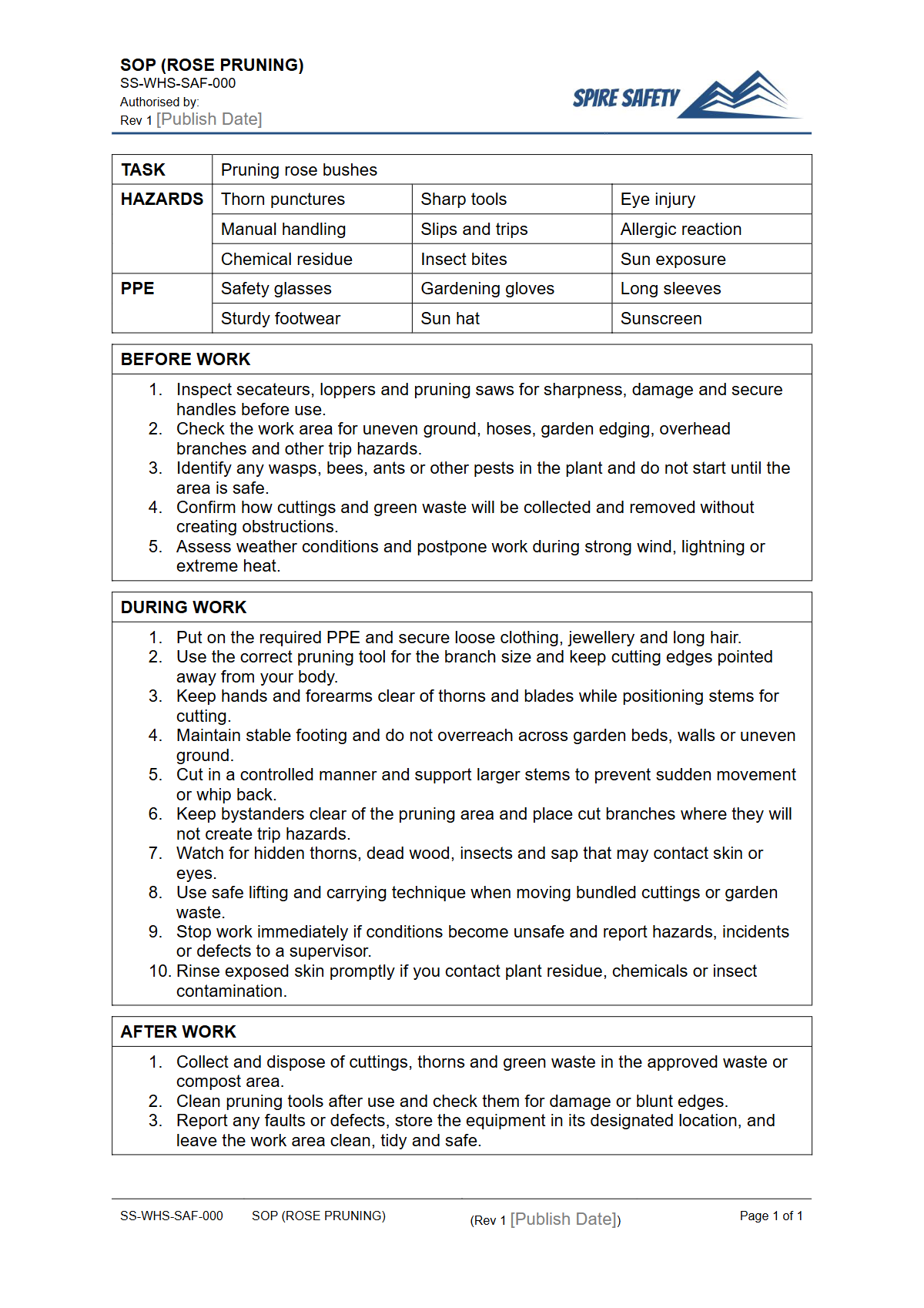
This Free Safe Operating Procedure (Rose Pruning) Template provides a structured framework for businesses to document a safe system of work for horticultural pruning tasks. While rose pruning might seem routine, it carries definite risks, including puncture wounds from thorns, cuts from secateurs, musculoskeletal strain from awkward postures, and potential exposure to pesticides or fungicides.
Implementing a formal SOP helps any Person Conducting a Business or Undertaking (PCBU) meet their primary duty of care under Australian WHS law. It serves as a vital tool for hazard identification, risk assessment, and the implementation of control measures to protect workers.
Using this template helps standardise procedures, ensuring that all workers, regardless of experience level, follow a consistent and safe method. It is designed as a starting point, aligned with the model WHS framework, to be adapted for your specific workplace environment.
Documenting these processes is a key part of building a robust safety culture and can be an integral component of your overall safety management system. For businesses involved in broader landscaping activities, you might also find our free Trencher SOP template useful for documenting procedures for ground preparation work.
Video walkthrough
How to use the Free Safe Operating Procedure (Rose Pruning) Template
This document is available for immediate download as a DOCX file, allowing for easy customisation to your specific operational needs. A PDF version is also provided for straightforward distribution and printing.
To effectively use this Safe Operating Procedure (Rose Pruning) template, you must conduct a site-specific risk assessment. Identify the unique hazards present in your work environment, such as uneven ground, overhead powerlines, public access areas, or the specific types of roses and their growth habits.
Important: This is a template and not a complete safety solution. We have no specific knowledge of your worksite, tools, equipment, or personnel.
You must review, edit, and add to this document to reflect the actual conditions and risks of your organisation. This includes specifying the exact make and model of tools used, the required Personal Protective Equipment (PPE), and detailing your workplace’s unique emergency and first aid procedures.
A comprehensive approach involves integrating SOPs into your broader WHS management systems to ensure they are actively used and reviewed.
When to use this Safe Operating Procedure
A Safe Operating Procedure for rose pruning should be used as a primary reference document before any related task begins. It is an essential resource for inducting new employees or contractors, providing them with clear, step-by-step instructions on how to perform the job safely.
It should also be a central part of any refresher training to reinforce safe work practices and address any complacency that may develop over time. Furthermore, this SOP should be reviewed and referred to during incident investigations or when planning changes to work processes, such as introducing new types of pruning tools or chemicals. Regular reviews are critical to maintaining the document's relevance and effectiveness; this process can be verified through formal WHS compliance auditing.
Who should use this document
This SOP is designed for a range of personnel within the horticultural, landscaping, and property maintenance industries. WHS managers and supervisors should use it to establish and enforce safety standards.
It provides them with a clear benchmark for observing work and providing feedback. Workers, including landscape gardeners, groundskeepers, and horticulturalists, are the primary end-users who must follow the procedure to ensure their own safety and the safety of others.
Business owners can use the finalised document to demonstrate due diligence in managing workplace risks. You can find more templates for a variety of tasks in our free WHS resources library to build out your safety documentation.
Organisations that manage a fleet of equipment will find value in standardising their procedures for all machinery. For instance, tasks that require cleaning equipment post-use might involve compressed air, making our free Air Compressor SOP another relevant resource.
By creating a library of specific SOPs, you ensure all hazardous tasks are covered by a documented safe system of work. If you require assistance in developing a comprehensive suite of documents, our WHS consulting services can provide tailored support.
Common mistakes
Common mistakes to avoid
- Using the template without customising it for site-specific conditions and tools.
- Failing to adequately train workers on the procedure and verify their understanding before they start work.
- Not providing the correct Personal Protective Equipment (PPE) specified in the SOP, or failing to inspect it for damage.
- Omitting clear, step-by-step emergency procedures for common injuries like deep cuts or chemical exposure.
Legal references
Legal considerations
The following legal requirements may be relevant to this type of work.
- Work Health and Safety Act (Harmonised) — Provides the primary duties for protecting workers and other people from work health and safety risks.
- Work Health and Safety Regulations (Harmonised) — Sets out requirements supporting the management of workplace hazards and risks.
The following codes may be relevant to this type of work.
- Managing WHS Risks Code of Practice — Provides practical guidance on identifying hazards, assessing risks and applying effective controls.
- Work Health and Safety Consultation, Cooperation and Coordination Code of Practice — Provides practical guidance on consulting workers and coordinating with other duty holders.
- Managing the Work Environment and Facilities Code of Practice — Provides practical guidance on safe work environments, workplace facilities and related controls.
Did you know
Tetanus Risk
Garden-related puncture wounds, such as those from rose thorns, can introduce soil-borne bacteria like *Clostridium tetani*. Keeping tetanus vaccinations up-to-date is a critical health control for anyone working with soil and plants.
The Hierarchy of Control
An SOP is an 'administrative control'. According to the hierarchy of risk control, higher-level controls like eliminating the hazard or substituting a hazardous tool with a safer one should always be considered first.
FAQ
Frequently asked questions
01Is an SOP legally required for rose pruning in Australia?
02What are the main hazards of rose pruning?
03How often should a Safe Operating Procedure be reviewed?
04Can I use this template for pruning other types of plants?
Share this resource
Free Safe Operating Procedure (Rose Pruning) Template
Browse Categories
How To Use It
- 1Download and open in Word or PDF.
- 2Replace the placeholders with your business details.
- 3Get it reviewed by a WHS specialist before rollout.
Need it customised?
Our WHS consultants can adapt this template to your site, run a gap analysis, or audit what you already have in place.
Book a Free Consultation WHS consulting servicesor call 1300 156 382
Related templates
- Free Safe Operating Procedure (Rotary Hammer) Template
- Free Safe Operating Procedure (Rotary Ironer) Template
- Free Safe Operating Procedure (Rotating Laser) Template
- Free Safe Operating Procedure (Rotisserie Loading) Template
- Free Safe Operating Procedure (Rotisserie Oven) Template
- Free Safe Operating Procedure (Rotor Safety) Template