
Free Safe Operating Procedure (Rotary Hammer) Template
Effectively manage the risks of using rotary hammers with our free Safe Operating Procedure template. Download this structured, customisable DOCX and PDF today.
Free Safe Operating Procedure (Rotary Hammer) Template
DOCX • 126 KB + PDF
Updated Oct 2026
No signup required
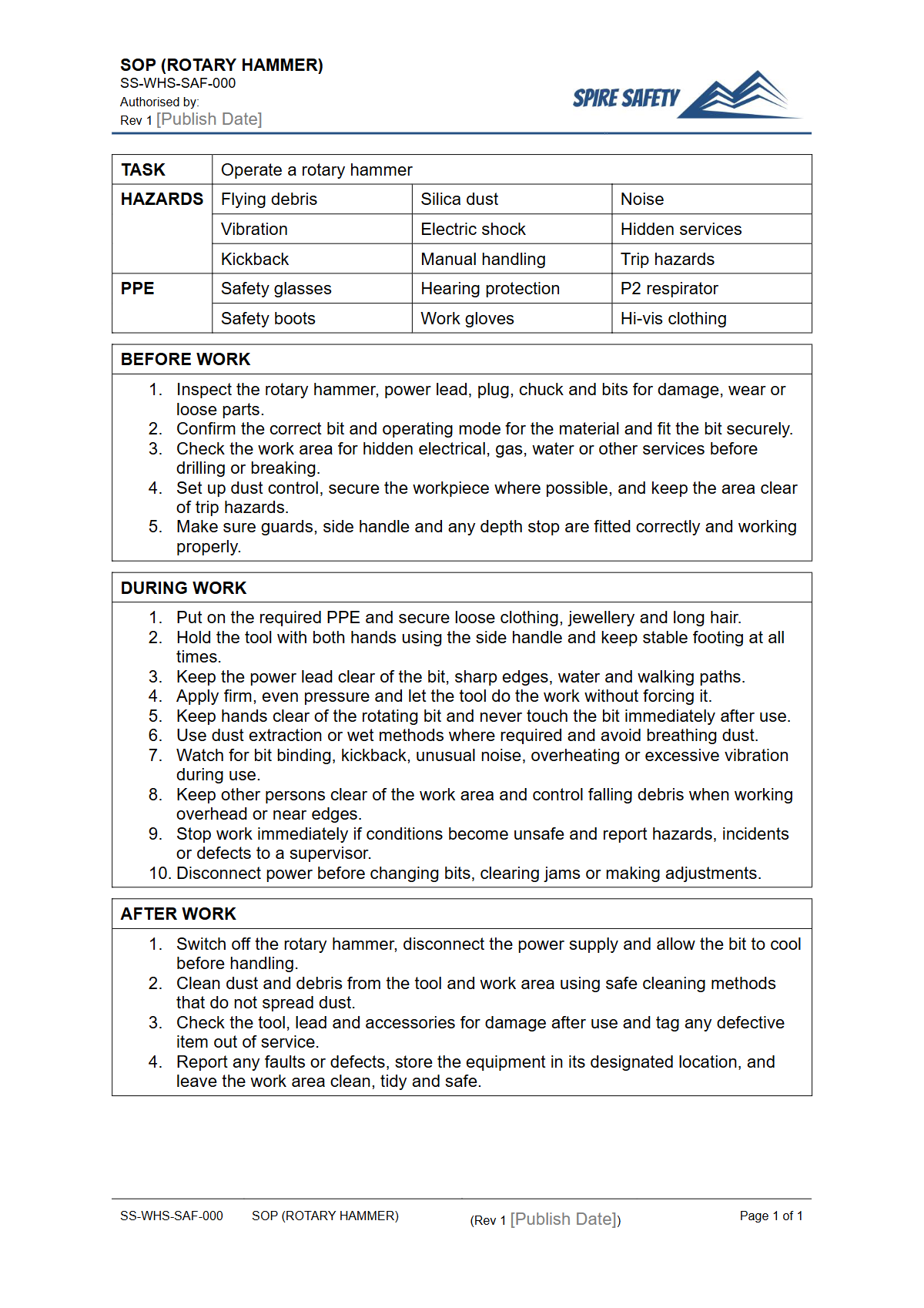
Purpose of the Free Safe Operating Procedure (Rotary Hammer) Template
A rotary hammer is an indispensable power tool in construction, demolition, and renovation, capable of drilling and chiselling through tough materials like concrete, brick, and stone. However, its power brings significant workplace health and safety risks, including Hand-Arm Vibration Syndrome (HAVS), hearing loss from excessive noise, injuries from ejected material, electrical shock, and exposure to hazardous airborne dust like respirable crystalline silica.
This free Safe Operating Procedure (Rotary Hammer) template provides a structured document for outlining the required controls to manage these hazards effectively. It serves as a foundational guide, aligned with Australian WHS principles, to help you document a safe system of work for your team.
By implementing a detailed SOP, you establish clear, consistent instructions for pre-start checks, operation, and post-use maintenance. This not only helps in training workers but also demonstrates a commitment to fulfilling your safety obligations as a PCBU. While this document focuses on rotary hammers, similar principles apply to other high-risk power tools, as detailed in our free Circular Saw SOP.
Video walkthrough
How to use the Free Safe Operating Procedure (Rotary Hammer) Template
This template is provided in both DOCX and PDF formats to suit your organisation's needs. The DOCX file is fully editable, allowing for comprehensive customisation.
The process is straightforward: download the file, and methodically work through each section to tailor the content to your specific operational context. Integrating this procedure into your broader safety framework is a key part of maintaining effective WHS management systems.
Important: This SOP Must Be Customised
This document is a template only. To be effective and support your safety duties, you must customise it to reflect the specific rotary hammer models you use, the tasks your workers perform, and the unique conditions of your worksite.
We cannot be responsible for safety outcomes if you fail to conduct your own risk assessment and adapt this procedure to your circumstances. Consultation with workers and health and safety representatives is a critical part of this process.
Key Sections to Customise
Pay close attention to the following sections to ensure the final document is relevant and robust:
- Plant and Equipment Details: Replace the generic placeholder with the specific make and model of rotary hammers used in your business.
- Personal Protective Equipment (PPE): Specify the exact type and rating of PPE required. For example, detail the class of hearing protection (e.g., Class 5 earmuffs), the need for P2-rated respiratory protection for silica dust, and the type of safety eyewear and gloves.
- Pre-operational Checks: Customise the pre-start inspection checklist to match your equipment. This should include checks for damage to the power cord and plug, testing of residual-current devices (RCDs), ensuring the chuck and bit are secure, and verifying the function of the safety clutch.
- Step-by-Step Operating Sequence: Adapt the procedure for the common tasks performed at your site. Include specific instructions on selecting the correct bit, setting the mode (e.g., rotary, hammer, or both), and techniques for maintaining control. Crucially, add site-specific rules, such as procedures for scanning for embedded electrical or plumbing services before drilling.
- Emergency and Maintenance Procedures: Detail your company's specific procedures for responding to tool malfunction, electric shock, or personal injury. Include information on who to contact and where first aid equipment is located.
When to use a Rotary Hammer SOP
A Safe Operating Procedure for a rotary hammer should be a living document integrated into your daily operations. It is not a file to be left on a shelf. Its primary uses include:
- Training and Induction: Use the SOP as the core training material for new workers and for refresher training for existing staff.
- Competency Assessment: It provides a clear benchmark against which to assess a worker's competency in safely operating the tool.
- Pre-task Planning: Workers and supervisors should review the SOP during toolbox talks or pre-start meetings before commencing work.
- Workplace Audits and Inspections: The SOP is a key piece of evidence that demonstrates a formalised process for managing risk. Many construction sites require an Air Compressor SOP and other plant procedures to be available on-site.
Who should use it
Safety is a shared responsibility, and different roles within an organisation will interact with the SOP in different ways:
- Workers and Operators: The primary users. They must read, understand, and follow the documented procedure every time they use a rotary hammer.
- Supervisors and Team Leaders: Responsible for ensuring workers are trained on the SOP and adhere to it. They must enforce its contents and correct unsafe behaviour.
- Health and Safety Representatives (HSRs): Use the SOP as a reference point during workplace inspections and when consulting with management on health and safety matters.
- Persons Conducting a Business or Undertaking (PCBU) / Management: Have the ultimate responsibility to provide safe systems of work. Developing, implementing, and reviewing SOPs is a fundamental part of meeting this duty.
Engaging a third party to review your completed procedures can provide valuable assurance. Regular WHS compliance auditing helps verify that your documented systems are being effectively implemented in practice.
If you require assistance in tailoring this template or developing more complex safety documentation, our WHS consulting services can provide expert guidance. For more templates and safety resources, browse our complete free WHS resources library.
Common mistakes
Common mistakes to avoid
- Using the incorrect bit type or a dull bit, which requires more force and increases vibration.
- Neglecting to wear appropriate PPE, especially P2-rated respiratory masks for silica dust and Class 5 hearing protection.
- Applying excessive body weight to the tool instead of letting its hammering action do the work, leading to fatigue and loss of control.
- Failing to check for embedded services like electrical conduits, water pipes, or gas lines before drilling into walls, floors, or ceilings.
Legal references
Legal considerations
The following legal requirements may be relevant to this type of work.
- Work Health and Safety Act (Harmonised) — Provides the primary duties for protecting workers and other people from work health and safety risks.
- Work Health and Safety Regulations (Harmonised) — Sets out requirements supporting the management of workplace hazards and risks.
The following codes may be relevant to this type of work.
- Managing WHS Risks Code of Practice — Provides practical guidance on identifying hazards, assessing risks and applying effective controls.
- Work Health and Safety Consultation, Cooperation and Coordination Code of Practice — Provides practical guidance on consulting workers and coordinating with other duty holders.
- Managing the Work Environment and Facilities Code of Practice — Provides practical guidance on safe work environments, workplace facilities and related controls.
Did you know
Vibration Exposure
Daily exposure to vibration from tools like rotary hammers is measured in points. The 'Exposure Action Value' (EAV) is 100 points per day, after which employers must take action to reduce exposure. The 'Exposure Limit Value' (ELV) is 400 points, which should never be exceeded.
Silica Dust
Respirable crystalline silica particles are so small they can penetrate deep into the lungs. Using water suppression or on-tool dust extraction when drilling with a rotary hammer is a key control measure to prevent worker exposure to this hazardous dust.
FAQ
Frequently asked questions
01What is the difference between a rotary hammer and a hammer drill?
02What are the main health risks from using a rotary hammer?
03How often should a Safe Operating Procedure for a rotary hammer be reviewed?
04Is a Safe Operating Procedure a legal requirement in Australia?
Share this resource
Free Safe Operating Procedure (Rotary Hammer) Template
Browse Categories
How To Use It
- 1Download and open in Word or PDF.
- 2Replace the placeholders with your business details.
- 3Get it reviewed by a WHS specialist before rollout.
Need it customised?
Our WHS consultants can adapt this template to your site, run a gap analysis, or audit what you already have in place.
Book a Free Consultation WHS consulting servicesor call 1300 156 382
Related templates
- Free Safe Operating Procedure (Rotary Ironer) Template
- Free Safe Operating Procedure (Rotating Laser) Template
- Free Safe Operating Procedure (Rotisserie Loading) Template
- Free Safe Operating Procedure (Rotisserie Oven) Template
- Free Safe Operating Procedure (Rotor Safety) Template
- Free Safe Operating Procedure (Roughness Tester) Template