
Free Safe Operating Procedure (Rope Grab) Template
Formalise the use of rope grabs with our comprehensive template. Download this free Safe Operating Procedure to improve workplace safety and training.
Free Safe Operating Procedure (Rope Grab) Template
DOCX • 126 KB + PDF
Updated Oct 2026
No signup required
Purpose of the Free Safe Operating Procedure (Rope Grab) Template
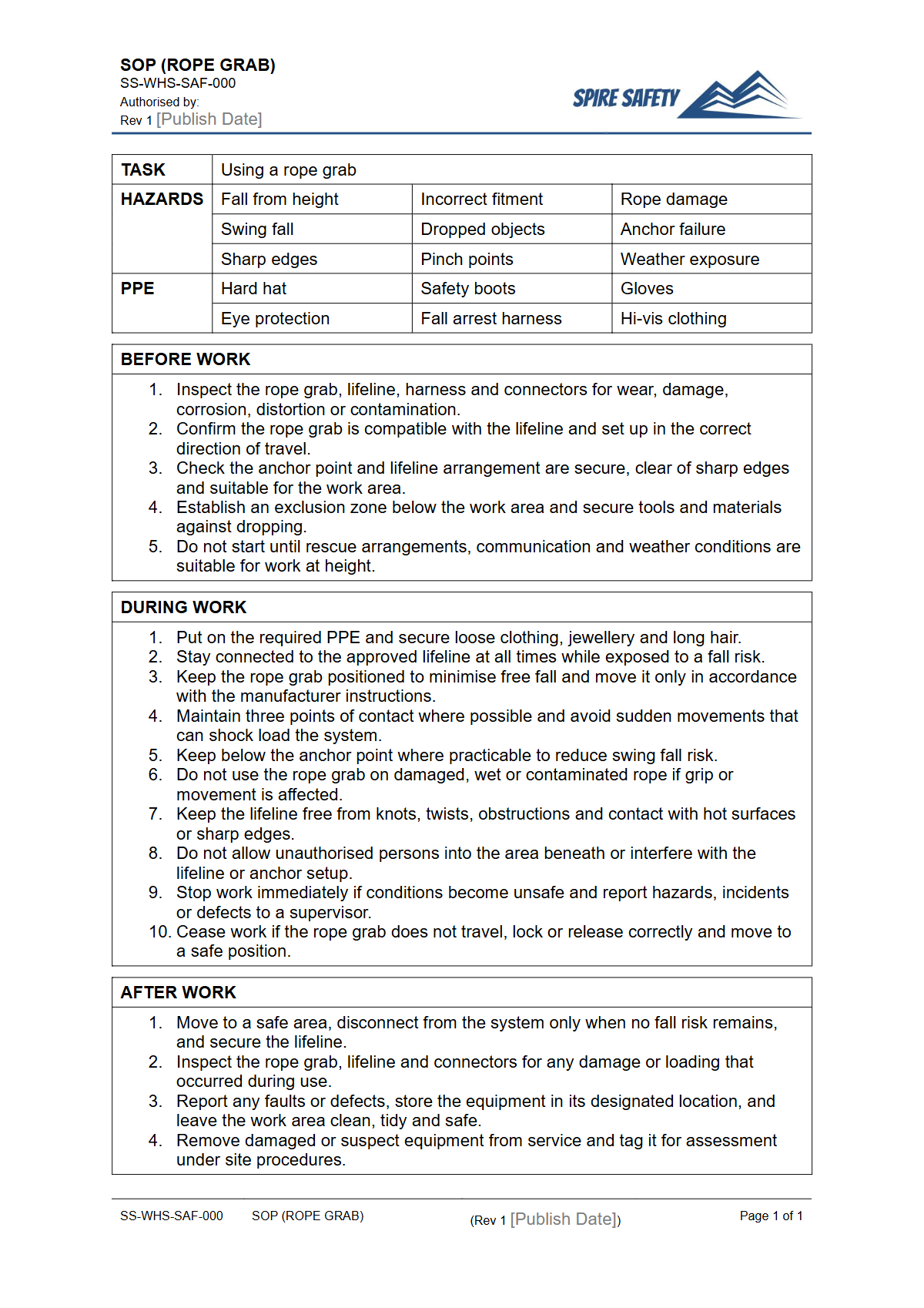
This Free Safe Operating Procedure (Rope Grab) Template provides a structured framework for documenting the safe use of rope grabs in your workplace. Rope grabs are critical personal protective equipment (PPE) for preventing falls from height, and having a clear SOP is essential for ensuring they are used correctly, inspected regularly, and maintained properly.
This document helps your organisation formalise procedures, assist in worker training, and demonstrate due diligence in managing high-risk activities. A documented procedure is a fundamental component of effective WHS management systems, providing clear instructions to minimise risk and protect workers.
Video walkthrough
How to use the Free Safe Operating Procedure (Rope Grab) Template
This SOP template is designed as a starting point. It should be downloaded and customised to reflect the specific rope grab models, lifelines, and work tasks at your site.
Fill in the required fields, add site-specific details, and incorporate information directly from the manufacturer’s instructions for your equipment. A robust safety system requires documented procedures for all high-risk equipment; for example, a site that requires work at height may also use elevated work platforms or telehandlers, which need their own documentation like our FREE Telehandler SOP Template.
This document is available in DOCX format for easy editing and a PDF version for straightforward distribution and printing.
Important Note on Customisation
This document is a template and is not a substitute for professional WHS advice. It is your organisation's responsibility to ensure the final Safe Operating Procedure is tailored to your unique operational environment, the specific equipment in use, and complies with current state or territory WHS legislation.
We are not liable for any incidents arising from the use of this template. You must consult the relevant manufacturer's guidelines, Australian Standards, and Codes of Practice when developing your final procedure.
When to use a Safe Operating Procedure for a Rope Grab
A Safe Operating Procedure for a rope grab should be developed and implemented before any work that requires its use. It is a critical document for any task involving work at height where a rope grab is part of a fall arrest or restraint system. This includes activities such as:
- Roof work and maintenance
- Telecommunications tower access
- Window cleaning
- Construction and structural steel erection
- General rope access tasks
The SOP should be used as a key resource during worker inductions, pre-start meetings, and competency training. Documenting procedures is not just for fall protection; all potentially hazardous tools and equipment, from power tools covered in our FREE Circular Saw SOP Template to fixed plant, require formal risk management.
Who should use this Safe Operating Procedure
This SOP is intended for use by multiple roles within an organisation to ensure a unified approach to safety:
- Persons Conducting a Business or Undertaking (PCBUs): To ensure they are meeting their primary duty of care to provide and maintain a safe work environment and safe systems of work.
- Managers and Supervisors: To train workers, enforce safe work practices, and ensure equipment is inspected and maintained correctly.
- Workers: To understand and follow the correct procedures for selecting, inspecting, and using rope grabs and associated fall protection equipment.
- WHS Officers and Committees: To assist in risk assessments, procedure development, and monitoring safety performance.
Developing comprehensive SOPs can be complex. Engaging external experts through WHS consulting can provide the necessary expertise to ensure your documentation is robust and practical.
Regular checks of these procedures should form part of your safety assurance activities, which can be validated through a formal WHS compliance auditing process. For more templates and safety guides, explore our complete free WHS resources library.
Common mistakes
Common mistakes to avoid
- Using a rope grab on a damaged, dirty, or incompatible rope.
- Failing to conduct a pre-use inspection for wear, damage, or correct function.
- Incorrectly attaching the rope grab to the lifeline or harness (e.g., upside down).
- Neglecting regular cleaning and maintenance as per manufacturer guidelines.
Legal references
Legal considerations
The following legal requirements may be relevant to this type of work.
- Work Health and Safety Act (Harmonised) — Provides the primary duties for protecting workers and other people from work health and safety risks.
- Work Health and Safety Regulations (Harmonised) — Sets out requirements supporting the management of workplace hazards and risks.
The following codes may be relevant to this type of work.
- Managing WHS Risks Code of Practice — Provides practical guidance on identifying hazards, assessing risks and applying effective controls.
- Work Health and Safety Consultation, Cooperation and Coordination Code of Practice — Provides practical guidance on consulting workers and coordinating with other duty holders.
- Managing the Work Environment and Facilities Code of Practice — Provides practical guidance on safe work environments, workplace facilities and related controls.
Did you know
Material Compatibility
Rope grabs are engineered for specific types and diameters of rope. Using an incompatible rope can cause the device to slip or fail to lock during a fall, with catastrophic consequences.
Australian Standard
The AS/NZS 1891 series provides detailed requirements for the components of industrial fall-arrest systems, including ropes and rope adjustment devices like rope grabs.
FAQ
Frequently asked questions
01What is a rope grab and why is it used?
02Does this Safe Operating Procedure cover all types of rope grabs?
03How often should a rope grab be inspected?
04What training is required to use a rope grab?
Share this resource
Free Safe Operating Procedure (Rope Grab) Template
Browse Categories
How To Use It
- 1Download and open in Word or PDF.
- 2Replace the placeholders with your business details.
- 3Get it reviewed by a WHS specialist before rollout.
Need it customised?
Our WHS consultants can adapt this template to your site, run a gap analysis, or audit what you already have in place.
Book a Free Consultation WHS consulting servicesor call 1300 156 382
Related templates
- Free Safe Operating Procedure (Rose Pruning) Template
- Free Safe Operating Procedure (Rotary Hammer) Template
- Free Safe Operating Procedure (Rotary Ironer) Template
- Free Safe Operating Procedure (Rotating Laser) Template
- Free Safe Operating Procedure (Rotisserie Loading) Template
- Free Safe Operating Procedure (Rotisserie Oven) Template