
Free Safe Operating Procedure (Room Service Trolley) Template
Download our free Safe Operating Procedure (Room service trolley) Template to manage hospitality risks. Get your customisable DOCX and PDF template today.
Free Safe Operating Procedure (Room Service Trolley) Template
DOCX • 126 KB + PDF
Updated Oct 2026
No signup required
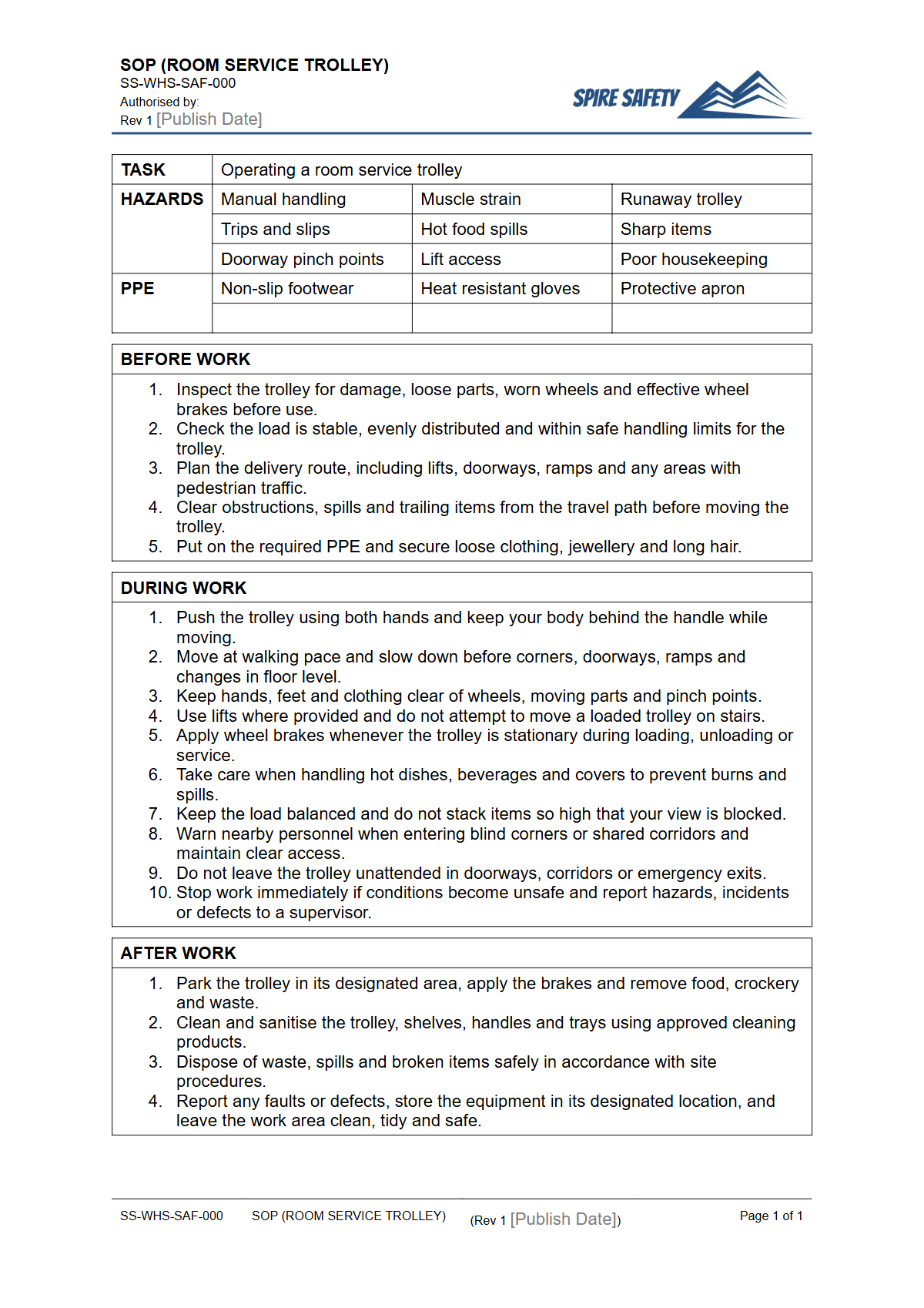
Purpose of the Free Safe Operating Procedure (Room Service Trolley) Template
Using a room service trolley may seem straightforward, but it involves significant workplace health and safety risks, including manual handling injuries, slips and trips, and collisions. This free Safe Operating Procedure (Room Service Trolley) Template provides a structured framework for documenting the safest way to perform this common hospitality task.
It helps organisations meet their duty of care by standardising procedures, outlining potential hazards, and detailing clear control measures to protect workers and guests.
A documented SOP ensures that every team member, from new hires to experienced staff, has a clear reference for safe work practices. By systematically addressing risks like over-stacking, navigating corridors, and managing hot food and liquids, the SOP becomes a critical tool in preventing workplace incidents.
It serves as the foundation for training, task observations, and incident investigations, promoting a consistent and safety-conscious culture. Similar to procedures for kitchen equipment, like our Safe Operating Procedure for a deep fryer, it breaks down a complex task into manageable, safe steps.
Video walkthrough
How to Use the Free Safe Operating Procedure (Room Service Trolley) Template
This template is a starting point designed for customisation. After downloading the DOCX or PDF file, you must adapt it to reflect the specific conditions and equipment in your workplace.
A generic procedure is not enough; effective safety management requires a document that is relevant to your operational reality.
Key Customisation Steps:
- Consultation: Engage with your room service staff, supervisors, and WHS representatives. Their first-hand experience is invaluable for identifying all a task's practical risks and effective controls.
- Site-Specific Details: Add details about your specific trolley models, typical loads, delivery routes (including lifts, ramps, and corridor types), and emergency procedures.
- Risk Assessment Integration: Ensure the controls listed in the SOP align directly with the findings of your workplace risk assessments for manual tasks.
- Review and Approval: Once customised, have the SOP formally reviewed and approved by a manager or person with the appropriate authority.
Please note: This document is a template only. We are not responsible for its implementation or for any workplace incidents.
You must customise this Safe Operating Procedure to your specific workplace, equipment, and processes in consultation with your team to ensure it is effective and addresses your unique operational risks. Integrating these tailored procedures is a fundamental component of building robust WHS management systems.
When to Use This Safe Operating Procedure
A Safe Operating Procedure is a dynamic document that should be used consistently throughout an employee's lifecycle, not just filed away after creation. It is most effective when used for:
- Induction and Training: Provide the SOP to all new room service employees as a core part of their job-specific training. Use it as a checklist to ensure all safety aspects are covered.
- Refresher Training: Conduct periodic refresher training for all staff, using the SOP to reinforce correct procedures and address any bad habits that may have developed.
- Pre-Task Reference: Encourage team members to review the SOP before undertaking non-routine or complex deliveries, such as for large functions or VIP guests.
- Incident Investigation: When an incident or near-miss occurs, the SOP is a critical reference to determine if procedures were followed and whether they need to be updated.
Regular reviews are essential. The SOP should be re-evaluated whenever new trolley models are introduced, hotel layouts change, or after a relevant incident. This proactive approach is a key part of the continuous improvement cycle checked during a WHS compliance audit.
Who Should Use This SOP
This SOP is intended for a range of personnel within a hospitality setting to ensure a shared understanding of safety expectations. Key users include:
- Room Service Staff: As the primary operators, they use the SOP as a daily guide to perform their duties safely.
- Hospitality and Hotel Managers: They are responsible for ensuring that SOPs are developed, implemented, and enforced as part of their overall operational management.
- Supervisors: Team leaders and supervisors use the SOP to train staff, monitor performance, and conduct on-the-job safety observations.
- WHS Managers and Officers: Safety professionals use the SOP as a tool to manage risk, ensure procedural consistency, and provide evidence of risk control measures.
In a large hotel or resort, multiple SOPs are necessary to cover the diverse range of tasks, from kitchen operations to laundry services which might even use a conveyer system SOP. If your organisation requires assistance in developing a comprehensive suite of safety documents, our expert WHS consulting services can provide tailored support. You can also explore our complete free WHS resources library for other useful templates.
Common mistakes
Common mistakes to avoid
- Using the generic template without customising it for specific site layouts and trolley models.
- Failing to consult with room service staff who have practical, hands-on experience with the task.
- Neglecting to provide practical, hands-on training to accompany the written SOP document.
- Forgetting to review and update the SOP after an incident, near-miss, or change in procedure.
Legal references
Legal considerations
The following legal requirements may be relevant to this type of work.
- Work Health and Safety Act (Harmonised) — Provides the primary duties for protecting workers and other people from work health and safety risks.
- Work Health and Safety Regulations (Harmonised) — Sets out requirements supporting the management of workplace hazards and risks.
The following codes may be relevant to this type of work.
- Managing WHS Risks Code of Practice — Provides practical guidance on identifying hazards, assessing risks and applying effective controls.
- Work Health and Safety Consultation, Cooperation and Coordination Code of Practice — Provides practical guidance on consulting workers and coordinating with other duty holders.
- Managing the Work Environment and Facilities Code of Practice — Provides practical guidance on safe work environments, workplace facilities and related controls.
Did you know
Manual Handling in Hospitality
The accommodation and food services industry has one of the highest rates of serious workers' compensation claims for injuries caused by lifting, pushing, or pulling objects.
Ergonomic Design
Modern room service trolleys often feature lighter materials, larger non-marking wheels, and adjustable-height handles to reduce the physical strain on workers and minimise the risk of musculoskeletal disorders.
FAQ
Frequently asked questions
01What are the main hazards of using a room service trolley?
02Is a Safe Operating Procedure for a room service trolley a legal requirement in Australia?
03How often should we review our room service trolley SOP?
04Can I use this template for other types of hospitality trolleys?
Share this resource
Free Safe Operating Procedure (Room Service Trolley) Template
Browse Categories
How To Use It
- 1Download and open in Word or PDF.
- 2Replace the placeholders with your business details.
- 3Get it reviewed by a WHS specialist before rollout.
Need it customised?
Our WHS consultants can adapt this template to your site, run a gap analysis, or audit what you already have in place.
Book a Free Consultation WHS consulting servicesor call 1300 156 382
Related templates
- Free Safe Operating Procedure (Room Turnaround Cleaning) Template
- Free Safe Operating Procedure (Root Ball Handling) Template
- Free Safe Operating Procedure (Rope Grab) Template
- Free Safe Operating Procedure (Rose Pruning) Template
- Free Safe Operating Procedure (Rotary Hammer) Template
- Free Safe Operating Procedure (Rotary Ironer) Template