
Free Safe Operating Procedure (Roof Ladder) Template
Get a structured starting point for managing roof access with our free Safe Operating Procedure (Roof Ladder) template. Download your customisable DOCX now.
Free Safe Operating Procedure (Roof Ladder) Template
DOCX • 126 KB + PDF
Updated Oct 2026
No signup required
Purpose of the Free Safe Operating Procedure (Roof Ladder) Template
Working at height remains one of the highest risk activities in Australian workplaces. A roof ladder is a specialised tool for providing temporary access on the surface of a pitched roof, but its use comes with inherent dangers.
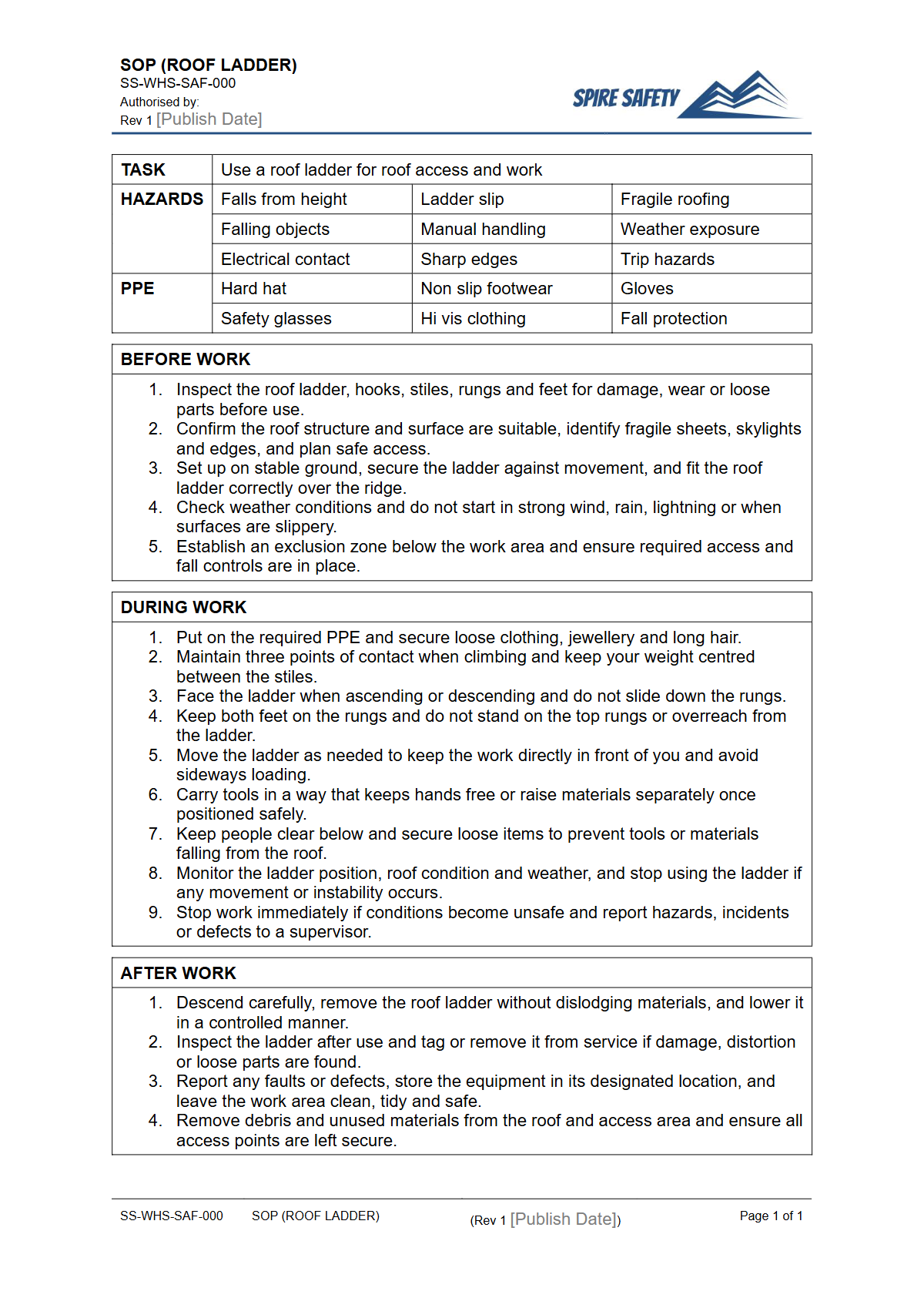
This Free Safe Operating Procedure (Roof Ladder) Template provides a structured starting point for your business to document safe work methods, manage risks, and ensure workers understand the required steps for using this equipment correctly. It is designed to be adapted to your specific operational needs and aligned with Australian WHS principles.
A Safe Operating Procedure (SOP) is a fundamental administrative control that outlines a logical sequence of steps for a specific task to be performed safely. The purpose of this Roof Ladder SOP template is to help your organisation formalise instructions for workers.
It details the entire process, from pre-operational checks and site assessment through to correct placement, use, and removal of the ladder. By implementing a clear SOP, you help fulfil your duty of care to provide and maintain a safe system of work, reduce the likelihood of falls, and create a consistent, trainable standard for all personnel.
This document acts as a critical tool in your overall risk management strategy for working at heights.
Video walkthrough
How to use the Free Safe Operating Procedure (Roof Ladder) Template
This resource is available for download as a DOCX file, which is fully editable in Microsoft Word or other compatible programs, and as a PDF for easy printing and distribution. To use it effectively, you must customise it to reflect your specific workplace.
This is not a finished, universally applicable document. We have provided a comprehensive framework, but you must review and amend it to include details about your specific roof ladder models, the types of roof surfaces encountered, environmental factors, and the personal protective equipment (PPE) your workers use. This customisation process should involve consultation with the workers who will be using the equipment. A well-developed SOP is a key component of robust WHS management systems.
When to use this Safe Operating Procedure
A documented SOP for roof ladder use should be in place before any worker is required to perform tasks on a pitched roof. It serves multiple functions throughout the work cycle.
It is a core document for inducting and training new employees, ensuring they learn the correct, safe method from the outset. It should also be used as a reference for pre-start meetings or toolbox talks to refresh knowledge before a job begins.
Furthermore, it can be used by supervisors to monitor work practices and confirm procedures are being followed correctly. It is also important to have documented procedures for other access equipment, and our extension ladder SOP provides a useful template for the ladders used to get to the roof edge.
Who should use it
This Safe Operating Procedure template is designed for use by Persons Conducting a Business or Undertaking (PCBUs), site supervisors, WHS managers, and team leaders. These individuals are responsible for developing, implementing, and monitoring safe work systems.
Once customised, the final SOP is a critical document for any worker or contractor who is required to use a roof ladder as part of their job. Every person using the equipment must be trained in the contents of the final, site-specific SOP and be deemed competent before starting work.
For organisations needing assistance to define roles and responsibilities, engaging in specialist WHS consulting can provide clarity and direction.
Integrating the SOP into Your Safety System
An SOP does not work in isolation. It must be integrated into your organisation's broader Work Health and Safety framework to be effective.
This means it should be referenced in your risk assessments for working at height and linked to your training records. Your system should also include schedules for regular ladder inspection and maintenance, with records kept for each piece of equipment.
Consider how other machinery might interact with the task; for instance, if materials are lifted to the roof using other plant, you may also need a telehandler SOP. To ensure all these elements are working together effectively, many businesses find value in conducting regular WHS compliance auditing to identify gaps and opportunities for improvement.
Key Elements of a Roof Ladder SOP
A comprehensive SOP for a roof ladder should cover several key areas to ensure clarity and safety. While our template provides a full structure, ensure your final version includes:
- Required PPE: Specify non-slip footwear, helmets, gloves, and any required fall-arrest systems.
- Pre-operational Checks: A checklist for inspecting the ladder for damage, including stiles, rungs, wheels, and the ridge hook.
- Risk Assessment: A prompt to assess the specific task risks, such as roof pitch, surface condition (wet, brittle), and weather (wind, rain).
- Step-by-Step Procedure: Clear instructions for transporting, placing, securing, ascending, descending, and removing the ladder.
- Emergency Procedures: Instructions on what to do in case of a fall or other incident.
You can find templates for other high-risk tasks and equipment in our free WHS resources library.
Common mistakes
Common mistakes to avoid
- Using a domestic-grade ladder for commercial or industrial work.
- Failing to properly secure the ladder at the top over the roof ridge.
- Overreaching to the side or carrying heavy/awkward loads while on the ladder.
- Placing the access ladder on unstable, soft, or uneven ground.
Legal references
Legal considerations
The following legal requirements may be relevant to this type of work.
- Work Health and Safety Act (Harmonised) — Provides the primary duties for protecting workers and other people from work health and safety risks.
- Work Health and Safety Regulations (Harmonised) — Sets out requirements supporting the management of workplace hazards and risks.
The following codes may be relevant to this type of work.
- Managing WHS Risks Code of Practice — Provides practical guidance on identifying hazards, assessing risks and applying effective controls.
- Work Health and Safety Consultation, Cooperation and Coordination Code of Practice — Provides practical guidance on consulting workers and coordinating with other duty holders.
- Managing the Work Environment and Facilities Code of Practice — Provides practical guidance on safe work environments, workplace facilities and related controls.
Did you know
Falls From Height
Falls from a height of just two metres or more account for a significant number of workplace fatalities and serious injuries in Australia. Even falls from lower heights can cause severe harm.
Ladder Angle
For access ladders used to reach the roofline, the correct setup angle is approximately 75 degrees. This is often remembered by the 4-to-1 rule: for every four metres of height, the base should be one metre out from the wall.
FAQ
Frequently asked questions
01Is a Safe Operating Procedure a legal requirement for using roof ladders in Australia?
02What is the difference between a roof ladder and an extension ladder?
03How often should I review my Roof Ladder SOP?
04Can I just use the manufacturer's instructions instead of an SOP?
Share this resource
Free Safe Operating Procedure (Roof Ladder) Template
Browse Categories
How To Use It
- 1Download and open in Word or PDF.
- 2Replace the placeholders with your business details.
- 3Get it reviewed by a WHS specialist before rollout.
Need it customised?
Our WHS consultants can adapt this template to your site, run a gap analysis, or audit what you already have in place.
Book a Free Consultation WHS consulting servicesor call 1300 156 382
Related templates
- Free Safe Operating Procedure (Roof Plant Cleaning) Template
- Free Safe Operating Procedure (Roof Plant Inspection) Template
- Free Safe Operating Procedure (Roof Seamer) Template
- Free Safe Operating Procedure (Roofing Torch) Template
- Free Safe Operating Procedure (Room Privacy Screen) Template
- Free Safe Operating Procedure (Room Service Trolley) Template