
Free Safe Operating Procedure (Roof Plant Cleaning) Template
Establish clear safety protocols for cleaning roof-mounted plant with our free Safe Operating Procedure template. Download the customisable DOCX and PDF now.
Free Safe Operating Procedure (Roof Plant Cleaning) Template
DOCX • 126 KB + PDF
Updated Oct 2026
No signup required
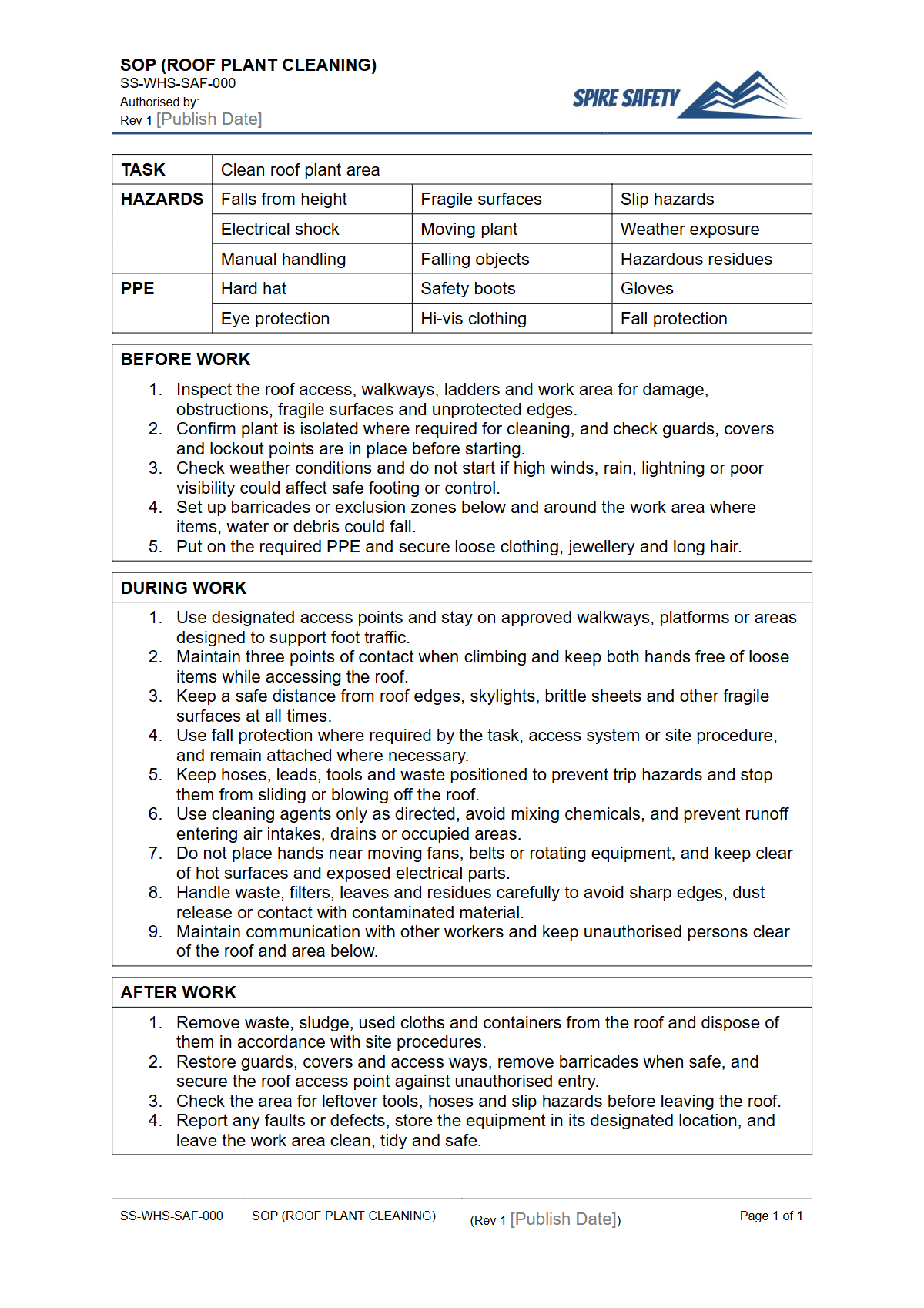
Purpose of this Free Safe Operating Procedure (Roof Plant Cleaning) Template
This Free Safe Operating Procedure (Roof Plant Cleaning) Template provides a structured framework for documenting the safety requirements for cleaning plant and equipment located on rooftops. Roof plant, which often includes HVAC systems, cooling towers, exhaust fans, and communication equipment, presents a unique combination of hazards.
This SOP is designed to help your organisation manage risks associated with working at heights, electrical energy, chemical handling, and the specific machinery being serviced. A documented procedure is a critical tool for ensuring tasks are performed consistently and safely, forming a key component of your overall safety management system.
By outlining the required personal protective equipment (PPE), pre-start checks, step-by-step instructions, and emergency procedures, this template helps you meet your duty of care as a Person Conducting a Business or Undertaking (PCBU). It provides a solid foundation for training workers and verifying their understanding of the required safety controls.
Integrating such procedures is fundamental to building robust WHS management systems that actively prevent incidents.
Video walkthrough
How to use this Free Safe Operating Procedure (Roof Plant Cleaning) Template
To effectively use this Safe Operating Procedure for roof plant cleaning, you must adapt it to the specific context of your workplace. Generic procedures are insufficient; safety relies on addressing the actual equipment, environment, and personnel at your site.
Download the DOCX file and begin by conducting a thorough risk assessment for the specific cleaning task. Involve workers and supervisors in this process to ensure all potential hazards are identified.
Use the findings from your risk assessment to populate and modify the template. Detail the exact types of roof plant, the specific cleaning agents used, the required energy isolation (lockout/tagout) points, and the fall prevention or fall arrest systems in place.
You may need separate SOPs for different types of roof plant if the cleaning processes vary significantly. For instance, cleaning a cooling tower will have different steps and hazards compared to cleaning solar panels.
For related tasks involving mobile plant for access, you may also need our FREE Telehandler SOP Template to manage those specific risks.
Important Customisation Note
This document is a template only. It is not a complete or compliant Safe Operating Procedure until it has been customised to your specific workplace, equipment, and processes.
We recommend a competent person, such as a WHS manager or supervisor, reviews and approves the final document before it is implemented.
When to use a Safe Operating Procedure
A Safe Operating Procedure for roof plant cleaning should be used every time the task is performed, whether for scheduled preventative maintenance or for ad-hoc cleaning. It is an essential document for worker training and induction, ensuring everyone understands the established safe work method before commencing work.
It should also be a key reference document during toolbox talks, especially when discussing high-risk activities like working at heights. A periodic review of its effectiveness can be a valuable part of your safety assurance activities, similar in principle to WHS compliance auditing for your overall system.
On large industrial sites, roof-mounted equipment may be part of a larger production line. In these cases, it's important to have SOPs for all interconnected machinery, such as a FREE Conveyer System SOP, to manage risks across the entire system.
Who should use this document
This SOP should be developed and implemented by those responsible for workplace safety and maintenance operations. This typically includes:
- WHS Managers and Advisors: To ensure the procedure aligns with legislative requirements and the organisation's safety management system.
- Facility and Maintenance Managers: To plan and supervise the work, ensuring resources like correct PPE and equipment are available.
- Supervisors: To directly oversee the work, conduct pre-start checks, and ensure the SOP is being followed correctly by the work team.
- Workers and Contractors: As a direct guide for performing the cleaning task safely. They must be trained on the SOP and have easy access to it at the work location.
Using an SOP ensures a consistent and documented approach to managing high-risk tasks. For complex cleaning jobs, you may also need SOPs for supporting equipment, such as the one detailed in our Free Air Compressor SOP Template used for blowing out dust and debris.
For guidance on developing and implementing a suite of WHS documents, consider engaging professional WHS consulting services.
This template is one of many available to help you build a safer workplace. Explore our complete free WHS resources library for more templates, checklists, and guides.
Common mistakes
Common mistakes to avoid
- Using a generic SOP without customising it for the specific roof, access method, and plant type.
- Failing to conduct a pre-start check for changing conditions, such as weather (wind, rain, heat).
- Neglecting to properly isolate all energy sources (electrical, mechanical, hydraulic) before starting work.
- Providing inadequate training or simply handing the document to workers without confirming their understanding.
Legal references
Legal considerations
The following legal requirements may be relevant to this type of work.
- Work Health and Safety Act (Harmonised) — Provides the primary duties for protecting workers and other people from work health and safety risks.
- Work Health and Safety Regulations (Harmonised) — Sets out requirements supporting the management of workplace hazards and risks.
The following codes may be relevant to this type of work.
- Managing WHS Risks Code of Practice — Provides practical guidance on identifying hazards, assessing risks and applying effective controls.
- Work Health and Safety Consultation, Cooperation and Coordination Code of Practice — Provides practical guidance on consulting workers and coordinating with other duty holders.
- Managing the Work Environment and Facilities Code of Practice — Provides practical guidance on safe work environments, workplace facilities and related controls.
Did you know
Falls from Height
According to Safe Work Australia, falls from height are a leading cause of fatalities in Australian workplaces, making robust fall prevention controls a critical part of any roof-based work.
Energy Isolation
Failing to properly isolate and de-energise plant before maintenance or cleaning is a major cause of serious injuries. A lockout/tagout (LOTO) procedure is a vital control measure.
FAQ
Frequently asked questions
01What is 'plant' on a roof?
02Is a Safe Operating Procedure a legal requirement for roof plant cleaning?
03What are the main hazards of cleaning roof plant?
04How often should a roof plant cleaning SOP be reviewed?
Share this resource
Free Safe Operating Procedure (Roof Plant Cleaning) Template
Browse Categories
How To Use It
- 1Download and open in Word or PDF.
- 2Replace the placeholders with your business details.
- 3Get it reviewed by a WHS specialist before rollout.
Need it customised?
Our WHS consultants can adapt this template to your site, run a gap analysis, or audit what you already have in place.
Book a Free Consultation WHS consulting servicesor call 1300 156 382
Related templates
- Free Safe Operating Procedure (Roof Plant Inspection) Template
- Free Safe Operating Procedure (Roof Seamer) Template
- Free Safe Operating Procedure (Roofing Torch) Template
- Free Safe Operating Procedure (Room Privacy Screen) Template
- Free Safe Operating Procedure (Room Service Trolley) Template
- Free Safe Operating Procedure (Room Turnaround Cleaning) Template