
Free Safe Operating Procedure (Roof Seamer) Template
Download our free Safe Operating Procedure for roof seamers to establish clear safety guidelines. This customisable template helps you manage risks effectively.
Free Safe Operating Procedure (Roof Seamer) Template
DOCX • 126 KB + PDF
Updated Oct 2026
No signup required
Purpose of the Free Safe Operating Procedure (Roof Seamer) Template
Operating a roof seamer, while essential for creating durable, weathertight standing seam metal roofs, introduces significant workplace hazards. This free Safe Operating Procedure (Roof Seamer) Template provides a structured framework for documenting the required steps to operate the equipment safely.
Its primary purpose is to help Persons Conducting a Business or Undertaking (PCBUs) manage risks associated with roof seamer use, including electrical shock, crush and pinch points, ergonomic strains, and slips, trips, and falls when working at height. By establishing a clear, repeatable process, this SOP helps standardise safe work practices, assists in worker training, and demonstrates a commitment to health and safety obligations under Australian WHS legislation.
Video walkthrough
How to use the Free Safe Operating Procedure (Roof Seamer) Template
This document is a template, not a finished procedure. To use it effectively, you must adapt it to the specific context of your workplace and the particular make and model of the roof seamer in use.
Download the DOCX file and begin by reviewing each section. Consult directly with the workers who will be operating the machinery, as their hands-on experience is invaluable for identifying practical risks and effective controls.
Edit the steps, add site-specific details, and insert information from the manufacturer’s operating manual. Integrating this document is a key component of building robust WHS management systems that protect your team and your business.
Customisation is Essential
A generic procedure is insufficient for ensuring safety. You must customise this template to reflect your unique operational environment, risk profile, and legal duties.
We have provided a comprehensive starting point, but the final responsibility for creating a safe and effective document rests with the PCBU. This includes specifying the exact PPE required, detailing emergency shutdown procedures, and outlining maintenance schedules relevant to your equipment.
When to use a Roof Seamer Safe Operating Procedure
A Safe Operating Procedure for a roof seamer should be a core part of your daily operations and safety management. It is not a document to be filed away and forgotten.
Use it as a primary tool for inducting and training new operators, ensuring they understand the risks and control measures before they ever touch the equipment. It should also be readily available at the worksite as a reference for pre-start checks and for refreshing knowledge on correct operational sequences.
Following an incident or a near miss, the SOP should be reviewed and updated to incorporate any lessons learned. You may also find it useful to cross-reference procedures for related equipment, such as our free Air Compressor SOP.
Who should use this Safe Operating Procedure
This SOP is intended for several key roles within an organisation. Primarily, it is for the operators of the roof seamer, providing them with clear, step-by-step instructions for safe use.
Supervisors and team leaders should also use it to oversee work, conduct safety observations, and ensure procedures are being followed correctly. WHS managers and safety officers will use the SOP as part of the broader safety system, for risk assessments, training development, and incident investigations.
Finally, PCBUs and company directors should ensure such procedures are in place and effectively implemented to meet their duty of care. Documenting competency for specific plant is critical, as shown in resources like our free Telehandler SOP template.
Key Elements Included in the Template
Our template guides you through the essential stages of safe operation:
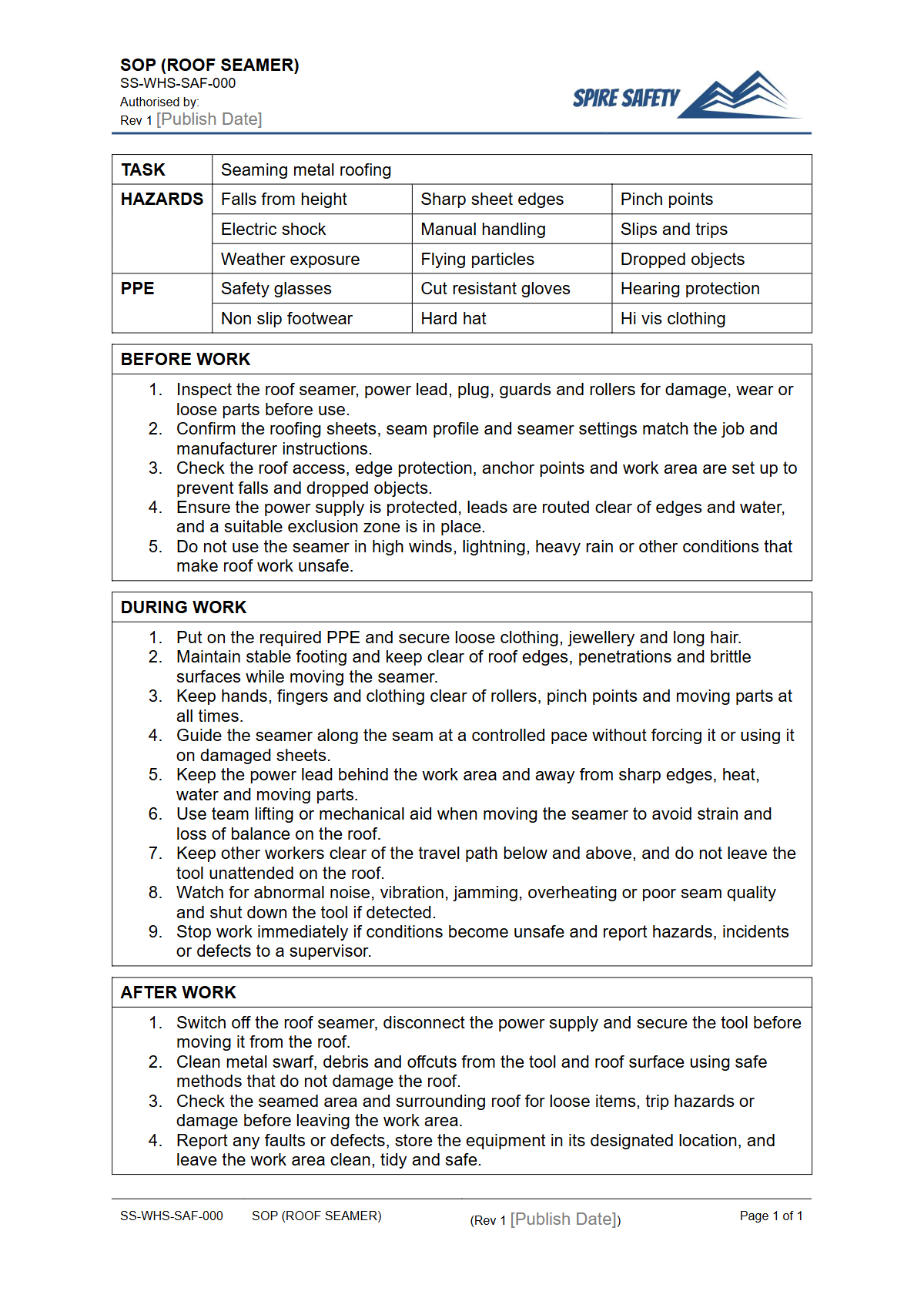
- Pre-Operational Checks: Detailing inspections for the power cord, seamer housing, rollers, and safety guards to ensure the equipment is in safe working order before use.
- Step-by-Step Operating Guide: A sequence for positioning the seamer, engaging it with the panel seam, and guiding it along the roof, including instructions for handling different roof pitches and complexities.
- Post-Operational Tasks: Outlining procedures for safely powering down, cleaning, inspecting, and storing the equipment to ensure it is ready and safe for the next use. Just as with other tools, a proper pack-down procedure is vital, a principle that applies equally to our free Circular Saw SOP.
Regular reviews ensure that safety documentation remains current and effective. A periodic audit can verify that the documented procedures are being followed in practice, forming a crucial feedback loop for continuous improvement in your safety program.
These checks can be part of broader WHS compliance auditing activities.
By implementing and consistently applying a detailed Safe Operating Procedure, your organisation can significantly reduce the risk of injury and incidents. For more templates and safety resources, explore our complete free WHS resources library.
Common mistakes
Common mistakes to avoid
- Forgetting to disconnect the power source before performing maintenance, cleaning, or adjustments.
- Operating the seamer on wet, unstable, or cluttered roof surfaces, increasing the risk of slips and falls.
- Neglecting to inspect the power cord and plugs for damage before each use.
- Not wearing appropriate personal protective equipment (PPE), particularly cut-resistant gloves and non-slip footwear.
Legal references
Legal considerations
The following legal requirements may be relevant to this type of work.
- Work Health and Safety Act (Harmonised) — Provides the primary duties for protecting workers and other people from work health and safety risks.
- Work Health and Safety Regulations (Harmonised) — Sets out requirements supporting the management of workplace hazards and risks.
The following codes may be relevant to this type of work.
- Managing WHS Risks Code of Practice — Provides practical guidance on identifying hazards, assessing risks and applying effective controls.
- Work Health and Safety Consultation, Cooperation and Coordination Code of Practice — Provides practical guidance on consulting workers and coordinating with other duty holders.
- Managing the Work Environment and Facilities Code of Practice — Provides practical guidance on safe work environments, workplace facilities and related controls.
Did you know
Expansion and Contraction
Standing seam metal roofs are specifically designed to allow for thermal movement. The seamed clips hold the panels in place while permitting them to expand and contract with temperature changes, preventing stress and buckling.
Cold Forming
The process of mechanically seaming metal roof panels is a 'cold forming' process. It folds and locks the metal together without heat, creating a strong, watertight joint that is often stronger than the original material.
FAQ
Frequently asked questions
01What are the main hazards associated with using a roof seamer?
02Is a Safe Operating Procedure a legal requirement in Australia?
03How often should an SOP for a roof seamer be reviewed?
04Can this template be used for both electric and battery-powered roof seamers?
Share this resource
Free Safe Operating Procedure (Roof Seamer) Template
Browse Categories
How To Use It
- 1Download and open in Word or PDF.
- 2Replace the placeholders with your business details.
- 3Get it reviewed by a WHS specialist before rollout.
Need it customised?
Our WHS consultants can adapt this template to your site, run a gap analysis, or audit what you already have in place.
Book a Free Consultation WHS consulting servicesor call 1300 156 382
Related templates
- Free Safe Operating Procedure (Roofing Torch) Template
- Free Safe Operating Procedure (Room Privacy Screen) Template
- Free Safe Operating Procedure (Room Service Trolley) Template
- Free Safe Operating Procedure (Room Turnaround Cleaning) Template
- Free Safe Operating Procedure (Root Ball Handling) Template
- Free Safe Operating Procedure (Rope Grab) Template