
Free Safe Operating Procedure (Roofing Torch) Template
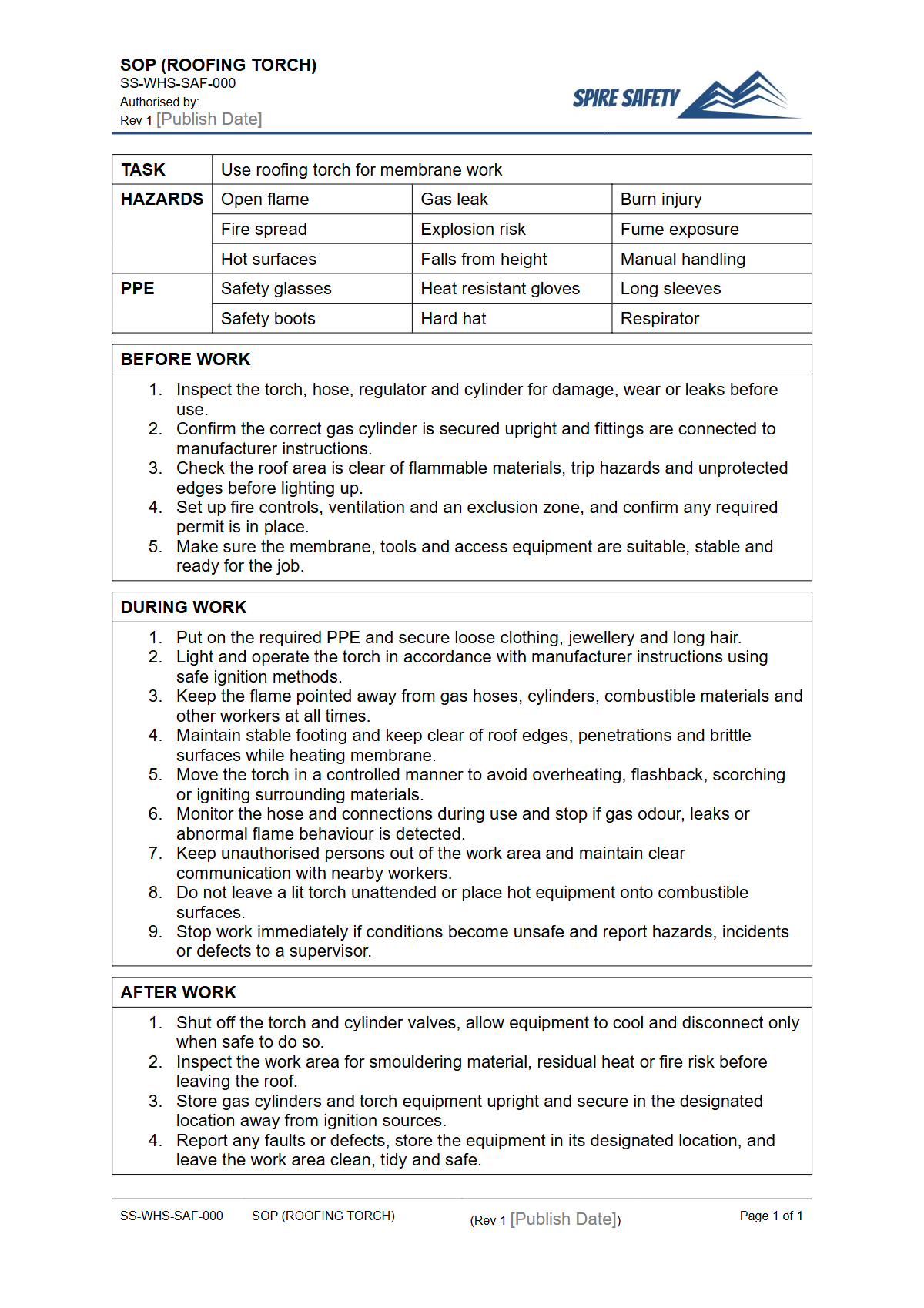
Formalise safety steps for torch-on membrane application with our free Safe Operating Procedure (Roofing Torch) Template. Download the DOCX or PDF to start.
Free Safe Operating Procedure (Roofing Torch) Template
DOCX • 126 KB + PDF
Updated Oct 2026
No signup required
Purpose of the Free Safe Operating Procedure (Roofing Torch) Template
Using a roofing torch for torch-on membrane application is a high-risk activity that requires a documented, safe system of work. This free Safe Operating Procedure (Roofing Torch) Template provides a structured starting point for your organisation to formalise the steps involved in operating this equipment safely.
It helps you control significant hazards like fire, explosions, burns, and exposure to fumes. A documented SOP is a fundamental component of a robust safety framework, demonstrating your commitment to protecting workers and meeting your duties under WHS legislation.
By clearly outlining pre-operational checks, safe operating steps, and shutdown procedures, this template helps standardise behaviour and reduce the chance of incidents. An effective SOP serves as a key training tool and a reference point for workers, ensuring that safety protocols are consistently understood and followed.
Integrating this procedure into your daily operations is a key part of building effective WHS management systems that proactively manage risk.
Video walkthrough
How to use the Free Safe Operating Procedure (Roofing Torch) Template
This template is provided in both an easily editable DOCX format and a ready-to-print PDF. To make it effective, you must adapt it to your specific operational context.
This involves a site-based review to ensure all information is accurate and relevant to your equipment, materials, and environment. A generic procedure is not sufficient; customisation is essential for managing your unique risks.
Key customisation steps include:
- Adding your company name, logo, and relevant site details.
- Specifying the exact make and model of the roofing torch and associated equipment.
- Detailing the type of LPG cylinders and membrane products being used.
- Incorporating site-specific risk controls, such as requirements for hot work permits and designated fire watch personnel.
- Listing the precise Personal Protective Equipment (PPE) required for the task.
- Updating emergency procedures with your specific contacts, assembly points, and first aid information.
It's crucial to remember that this is a template. We haven't visited your site, so you must customise this document to reflect your specific equipment, processes, and risk controls. Just as you document processes for gas torches, it's vital to have procedures for other high-risk tools on site, as detailed in our FREE Circular Saw SOP (Safe Operating Procedure) Template.
When to use it
A Safe Operating Procedure for a roofing torch should be a living document integrated into your daily work cycle. It is not a document to be filed away and forgotten.
Use it during worker inductions to ensure new team members understand the safety requirements from day one. It should also be a central part of task-specific training and competency assessments for any operator authorised to use a roofing torch.
The SOP can be used as a pre-start checklist to guide workers through required inspections. Furthermore, it serves as an excellent resource for toolbox talks, allowing supervisors to refresh the team on critical risks like fire prevention, manual handling of gas cylinders, or emergency responses.
In the event of an incident or near-miss, the SOP provides a baseline against which to review work practices. Regular reviews are also essential during safety reviews or WHS compliance auditing to ensure the procedure remains current and effective.
Who should use it
Various personnel within an organisation have a role in using and maintaining the SOP for roofing torch operations:
Workers and Operators
The primary users of the SOP. They must be trained on its contents and follow the prescribed steps every time they perform the task to ensure their safety and the safety of others.
Supervisors and Site Managers
Responsible for implementing the SOP on site. This includes providing training, ensuring operators are competent, monitoring compliance, and leading pre-start discussions based on the procedure.
Safety Officers and Managers
Use the SOP as part of the broader safety management system. They assist in developing and reviewing the procedure, integrating it with risk assessments and using it as a benchmark during workplace inspections and audits.
PCBUs (Persons Conducting a Business or Undertaking)
Business owners and directors are ultimately responsible for providing a safe work environment. A well-implemented SOP is evidence that the PCBU has established a formal, safe system of work for a high-risk activity.
On a busy construction site, various plant and equipment are often used concurrently. While focusing on torching, don't neglect other machinery.
Consider formalising procedures for equipment like compressors, as shown in our Free Air Compressor SOP (Safe Operating Procedure) Template, to maintain a comprehensive approach to site safety.
Common mistakes
Common mistakes to avoid
- Forgetting to conduct a thorough fire watch after work is completed.
- Using damaged or worn hoses, regulators, or torch parts, leading to gas leaks.
- Applying the torch directly over or near combustible materials without adequate shielding.
- Failing to have a suitable, fully charged fire extinguisher within immediate reach.
- Leaving the gas cylinder valve open when the torch is not in use.
Legal references
Legal considerations
The following legal requirements may be relevant to this type of work.
- Work Health and Safety Act (Harmonised) — Provides the primary duties for protecting workers and other people from work health and safety risks.
- Work Health and Safety Regulations (Harmonised) — Sets out requirements supporting the management of workplace hazards and risks.
The following codes may be relevant to this type of work.
- Managing WHS Risks Code of Practice — Provides practical guidance on identifying hazards, assessing risks and applying effective controls.
- Work Health and Safety Consultation, Cooperation and Coordination Code of Practice — Provides practical guidance on consulting workers and coordinating with other duty holders.
- Managing the Work Environment and Facilities Code of Practice — Provides practical guidance on safe work environments, workplace facilities and related controls.
Did you know
The Danger Lingers
Many fires related to torch-on roofing occur hours after the work has finished, caused by smouldering in hidden spaces. This is why a dedicated 'fire watch' period of at least 60 minutes post-operation is a critical safety step.
Heavier Than Air
The LPG (Liquefied Petroleum Gas) used in roofing torches is heavier than air. In the event of a leak, the gas can accumulate in low-lying areas like drains or pits, creating a significant and often invisible fire or explosion hazard.
FAQ
Frequently asked questions
01What PPE is required for using a roofing torch?
02Do I need a hot work permit to use a roofing torch?
03How often should I inspect a roofing torch and its gas cylinder?
04Can this template be used as my risk assessment?
Share this resource
Free Safe Operating Procedure (Roofing Torch) Template
Browse Categories
How To Use It
- 1Download and open in Word or PDF.
- 2Replace the placeholders with your business details.
- 3Get it reviewed by a WHS specialist before rollout.
Need it customised?
Our WHS consultants can adapt this template to your site, run a gap analysis, or audit what you already have in place.
Book a Free Consultation WHS consulting servicesor call 1300 156 382
Related templates
- Free Safe Operating Procedure (Room Privacy Screen) Template
- Free Safe Operating Procedure (Room Service Trolley) Template
- Free Safe Operating Procedure (Room Turnaround Cleaning) Template
- Free Safe Operating Procedure (Root Ball Handling) Template
- Free Safe Operating Procedure (Rope Grab) Template
- Free Safe Operating Procedure (Rose Pruning) Template