
Free Safe Operating Procedure (Roof Drain Clearing) Template
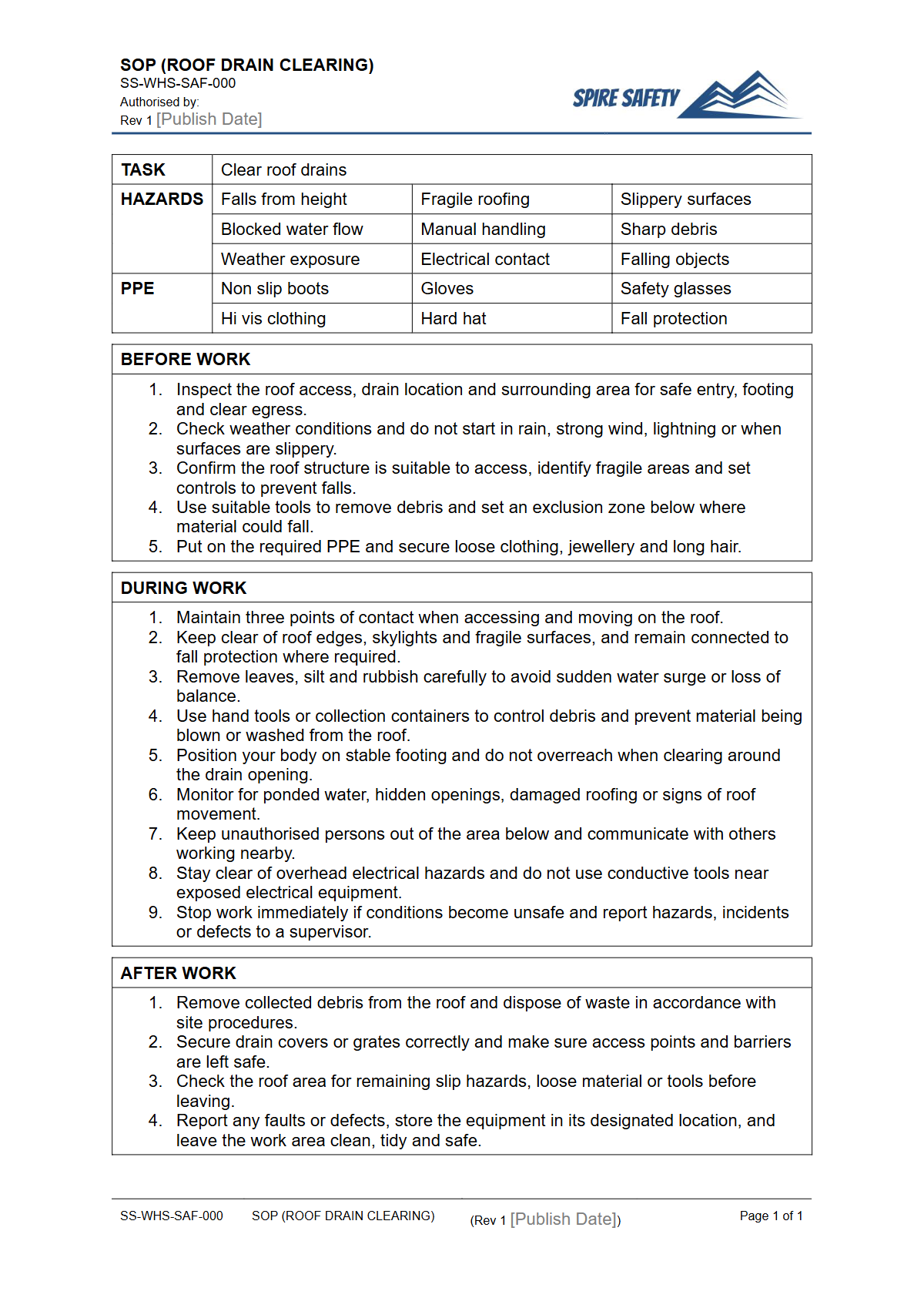
Manage the risks of clearing roof drainage systems with our structured Safe Operating Procedure template. Download your free DOCX and PDF to get started.
Free Safe Operating Procedure (Roof Drain Clearing) Template
DOCX • 126 KB + PDF
Updated Oct 2026
No signup required
Purpose of the Free Safe Operating Procedure (Roof Drain Clearing) Template
Clearing blocked roof drains and gutters is a critical maintenance task, but it carries significant work health and safety risks. Our Free Safe Operating Procedure (Roof Drain Clearing) Template provides a structured framework for documenting a safe system of work for this activity.
It helps you identify hazards and implement control measures to protect your workers. Using a documented procedure is a fundamental step in meeting your legal obligations as a Person Conducting a Business or Undertaking (PCBU) to ensure a safe working environment.
This Safe Operating Procedure (SOP) prompts you to consider major hazards associated with clearing roof drains, including falls from height, electrical risks from nearby power lines or equipment, manual handling injuries from lifting heavy debris, and exposure to biological hazards like mould, bacteria, and pests in stagnant water. Formalising your process helps ensure tasks are performed consistently and safely every time, forming a key part of your overall safety management system.
Video walkthrough
How to use the Free Safe Operating Procedure (Roof Drain Clearing) Template
This free Safe Operating Procedure for roof drain clearing is designed as a comprehensive starting point. It is available in both DOCX and PDF formats for your convenience.
The DOCX file is fully editable, allowing you to tailor the content to the unique circumstances of your workplace, including your specific buildings, access methods, tools, and emergency plans. Effective safety documentation requires a site-specific approach.
To use this template effectively:
- Conduct a Risk Assessment: Before customising the template, perform a thorough risk assessment for the roof drain clearing tasks at your specific location. This should identify all credible hazards.
- Customise the Content: Edit the document to include your company name, logo, and site-specific details. Fill in the required Personal Protective Equipment (PPE), detail the step-by-step process your workers must follow, and outline your emergency and rescue procedures. If heavy machinery like an elevated work platform or telehandler is used for access, you must ensure separate procedures are in place, such as a specific telehandler SOP template.
- Consult with Your Team: Involve the workers who will be performing the task. Their practical experience is invaluable for creating a procedure that is both safe and workable. Consultation is also a requirement under WHS legislation.
- Train and Implement: Once finalised and approved, ensure all relevant workers and supervisors are trained on the SOP. Make the document readily accessible at the point of work. Regular checks, such as those performed during WHS compliance audits, can verify that the documented procedures are being followed correctly.
Important Note: This document is a template only. It is not a substitute for a comprehensive risk assessment.
As a PCBU, you are responsible for ensuring health and safety in your workplace. We are not liable for any incidents that may occur from the use of this document.
It is your responsibility to customise it to your specific needs.
When to use it
A Safe Operating Procedure for roof drain clearing should be used as a primary reference document for several key activities. It is essential for training new employees or contractors who are assigned this task, ensuring they understand the approved safe method from the outset.
It should also be a central part of your pre-start toolbox talks before any roof drainage maintenance begins, serving as a checklist to confirm all safety controls are in place.
Furthermore, this SOP is a vital tool for supervisors to monitor work and for incident investigation should a near miss or accident occur. Regularly scheduled reviews of your SOP, triggered by changes in equipment, environment, or regulations, will ensure it remains a relevant and effective part of developing a robust WHS management system.
Who should use it
This template is intended for use by anyone responsible for managing workplace safety and maintenance operations. This includes WHS Managers, Health and Safety Representatives (HSRs), Facilities Managers, Maintenance Supervisors, and Team Leaders.
These individuals will typically lead the customisation, review, and implementation of the procedure.
The final, approved SOP is for the workers who perform the task, such as maintenance staff, plumbers, roofers, and specialist contractors. It provides them with clear, unambiguous instructions on how to complete their work safely and consistently.
Using tools safely is a core component, and for other tasks, you may need additional documents like an air compressor SOP template if pneumatic tools are involved. You can find more examples in our free WHS resources library to build out your procedural documentation.
Common mistakes
Common mistakes to avoid
- Using the template without customising it for site-specific conditions and equipment.
- Failing to consult with the workers who perform the task when drafting the procedure.
- Neglecting to provide adequate training on the finalised SOP and associated emergency plans.
- Skipping a pre-work risk assessment (e.g., a Take 5), assuming the SOP covers all possible scenarios like weather changes.
Legal references
Legal considerations
The following legal requirements may be relevant to this type of work.
- Work Health and Safety Act (Harmonised) — Provides the primary duties for protecting workers and other people from work health and safety risks.
- Work Health and Safety Regulations (Harmonised) — Sets out requirements supporting the management of workplace hazards and risks.
The following codes may be relevant to this type of work.
- Managing WHS Risks Code of Practice — Provides practical guidance on identifying hazards, assessing risks and applying effective controls.
- Work Health and Safety Consultation, Cooperation and Coordination Code of Practice — Provides practical guidance on consulting workers and coordinating with other duty holders.
- Managing the Work Environment and Facilities Code of Practice — Provides practical guidance on safe work environments, workplace facilities and related controls.
Did you know
Heightened Risk
According to Safe Work Australia, falls from height remain a leading cause of fatalities and serious injuries in Australian workplaces. Many of these incidents occur from heights of less than four metres, a common working height for single-storey roof maintenance.
The Weight of Water
A single blocked downpipe or gutter can hold a significant weight of water and debris. This not only increases the risk of structural failure but also presents a serious manual handling hazard when workers try to clear it.
FAQ
Frequently asked questions
01What are the main hazards involved in clearing roof drains?
02Is a Safe Operating Procedure a legal requirement for roof drain clearing?
03How often should we review our Roof Drain Clearing SOP?
04Can I use this SOP for clearing ground-level drains and pits?
Share this resource
Free Safe Operating Procedure (Roof Drain Clearing) Template
Browse Categories
How To Use It
- 1Download and open in Word or PDF.
- 2Replace the placeholders with your business details.
- 3Get it reviewed by a WHS specialist before rollout.
Need it customised?
Our WHS consultants can adapt this template to your site, run a gap analysis, or audit what you already have in place.
Book a Free Consultation WHS consulting servicesor call 1300 156 382
Related templates
- Free Safe Operating Procedure (Roof Gutter Inspection) Template
- Free Safe Operating Procedure (Roof Ladder) Template
- Free Safe Operating Procedure (Roof Plant Cleaning) Template
- Free Safe Operating Procedure (Roof Plant Inspection) Template
- Free Safe Operating Procedure (Roof Seamer) Template
- Free Safe Operating Procedure (Roofing Torch) Template