
Free Safe Operating Procedure (Roof Cleaning) Template
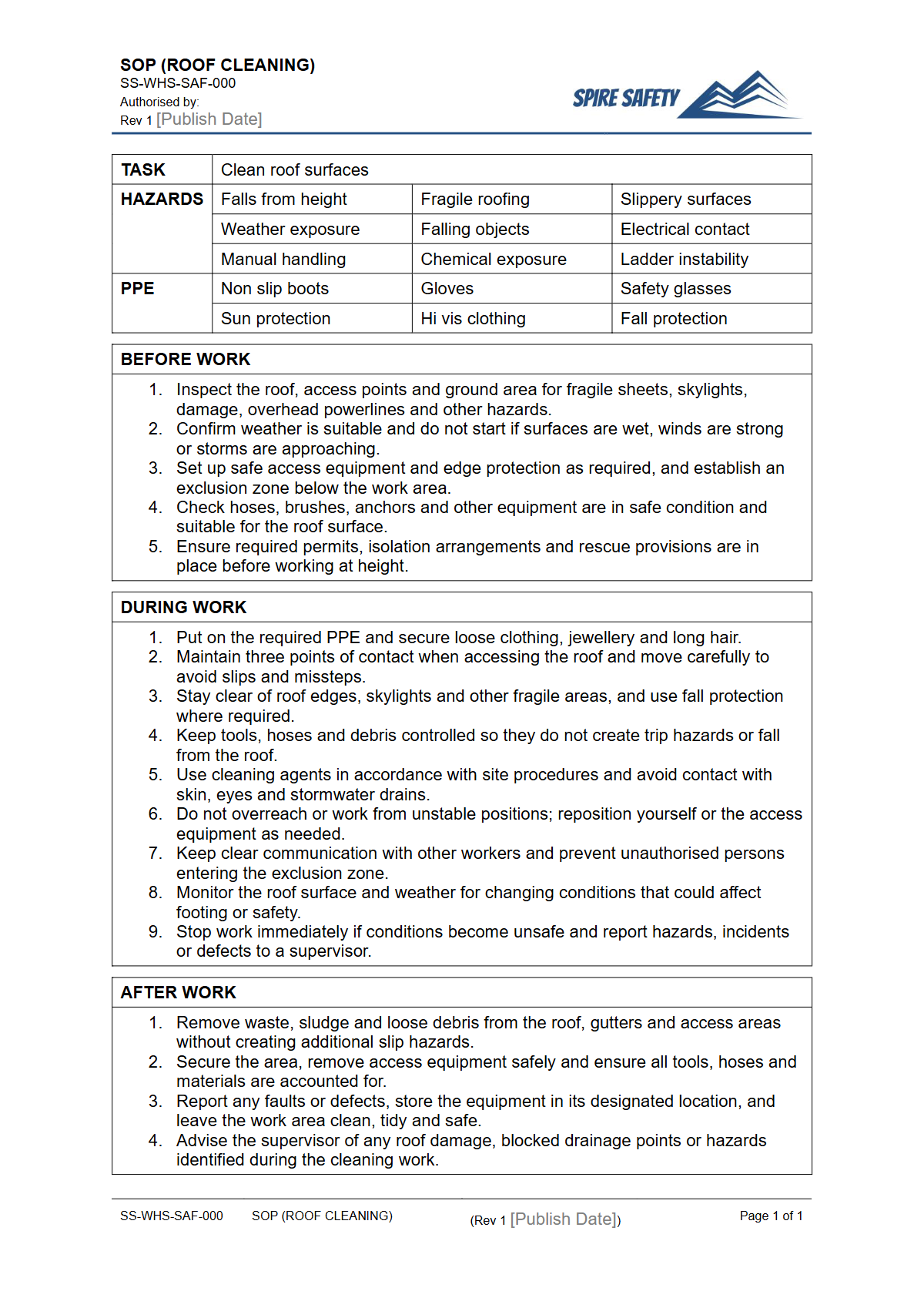
Download our free Safe Operating Procedure for roof cleaning to standardise your high-risk work. This template helps you document safety steps and controls.
Free Safe Operating Procedure (Roof Cleaning) Template
DOCX • 126 KB + PDF
Updated Oct 2026
No signup required
Purpose of the Free Safe Operating Procedure (Roof Cleaning) Template
Standardise your roof cleaning tasks and manage associated risks with our free Safe Operating Procedure (Roof Cleaning) Template. Roof cleaning is a high-risk activity involving potential exposure to serious hazards, including falls from height, chemical exposure from cleaning agents, electrical risks from overhead power lines or equipment, and musculoskeletal injuries.
This SOP provides a structured starting point for documenting a safe process, helping your organisation meet its duty of care under Australian WHS laws.
A documented SOP is a fundamental component of a robust safety framework. It ensures tasks are performed consistently and safely by all workers, provides a basis for training and competency assessment, and demonstrates a commitment to proactive risk management.
Integrating clear procedures into your overall WHS management systems establishes a foundation for a strong safety culture.
Video walkthrough
How to use the Free Safe Operating Procedure (Roof Cleaning) Template
This template is provided in both DOCX and PDF formats for your convenience. The DOCX file is fully editable, allowing you to tailor the content to your specific operational needs. To use it effectively, follow these steps:
- Download the DOCX template.
- Review each section and identify areas that require site-specific information.
- Update the procedure with details of the exact equipment used (e.g., pressure washers, water-fed poles), specific cleaning chemicals (and their Safety Data Sheets), and the types of roofs you service (e.g., tiled, metal).
- Incorporate your business's specific control measures for identified hazards, such as the type of fall protection systems required (e.g., harnesses, guardrails, anchor points).
- Add your company branding and document control information.
Important: This is a template, not a finished document. Before use, you MUST customise this template to reflect the specific equipment, site conditions, and control measures relevant to your workplace.
We strongly recommend having a competent person review the final document before implementation. If you need assistance, our WHS consulting team can provide expert guidance.
When to use it
A Safe Operating Procedure for roof cleaning should be used as a core part of your work planning and execution process. It is not a document to be filed away and forgotten.
It should be actively used during worker inductions, pre-start meetings, and for refresher training. The SOP serves as a critical reference tool for supervisors and workers before and during the job, ensuring safety protocols are fresh in their minds.
Furthermore, the content of this SOP should be used to inform the development of a Safe Work Method Statement (SWMS) for roof cleaning, as it is classified as high-risk construction work. Regular reviews of your documented procedures as part of your internal audit schedule are also essential.
A WHS compliance auditing program can help verify that your documented procedures are being effectively implemented in practice.
Who should use it
This SOP is intended for use by multiple roles within an organisation:
- Persons Conducting a Business or Undertaking (PCBUs): To fulfil their primary duty of care by providing and maintaining a safe system of work.
- Managers and Supervisors: To train workers, induct them onto a site, supervise the work, and ensure the documented procedure is followed correctly.
- Workers: As a guide to performing their tasks safely and as a reference for pre-start checks and hazard controls.
- WHS Professionals: As a foundational document within the safety management system to aid in risk assessments, incident investigations, and compliance monitoring.
While this SOP covers the roof cleaning process, your site may use specific plant for access. We also provide a FREE Telehandler SOP Template to manage those separate risks.
You can browse our complete free WHS resources library for other useful templates.
Common mistakes
Common mistakes to avoid
- Failing to customise the template for the specific roof type, access method, and site conditions.
- Ignoring dynamic risk factors like changing weather (wind, rain, heat) during the job.
- Using incorrect, damaged, or poorly maintained fall prevention equipment.
- Inadequate worker training on chemical handling, pressure washer use, or emergency rescue procedures.
Legal references
Legal considerations
The following legal requirements may be relevant to this type of work.
- Work Health and Safety Act (Harmonised) — Provides the primary duties for protecting workers and other people from work health and safety risks.
- Work Health and Safety Regulations (Harmonised) — Sets out requirements supporting the management of workplace hazards and risks.
The following codes may be relevant to this type of work.
- Managing WHS Risks Code of Practice — Provides practical guidance on identifying hazards, assessing risks and applying effective controls.
- Work Health and Safety Consultation, Cooperation and Coordination Code of Practice — Provides practical guidance on consulting workers and coordinating with other duty holders.
- Managing the Work Environment and Facilities Code of Practice — Provides practical guidance on safe work environments, workplace facilities and related controls.
Did you know
Fall Statistics
According to Safe Work Australia, falls from a height are a leading cause of fatalities and serious injuries in Australian workplaces, particularly within the construction industry.
FAQ
Frequently asked questions
01What is the difference between an SOP and a SWMS for roof cleaning?
02Is this roof cleaning SOP suitable for high-pressure water jetting?
03Does this template cover the use of chemicals for moss and mould removal?
04How often should a Safe Operating Procedure be reviewed?
Share this resource
Free Safe Operating Procedure (Roof Cleaning) Template
Browse Categories
How To Use It
- 1Download and open in Word or PDF.
- 2Replace the placeholders with your business details.
- 3Get it reviewed by a WHS specialist before rollout.
Need it customised?
Our WHS consultants can adapt this template to your site, run a gap analysis, or audit what you already have in place.
Book a Free Consultation WHS consulting servicesor call 1300 156 382
Related templates
- Free Safe Operating Procedure (Roof Cutter) Template
- Free Safe Operating Procedure (Roof Drain Clearing) Template
- Free Safe Operating Procedure (Roof Gutter Inspection) Template
- Free Safe Operating Procedure (Roof Ladder) Template
- Free Safe Operating Procedure (Roof Plant Cleaning) Template
- Free Safe Operating Procedure (Roof Plant Inspection) Template