
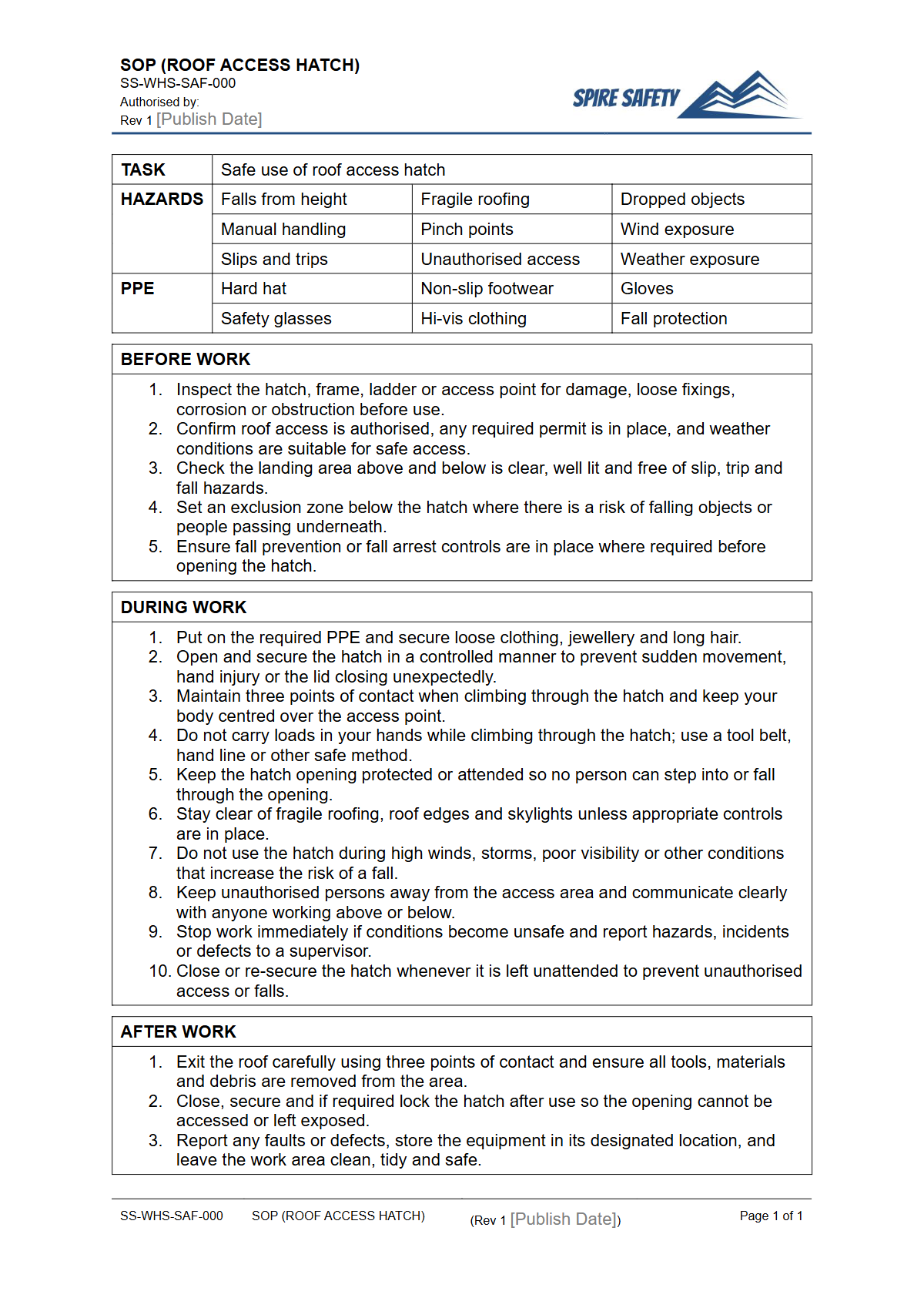
Free Safe Operating Procedure (Roof Access Hatch) Template
Manage roof access risks with our comprehensive Safe Operating Procedure template. Download the free DOCX or PDF to start standardising your procedures.
Free Safe Operating Procedure (Roof Access Hatch) Template
DOCX • 126 KB + PDF
Updated Oct 2026
No signup required
Purpose of the Free Safe Operating Procedure (Roof Access Hatch) Template
This Free Safe Operating Procedure (Roof Access Hatch) Template provides a structured framework for documenting the required steps to safely access and work from a roof via an access hatch. Using a standardised procedure helps organisations meet their duty of care under Australian WHS laws by managing the significant risks associated with working at height, such as falls, dropped objects, and exposure to weather.
The primary purpose is to eliminate or minimise these risks by providing clear, step-by-step instructions for workers to follow.
Implementing a formal SOP ensures that all personnel, including employees and contractors, are aware of the hazards and the mandatory control measures. It serves as a critical training tool and a reference point for supervisors and workers, promoting a consistent and safe approach to a high-risk task.
This document is a key component of a robust safety framework, demonstrating a proactive commitment to workplace health and safety. Properly developed SOPs are essential for building a documented WHS management system that protects workers and the business.
Video walkthrough
How to use the Free Safe Operating Procedure (Roof Access Hatch) Template
Our template is available as a DOCX file for easy customisation in Microsoft Word or other word processors, and as a PDF for quick reference. The DOCX version is designed to be adapted to your specific operational needs.
You should add your company branding, specific site details, and information about the types of roof access hatches and associated equipment used at your workplace.
It is crucial to remember that this document is a template. We have developed it to serve as a starting point, but you must customise it to reflect the specific hazards, equipment, and control measures relevant to your workplace.
This includes conducting a site-specific risk assessment for roof access and incorporating the findings into the SOP. If you are unsure how to tailor the document effectively, consider seeking guidance from a WHS consulting professional.
Integrating SOPs into Your Safety Framework
A Safe Operating Procedure is most effective when it is part of a broader, systematic approach to safety. Once customised, this SOP should be integrated into your company's safety management system.
This involves communicating the procedure to all relevant workers, providing practical training, and ensuring supervisors enforce its use. For organisations seeking to formalise their safety processes to an international standard, our ISO 45001 consulting services can help embed documents like this into a certified OHS management system.
When to use it
This Safe Operating Procedure should be reviewed and used before any task that requires personnel to access a roof area via a hatch. It is not just for major projects but for all access, including:
- Routine maintenance of rooftop equipment, such as HVAC units, solar panels, or communication antennae.
- Scheduled inspections of the roof surface, gutters, and flashing.
- Installation or removal of equipment located on the roof.
- Emergency access for repairs following storm damage or other incidents.
The SOP should also be a key document during safety reviews, incident investigations, and as part of a scheduled WHS compliance audit. It establishes the benchmark for safe behaviour against which actual work practices can be measured.
Who should use it
This Safe Operating Procedure is intended for a range of personnel within an organisation. Key users include:
- Persons Conducting a Business or Undertaking (PCBUs): To ensure they are providing and maintaining a safe system of work.
- Managers and Supervisors: To train workers, supervise the task, and ensure the procedure is followed correctly.
- Workers: Any employee or contractor required to access the roof must be trained in and follow the SOP.
- WHS/OHS Representatives and Committees: To use as a tool for consultation and to verify that adequate control measures are in place.
Explore our library of free WHS resources for more templates and guides to support your safety management efforts.
Common mistakes
Common mistakes to avoid
- Failing to customise the template for site-specific conditions, such as different hatch types or roof surfaces.
- Not training workers on the procedure or verifying their understanding before they undertake the task.
- Neglecting to include specific, actionable emergency and rescue procedures for a fall incident.
- Treating the SOP as a 'set and forget' document instead of reviewing and updating it regularly.
Legal references
Legal considerations
The following legal requirements may be relevant to this type of work.
- Work Health and Safety Act (Harmonised) — Provides the primary duties for protecting workers and other people from work health and safety risks.
- Work Health and Safety Regulations (Harmonised) — Sets out requirements supporting the management of workplace hazards and risks.
The following codes may be relevant to this type of work.
- Managing WHS Risks Code of Practice — Provides practical guidance on identifying hazards, assessing risks and applying effective controls.
- Work Health and Safety Consultation, Cooperation and Coordination Code of Practice — Provides practical guidance on consulting workers and coordinating with other duty holders.
- Managing the Work Environment and Facilities Code of Practice — Provides practical guidance on safe work environments, workplace facilities and related controls.
Did you know
Falls From Height
Falls from a height are a leading cause of death and serious injury in Australian workplaces. Most fatal falls involve distances of four metres or less, a height easily reached via a single-storey roof access hatch.
The Hierarchy of Control
An SOP is an administrative control. It should be used in combination with higher-level controls like fixed guardrails (engineering) and travel restraint systems (engineering) to provide robust protection against fall risks.
FAQ
Frequently asked questions
01What should be included in a Roof Access Hatch SOP?
02Is a Safe Operating Procedure a legal requirement for roof access in Australia?
03Who is considered a 'competent person' to sign off on this SOP?
04How often should a Roof Access Hatch SOP be reviewed?
Share this resource
Free Safe Operating Procedure (Roof Access Hatch) Template
Browse Categories
How To Use It
- 1Download and open in Word or PDF.
- 2Replace the placeholders with your business details.
- 3Get it reviewed by a WHS specialist before rollout.
Need it customised?
Our WHS consultants can adapt this template to your site, run a gap analysis, or audit what you already have in place.
Book a Free Consultation WHS consulting servicesor call 1300 156 382
Related templates
- Free Safe Operating Procedure (Roof Anchor Use) Template
- Free Safe Operating Procedure (Roof Cleaning) Template
- Free Safe Operating Procedure (Roof Cutter) Template
- Free Safe Operating Procedure (Roof Drain Clearing) Template
- Free Safe Operating Procedure (Roof Gutter Inspection) Template
- Free Safe Operating Procedure (Roof Ladder) Template