
Free Safe Operating Procedure (Roller Painting) Template
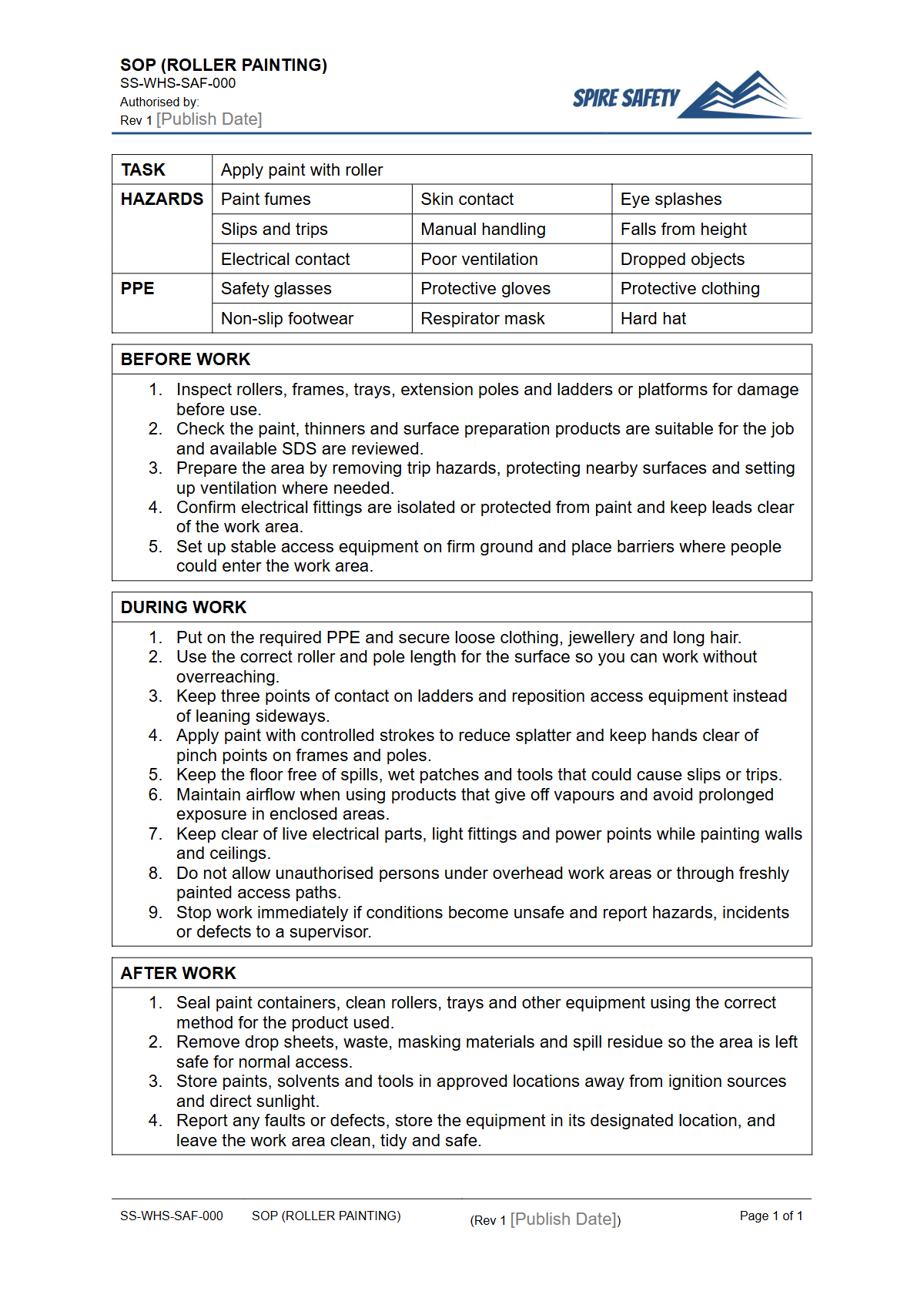
Download our free Safe Operating Procedure (Roller Painting) Template to formalise safety steps for your painting tasks. Get your DOCX and PDF now.
Free Safe Operating Procedure (Roller Painting) Template
DOCX • 126 KB + PDF
Updated Oct 2026
No signup required
Purpose of the Free Safe Operating Procedure (Roller Painting) Template
This free Safe Operating Procedure (Roller Painting) Template provides a structured starting point for documenting the safety requirements for painting tasks using rollers. Its purpose is to help Persons Conducting a Business or Undertaking (PCBUs) manage health and safety risks by outlining a clear, step-by-step process for workers to follow.
Using a formalised SOP helps standardise work methods, ensuring tasks are performed consistently and safely every time.
Implementing a specific SOP for roller painting helps control common hazards such as manual handling injuries from lifting paint drums, exposure to hazardous chemicals and volatile organic compounds (VOCs), and slips, trips, and falls from spills or poorly managed equipment. By defining controls like required Personal Protective Equipment (PPE), ventilation requirements, and correct ergonomic techniques, the SOP becomes a critical tool in your risk management framework.
Just as you would use a specific procedure for power tools, like that detailed in our FREE Circular Saw SOP Template, painting requires its own dedicated set of safety instructions.
Video walkthrough
How to use the Free Safe Operating Procedure (Roller Painting) Template
To use this Safe Operating Procedure (Roller Painting) Template, download the DOCX file and adapt it to your specific operational needs. While the template is aligned with Australian WHS principles, it is a generic document that must be customised to be effective and relevant.
Follow these steps to implement it:
- Customise: Add your company name, logo, relevant dates, and the specific location where the work will be performed.
- Detail Tasks: Modify the step-by-step procedures to reflect the exact paints, thinners, equipment, and surfaces involved in your work. Include brand names of chemicals if necessary to cross-reference with Safety Data Sheets (SDS).
- Assess Risks: Review the listed hazards and controls, adding any unique risks present in your workplace, such as working at heights, in confined spaces, or in extreme temperatures.
- Consult: Discuss the draft procedure with workers and supervisors who perform the task. Their feedback is invaluable for creating a practical and effective document.
Finalising this SOP is a key step in developing robust WHS management systems that actively protect your team. Remember, we provide this template as a starting point, and you must ensure the final document accurately reflects your specific workplace risks and control measures.
When to use a Safe Operating Procedure
A Safe Operating Procedure for roller painting should be used as a primary reference document in several situations. It is an essential tool for worker induction and training, providing new team members with a clear guide to performing the task safely.
It should also be used for pre-start meetings or toolbox talks to refresh workers' knowledge of the hazards and controls before work begins.
The SOP also serves as a benchmark for workplace inspections and observations. Supervisors can use it to verify that work is being carried out according to the agreed-upon safe method.
In the unfortunate event of an incident or near-miss, the SOP is a critical reference for the investigation process, helping to identify any deviations from the established procedure.
Who should use this Safe Operating Procedure
This document is intended for several key roles within an organisation:
- Workers: The primary users are the individuals performing the roller painting. They must understand and follow the procedure to ensure their own safety and the safety of others.
- Supervisors and Team Leaders: Managers must use the SOP to train workers, oversee work, and enforce the specified safety controls. Their role often extends to periodic reviews and ensuring the procedure remains relevant, which can be supported by formal WHS compliance auditing to verify its effectiveness.
- WHS Managers and Advisors: Safety professionals use the SOP as part of the overall safety management system. They are typically responsible for assisting with its development, managing the review process, and ensuring it aligns with legislative requirements and company policy.
Key Hazards in Roller Painting
The SOP helps control numerous hazards inherent in painting tasks. Key risks include:
- Hazardous Chemicals: Paints, primers, and solvents can release VOCs and other chemicals that cause respiratory irritation, dizziness, or long-term health effects. Controls include ensuring adequate ventilation, using low-VOC products where possible, and wearing appropriate respiratory protective equipment (RPE).
- Manual Tasks: Lifting heavy paint tins, prolonged standing, and repetitive rolling motions can lead to musculoskeletal injuries. Controls involve using mechanical aids, team lifting, taking regular breaks, and using extension poles to avoid over-reaching. The principles of safe operation apply across many types of equipment, similar to what is outlined in a Free Air Compressor SOP.
- Slips, Trips & Falls: Paint spills create slippery surfaces, while drop sheets, buckets, and extension cords can introduce trip hazards. Good housekeeping, immediate clean-up of spills, and organised work areas are essential controls.
This template is just one of many tools available to help strengthen your safety processes. You can explore our complete free WHS resources library for more templates and guides to support your organisation's safety goals.
Common mistakes
Common mistakes to avoid
- Using the template without customising it for site-specific paints, equipment, and environmental conditions.
- Failing to include detailed procedures for waste disposal and cleaning up spills.
- Not consulting with the workers who actually perform the painting tasks when drafting or reviewing the SOP.
- Treating the SOP as a 'set and forget' document instead of reviewing it after process changes or incidents.
Legal references
Legal considerations
The following legal requirements may be relevant to this type of work.
- Work Health and Safety Act (Harmonised) — Provides the primary duties for protecting workers and other people from work health and safety risks.
- Work Health and Safety Regulations (Harmonised) — Sets out requirements supporting the management of workplace hazards and risks.
The following codes may be relevant to this type of work.
- Managing WHS Risks Code of Practice — Provides practical guidance on identifying hazards, assessing risks and applying effective controls.
- Work Health and Safety Consultation, Cooperation and Coordination Code of Practice — Provides practical guidance on consulting workers and coordinating with other duty holders.
- Managing the Work Environment and Facilities Code of Practice — Provides practical guidance on safe work environments, workplace facilities and related controls.
Did you know
VOCs in Paint
Many common indoor paints can release Volatile Organic Compounds (VOCs) for days, weeks, or even months after application, impacting indoor air quality. Using low-VOC or zero-VOC paints significantly reduces this risk.
Painter's Shoulder
Musculoskeletal disorders, particularly affecting the shoulder, back, and neck, are among the most common injuries for painters due to repetitive overhead movements and sustained awkward postures.
FAQ
Frequently asked questions
01What should be included in a roller painting SOP?
02Is a Safe Operating Procedure a legal requirement in Australia?
03How often should we review our painting SOP?
04Can this template be used for spray painting as well?
Share this resource
Free Safe Operating Procedure (Roller Painting) Template
Browse Categories
How To Use It
- 1Download and open in Word or PDF.
- 2Replace the placeholders with your business details.
- 3Get it reviewed by a WHS specialist before rollout.
Need it customised?
Our WHS consultants can adapt this template to your site, run a gap analysis, or audit what you already have in place.
Book a Free Consultation WHS consulting servicesor call 1300 156 382
Related templates
- Free Safe Operating Procedure (Roller Shutter Reset) Template
- Free Safe Operating Procedure (Rolling Mill) Template
- Free Safe Operating Procedure (Roof Access Hatch) Template
- Free Safe Operating Procedure (Roof Anchor Use) Template
- Free Safe Operating Procedure (Roof Cleaning) Template
- Free Safe Operating Procedure (Roof Cutter) Template