
Free Safe Operating Procedure (Roller Shutter Reset) Template
Streamline your safety documents with our free Safe Operating Procedure (Roller Shutter Reset) Template. Download the customisable DOCX and PDF today.
Free Safe Operating Procedure (Roller Shutter Reset) Template
DOCX • 126 KB + PDF
Updated Oct 2026
No signup required
Purpose of the Free Safe Operating Procedure (Roller Shutter Reset) Template
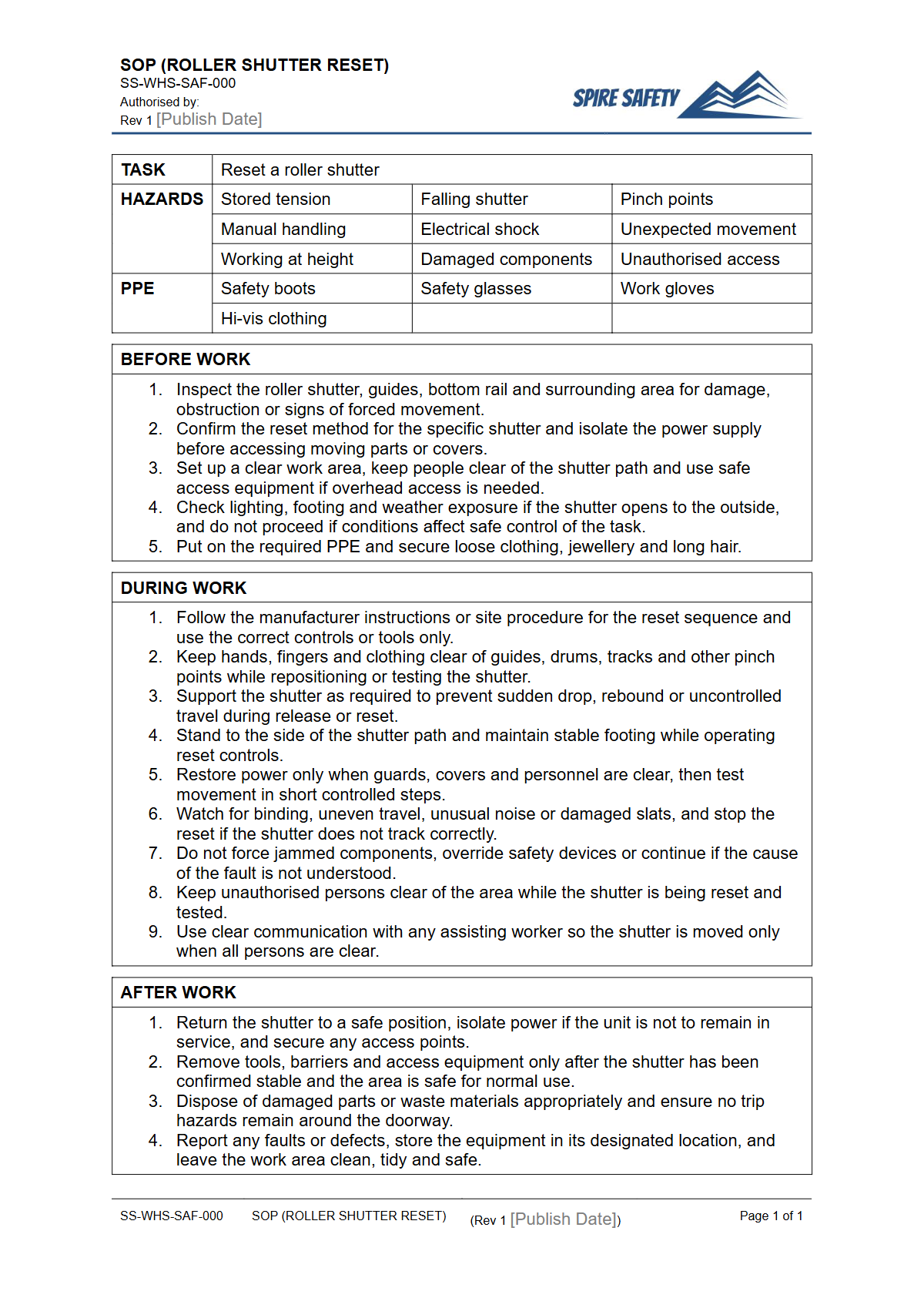
Resetting a commercial or industrial roller shutter is a task that carries significant risks, including crushing, entanglement, and electrical shock from motors and control panels. This free Safe Operating Procedure (Roller Shutter Reset) Template provides a structured starting point for documenting a safe system of work for this specific task.
Using a clear, step-by-step SOP helps control hazards and ensures the process is carried out consistently and safely by trained personnel. It forms a crucial part of your overall safety management, demonstrating a commitment to proactive risk control.
Developing robust SOPs is a fundamental component of effective WHS management systems. This template helps formalise procedures, clarify responsibilities, and provide a clear reference for workers, supervisors, and safety officers involved in maintaining workplace plant and equipment.
Video walkthrough
How to use the Free Safe Operating Procedure (Roller Shutter Reset) Template
This document is designed as a foundational template, not an out-of-the-box solution. Before implementation, you must conduct a thorough risk assessment specific to your workplace, considering the unique model of roller shutter, its location, power source, and surrounding environment.
The findings of your risk assessment should be used to add, remove, or modify steps within this template to ensure it is practical and effective for your site.
It is critical to adapt this procedure for other high-risk mechanical equipment. For instance, processes for safely isolating and testing machinery will differ, as outlined in our FREE Conveyer System SOP (Safe Operating Procedure) Template. Ensure each piece of plant has its own tailored SOP.
Customisation is Essential
Please note: This document is a template and must be customised to the specific roller shutter model, workplace environment, and legal requirements of your state or territory. We recommend a competent person reviews and approves the final document before use.
Un-customised, generic procedures may not adequately control the specific hazards present in your work area.
When to Use a Roller Shutter Reset SOP
This Safe Operating Procedure should be used specifically for resetting a roller shutter that has malfunctioned, stopped unexpectedly, or become dislodged from its tracks. It is not intended for routine daily opening and closing operations. Common triggers for using this SOP include:
- After an impact with a vehicle or forklift.
- Following a power failure or electrical fault that causes the door to stop mid-cycle.
- When the safety sensors (photoelectric beams) have been triggered and the door requires a manual reset.
- After emergency maintenance or repairs have been completed.
The procedure ensures that the reset is performed in a controlled manner, beginning with hazard identification and energy isolation (lockout/tagout) and concluding with function testing and a return to service. Regular reviews and updates are also vital; WHS compliance auditing can help identify gaps in your procedural documentation and its implementation.
Who Should Use This Safe Operating Procedure
Only workers who have been trained, assessed as competent, and explicitly authorised by management should perform a roller shutter reset. Competency should include a thorough understanding of:
- The specific hazards of the roller shutter, including stored energy in springs, gravity, and electrical systems.
- The full lockout/tagout (LOTO) procedure for isolating all energy sources.
- The mechanical components and reset mechanisms of the specific shutter model.
- Emergency procedures in case of an incident.
Depending on the risk assessment, the task may require two people: one to perform the reset and a spotter to monitor for hazards and manage the exclusion zone. Workers operating other large equipment, such as those guided by a FREE Telehandler SOP Template, require similar specific training and authorisation before use.
By limiting the task to authorised personnel, you ensure it is performed by individuals with the right skills and knowledge, significantly reducing the risk of injury or further equipment damage. For a wider range of procedural documents, you can browse our complete free WHS resources library.
Common mistakes
Common mistakes to avoid
- Failing to perform a full lockout/tagout (LOTO) to isolate all energy sources before starting work.
- Using the template without customising it for the specific roller shutter model and workplace conditions.
- Allowing untrained or unauthorised personnel to attempt the reset procedure.
- Working alone without a spotter, especially when manual lifting or manipulation of the shutter is required.
Legal references
Legal considerations
The following legal requirements may be relevant to this type of work.
- Work Health and Safety Act (Harmonised) — Provides the primary duties for protecting workers and other people from work health and safety risks.
- Work Health and Safety Regulations (Harmonised) — Sets out requirements supporting the management of workplace hazards and risks.
The following codes may be relevant to this type of work.
- Managing WHS Risks Code of Practice — Provides practical guidance on identifying hazards, assessing risks and applying effective controls.
- Work Health and Safety Consultation, Cooperation and Coordination Code of Practice — Provides practical guidance on consulting workers and coordinating with other duty holders.
- Managing the Work Environment and Facilities Code of Practice — Provides practical guidance on safe work environments, workplace facilities and related controls.
Did you know
Stored Energy Hazard
The large counterbalance springs in a roller shutter can store enormous amounts of kinetic energy. An uncontrolled release during a reset or repair is a primary cause of severe injury, highlighting the critical importance of a documented and followed procedure.
FAQ
Frequently asked questions
01What is the difference between an SOP and a SWMS for a roller shutter?
02Does this template include steps for electrical isolation?
03Who is a 'competent person' to perform a roller shutter reset?
04How often should a Safe Operating Procedure be reviewed?
Share this resource
Free Safe Operating Procedure (Roller Shutter Reset) Template
Browse Categories
How To Use It
- 1Download and open in Word or PDF.
- 2Replace the placeholders with your business details.
- 3Get it reviewed by a WHS specialist before rollout.
Need it customised?
Our WHS consultants can adapt this template to your site, run a gap analysis, or audit what you already have in place.
Book a Free Consultation WHS consulting servicesor call 1300 156 382
Related templates
- Free Safe Operating Procedure (Rolling Mill) Template
- Free Safe Operating Procedure (Roof Access Hatch) Template
- Free Safe Operating Procedure (Roof Anchor Use) Template
- Free Safe Operating Procedure (Roof Cleaning) Template
- Free Safe Operating Procedure (Roof Cutter) Template
- Free Safe Operating Procedure (Roof Drain Clearing) Template