
Free Safe Operating Procedure (Roller Door Cleaning) Template
Download our free Safe Operating Procedure (Roller Door Cleaning) Template to formalise your workplace safety processes for this common maintenance task.
Free Safe Operating Procedure (Roller Door Cleaning) Template
DOCX • 126 KB + PDF
Updated Oct 2026
No signup required
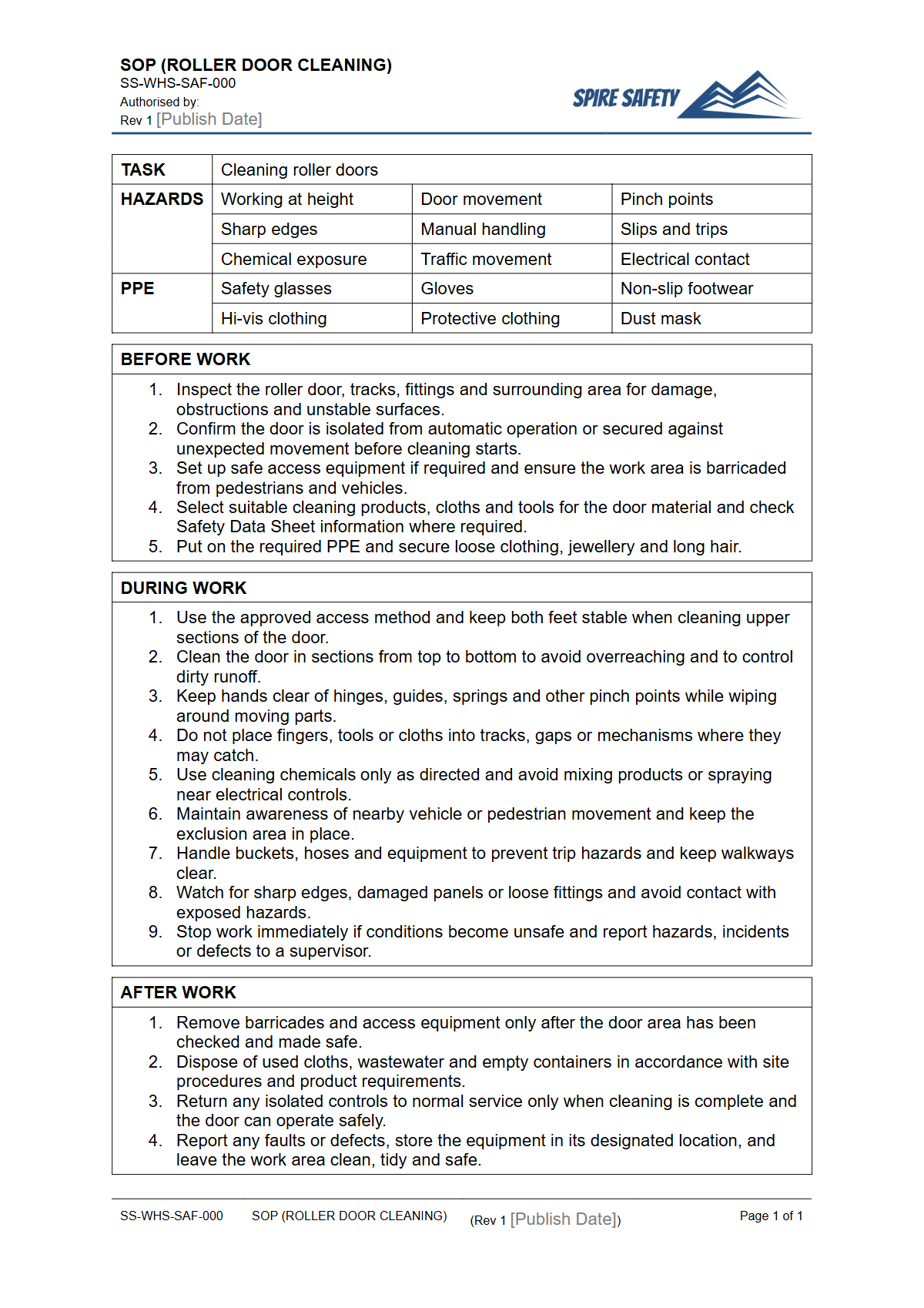
Purpose of the Free Safe Operating Procedure (Roller Door Cleaning) Template
This Safe Operating Procedure (SOP) template provides a structured framework for documenting the process of safely cleaning commercial and industrial roller doors. Regular cleaning is essential for maintenance and presentation, but it involves hazards that must be controlled.
Using our free Safe Operating Procedure (Roller Door Cleaning) Template helps your organisation define and communicate the required steps to minimise risks such as electrical shock, falls from height, chemical exposure, and manual handling injuries. It serves as a critical tool for ensuring workers understand the identified hazards and the control measures they must implement before, during, and after the task.
Formalising this process is a key component of a proactive safety culture. A documented SOP demonstrates a commitment to providing a safe system of work, which is a fundamental duty for any Person Conducting a Business or Undertaking (PCBU) under Australian WHS legislation.
It acts as a reference for training, task planning, and incident investigation. Properly implemented, it helps standardise behaviour and reduce the likelihood of accidents related to this routine but potentially hazardous activity.
Thorough documentation like this is foundational to building robust WHS management systems that protect both your people and your business.
What is a Safe Operating Procedure?
A Safe Operating Procedure is a written document that provides step-by-step instructions on how to perform a task safely. It goes beyond a simple checklist by detailing the 'how' and 'why' of safety controls.
An effective SOP for roller door cleaning will identify the specific equipment involved, required Personal Protective Equipment (PPE), potential hazards at each stage, and the precise actions needed to control the associated risks. This creates a clear, repeatable, and auditable process that any trained and competent worker can follow.
Video walkthrough
How to use the Free Safe Operating Procedure (Roller Door Cleaning) Template
To use this resource, download the DOCX file and open it in your preferred word processor. The template is pre-formatted with sections that guide you through documenting every critical aspect of the cleaning procedure.
You will need to carefully review each section and populate it with information specific to your workplace, including the make and model of the roller doors, the exact cleaning chemicals used, and the unique environmental conditions of the work area.
Important: This document is a template and is not a completed Safe Operating Procedure. It must be customised to suit the specific plant, substances, and processes used in your workplace.
We are not liable for any safety outcomes resulting from the use of this template. You should conduct a site-specific risk assessment before finalising the document.
After customisation, the SOP should be reviewed and approved by a competent person, and all relevant workers must be trained on its contents. This level of diligence is often reviewed during a WHS compliance audit.
When to use this Safe Operating Procedure
An SOP for roller door cleaning should be developed and implemented before the task is ever carried out. It is a proactive safety tool, not a reactive one.
It should be used as the primary training document for any new workers assigned to the task, ensuring they understand the approved method from day one. It also serves as an essential pre-start reference for experienced workers, allowing them to refresh their knowledge of the required safety controls, such as correct electrical isolation procedures and PPE requirements.
The SOP should also be referenced during regular safety talks, toolbox meetings, and whenever the procedure is reviewed or updated. If there is a change in equipment (e.g., a new roller door model is installed), cleaning chemicals, or if an incident or near-miss occurs, the SOP must be reviewed and amended to reflect the new information or lessons learned.
Much like our FREE Conveyer System SOP Template, this document is a living part of your safety system.
Who should use this Safe Operating Procedure
This template is designed for use by WHS managers, site supervisors, team leaders, and business owners who are responsible for creating and maintaining a safe work environment. These individuals will typically lead the customisation process, ensuring the final SOP is comprehensive, accurate, and aligned with a supporting risk assessment.
Once finalised, the primary users of the SOP are the workers and contractors tasked with performing the cleaning. The document empowers them with the knowledge to work safely and provides a clear standard against which their performance can be measured.
Consultation is a key part of developing an effective SOP. The workers who perform the cleaning have practical, hands-on knowledge and must be involved in drafting and reviewing the procedure.
This ensures the steps are practical, realistic, and address the actual hazards they face. Similar processes apply when documenting procedures for other common equipment, and our Free Air Compressor SOP Template provides another example of this structure in action.
By providing a clear, step-by-step guide, the SOP helps PCBUs fulfil their duty of care and assists workers in meeting their own WHS obligations to work safely and look out for the safety of others. You can find many more templates for different tasks in our free WHS resources library to build out your safety documentation.
Common mistakes
Common mistakes to avoid
- Forgetting to electrically isolate the door motor and apply a personal lock and tag (Lockout-Tagout) before starting.
- Using unstable platforms like chairs, crates, or boxes to reach high areas instead of proper ladders or EWPs.
- Failing to read the Safety Data Sheet (SDS) for cleaning chemicals and not wearing the required PPE, such as gloves and safety glasses.
- Not securing the area below the work, creating a risk of falling objects or spills for other personnel.
Legal references
Legal considerations
The following legal requirements may be relevant to this type of work.
- Work Health and Safety Act (Harmonised) — Provides the primary duties for protecting workers and other people from work health and safety risks.
- Work Health and Safety Regulations (Harmonised) — Sets out requirements supporting the management of workplace hazards and risks.
The following codes may be relevant to this type of work.
- Managing WHS Risks Code of Practice — Provides practical guidance on identifying hazards, assessing risks and applying effective controls.
- Work Health and Safety Consultation, Cooperation and Coordination Code of Practice — Provides practical guidance on consulting workers and coordinating with other duty holders.
- Managing the Work Environment and Facilities Code of Practice — Provides practical guidance on safe work environments, workplace facilities and related controls.
Did you know
Maintenance Matters
The Australian Standard AS 5000:2021 recommends that industrial and commercial doors be serviced by a trained technician at least every 12 months to ensure continued safe operation.
Hidden Dangers
Many roller door incidents are not caused by the door's automatic movement but by secondary tasks like maintenance and cleaning, often involving electrical, chemical, or fall-related hazards that are not adequately controlled.
FAQ
Frequently asked questions
01What are the main hazards when cleaning a commercial roller door?
02Does an SOP replace a risk assessment for roller door cleaning?
03How often should a Safe Operating Procedure be reviewed?
04Is it mandatory to have an SOP for cleaning roller doors in Australia?
Share this resource
Free Safe Operating Procedure (Roller Door Cleaning) Template
Browse Categories
How To Use It
- 1Download and open in Word or PDF.
- 2Replace the placeholders with your business details.
- 3Get it reviewed by a WHS specialist before rollout.
Need it customised?
Our WHS consultants can adapt this template to your site, run a gap analysis, or audit what you already have in place.
Book a Free Consultation WHS consulting servicesor call 1300 156 382
Related templates
- Free Safe Operating Procedure (Roller Door Operation) Template
- Free Safe Operating Procedure (Roller Painting) Template
- Free Safe Operating Procedure (Roller Shutter Reset) Template
- Free Safe Operating Procedure (Rolling Mill) Template
- Free Safe Operating Procedure (Roof Access Hatch) Template
- Free Safe Operating Procedure (Roof Anchor Use) Template