
Free Safe Operating Procedure (Rock Scaling) Template
Formalise your rock scaling process with our free Safe Operating Procedure template. Download the customisable DOCX to establish clear safety steps now.
Free Safe Operating Procedure (Rock Scaling) Template
DOCX • 126 KB + PDF
Updated Oct 2026
No signup required
Purpose of the Free Safe Operating Procedure (Rock Scaling) Template
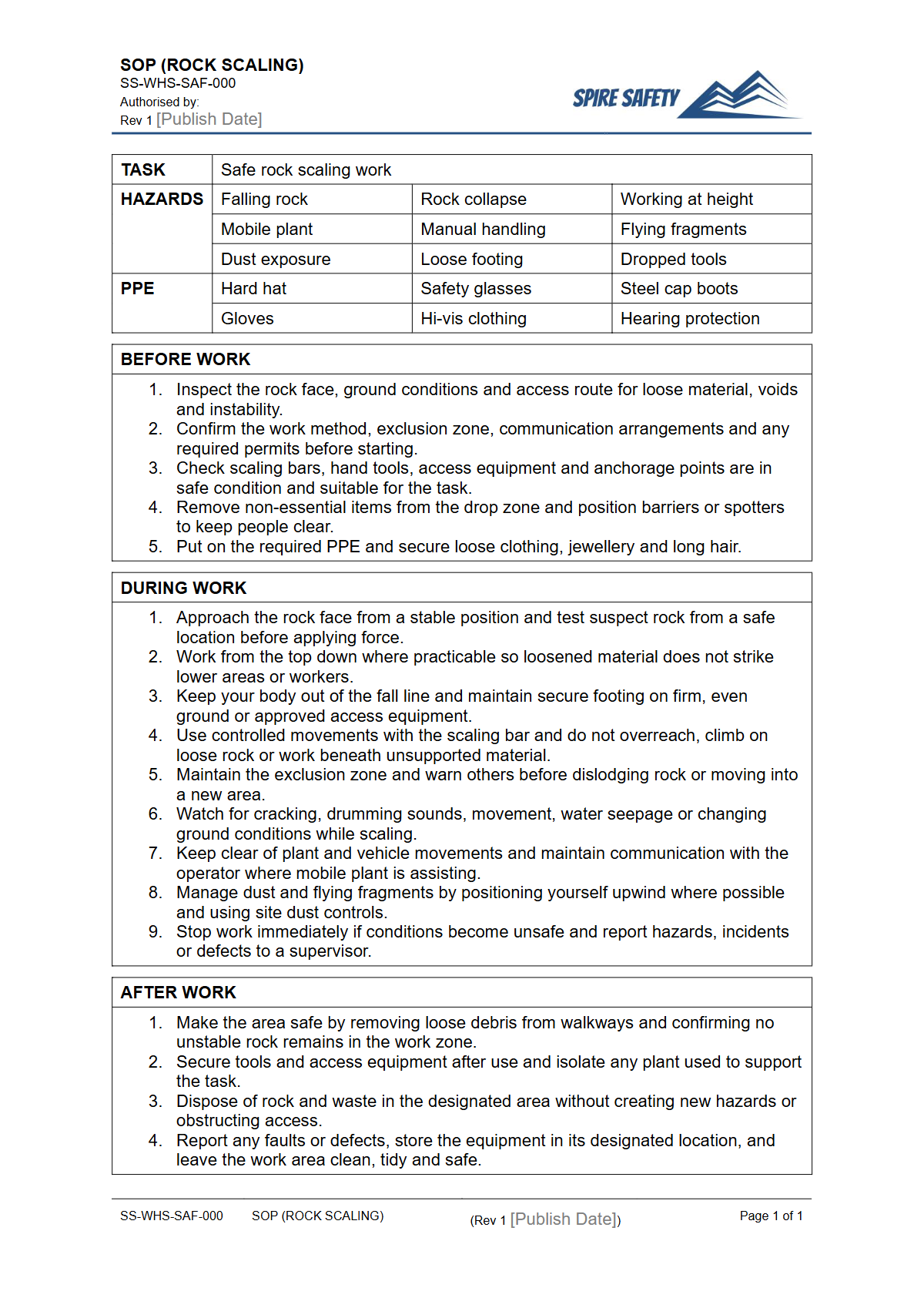
Rock scaling is a high-risk activity that involves the removal of loose or unstable rocks from a rock face to prevent rockfalls. This Free Safe Operating Procedure (Rock Scaling) Template provides a structured framework for documenting the required safety controls and work sequence.
Using a formal SOP helps your organisation standardise its processes, train workers effectively, and demonstrate due diligence in managing risks associated with geotechnical hazards. It serves as a vital tool for ensuring that all personnel understand the specific steps, equipment, and precautions necessary to perform the task safely.
A well-defined SOP is a fundamental component of a robust safety management system. It provides clear, actionable instructions that minimise ambiguity and reduce the likelihood of incidents caused by procedural errors.
Integrating procedures like this one into your broader framework supports a proactive safety culture and helps build comprehensive WHS management systems that protect workers and meet regulatory expectations.
Video walkthrough
How to use the Free Safe Operating Procedure (Rock Scaling) Template
This Safe Operating Procedure is available as a fully editable DOCX file for easy customisation, as well as a print-ready PDF. After downloading, a competent person with experience in geotechnical work and rock scaling must thoroughly review and adapt the document to align with your specific operational context.
This includes detailing the exact machinery, tools, site conditions, personnel roles, and emergency procedures relevant to your workplace.
Important: This document is a template only. We are not WHS consultants, and this template does not constitute legal or safety advice.
You MUST customise this document to reflect the unique hazards and control measures of your specific worksite, plant, and equipment. Its effectiveness is entirely dependent on its correct adaptation, implementation, and review by competent persons within your organisation.
Key Components of the Safe Operating Procedure
Our template is structured to guide you through the essential stages of the rock scaling process, aligned with Australian WHS principles.
Pre-Operational Checks
Before any work begins, a series of critical checks must be completed. The SOP outlines steps for a thorough pre-work risk assessment, including a geotechnical evaluation of the rock face's stability.
It includes sections for verifying the condition of all equipment, such as scaling bars, harnesses, ropes, and any associated machinery. It also prompts the formal establishment of exclusion zones to protect people and property from falling debris, a common requirement in many civil earthworks jobs which might also require a FREE Grader SOP (Safe Operating Procedure) Template for associated site preparation.
Step-by-Step Operating Sequence
The core of the SOP details the safe, sequential execution of the scaling task. This section covers the correct method for accessing the work area (e.g., rope access, elevated work platform), communication protocols between the scaling team and ground crew, and the systematic process of scaling from the top of the face downwards.
Detailing this sequence ensures a consistent and controlled approach, which is critical for managing the dynamic hazards involved. For other ground-disturbing activities, a similar level of procedural detail is required, as outlined in our FREE Trencher SOP (Safe Operating Procedure) Template.
Post-Operational Tasks
Once scaling is complete, the SOP guides users through essential post-work procedures. This includes clearing and managing scaled debris, conducting a final inspection of the rock face to confirm its stability, and dismantling any exclusion zones.
The procedure also covers the proper cleaning, inspection, and storage of all tools and personal protective equipment (PPE), ensuring they are ready and safe for future use. For different types of heavy machinery used in site cleanup, a dedicated SOP like our FREE Scraper SOP (Safe Operating Procedure) Template is equally important.
When to use this Safe Operating Procedure
This SOP should be used as a primary planning and operational document before any rock scaling work is undertaken. It is an essential resource for worker training and induction, ensuring everyone involved is aware of the approved methodology.
Furthermore, it serves as a key reference document during safety meetings, incident investigations, and performance reviews. Regular use and review of the SOP are critical components of any internal or external WHS compliance auditing program, providing tangible evidence of your risk management processes.
Who should use this template
This template is designed for use by personnel responsible for planning, managing, and executing rock scaling operations. This includes Site Supervisors, Project Managers, Geotechnical Engineers, WHS Advisors, and business owners in sectors such as civil construction, mining, quarrying, and infrastructure maintenance.
It empowers teams to formalise their safety protocols, providing a clear and defensible system of work. If you're looking for more documents to support your safety system, you can browse our complete free WHS resources library for a wide range of templates.
Common mistakes
Common mistakes to avoid
- Failing to establish and maintain adequate exclusion zones below the work area.
- Using incorrect or poorly maintained scaling tools and personal protective equipment (PPE).
- Neglecting to conduct a pre-work site inspection and risk assessment by a competent person.
- Working from the bottom of the rock face upwards, which increases the risk of being struck by dislodged material.
Legal references
Legal considerations
The following legal requirements may be relevant to this type of work.
- Work Health and Safety Act (Harmonised) — Provides the primary duties for protecting workers and other people from work health and safety risks.
- Work Health and Safety Regulations (Harmonised) — Sets out requirements supporting the management of workplace hazards and risks.
The following codes may be relevant to this type of work.
- Managing WHS Risks Code of Practice — Provides practical guidance on identifying hazards, assessing risks and applying effective controls.
- Work Health and Safety Consultation, Cooperation and Coordination Code of Practice — Provides practical guidance on consulting workers and coordinating with other duty holders.
- Managing the Work Environment and Facilities Code of Practice — Provides practical guidance on safe work environments, workplace facilities and related controls.
Did you know
A Matter of Control
In the hierarchy of controls, rock scaling is considered an administrative control. Higher-level controls like installing rock bolts (engineering) or redesigning a slope (elimination) are preferred where practicable to remove the hazard at its source.
Geotechnical Insight
A thorough geotechnical assessment is a critical prerequisite for any rock scaling project. It helps identify the rock type, joint patterns, and potential failure modes, which directly informs the safest and most effective scaling method to use.
FAQ
Frequently asked questions
01What is the primary purpose of a rock scaling SOP?
02Is this template suitable for both manual and mechanical scaling?
03Who is responsible for customising this SOP for a specific site?
04How often should a rock scaling SOP be reviewed?
Share this resource
Free Safe Operating Procedure (Rock Scaling) Template
Browse Categories
How To Use It
- 1Download and open in Word or PDF.
- 2Replace the placeholders with your business details.
- 3Get it reviewed by a WHS specialist before rollout.
Need it customised?
Our WHS consultants can adapt this template to your site, run a gap analysis, or audit what you already have in place.
Book a Free Consultation WHS consulting servicesor call 1300 156 382
Related templates
- Free Safe Operating Procedure (Rod Spinner) Template
- Free Safe Operating Procedure (Roll Cage Handling) Template
- Free Safe Operating Procedure (Roll Cage Loading) Template
- Free Safe Operating Procedure (Roll Cage Unloading) Template
- Free Safe Operating Procedure (Roller Door Cleaning) Template
- Free Safe Operating Procedure (Roller Door Operation) Template