
Free Safe Operating Procedure (Roll Cage Loading) Template
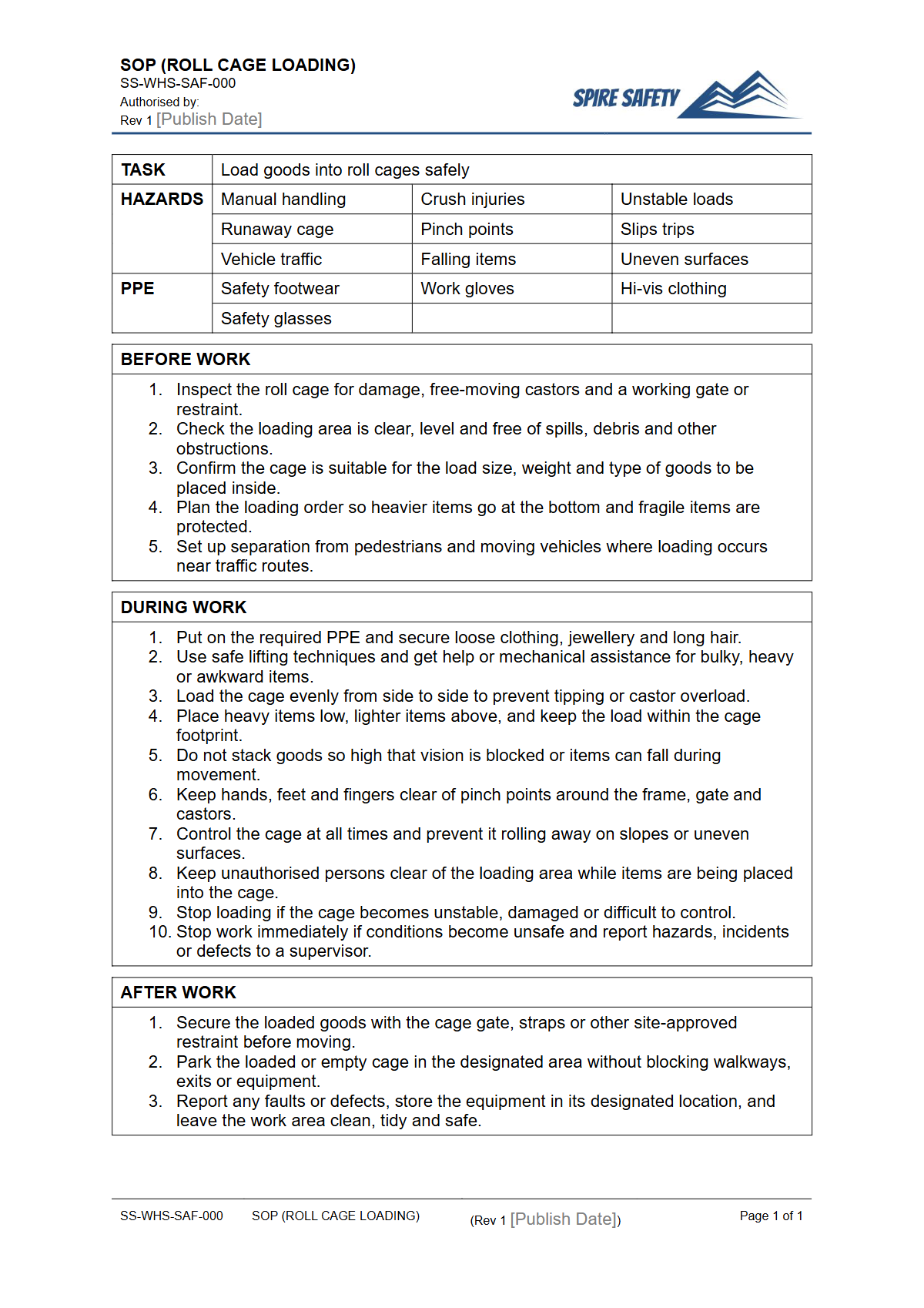
Download our free Safe Operating Procedure for roll cage loading. This customisable template helps you document safe work steps for your team.
Free Safe Operating Procedure (Roll Cage Loading) Template
DOCX • 126 KB + PDF
Updated Oct 2026
No signup required
Purpose of the Free Safe Operating Procedure (Roll Cage Loading) Template
Effectively managing manual handling tasks is a cornerstone of workplace safety, particularly in logistics, retail, and healthcare settings. Our Free Safe Operating Procedure (Roll Cage Loading) Template provides a structured starting point for documenting the risks and controls associated with this common task.
Using a standardised procedure helps your organisation ensure that all workers understand the safest way to inspect, load, and move roll cages, minimising the risk of injury.
This SOP template guides you in outlining key safety considerations, such as pre-use inspections, correct loading techniques to maintain stability, and identifying the Safe Working Load (SWL). Documenting these steps is a fundamental part of managing risks like musculoskeletal disorders from awkward postures, strains from overexertion, and crush injuries from unstable loads.
A well-developed SOP is an essential component of your overall WHS management systems, demonstrating a clear commitment to worker safety.
Video walkthrough
How to use the Free Safe Operating Procedure (Roll Cage Loading) Template
This resource is available as a fully editable DOCX file, allowing for easy customisation, and a print-ready PDF. To use it, simply download the file and adapt it to your specific operational context.
It is crucial to remember that this is a template. We've designed it to be a strong starting point, but you must customise it to reflect the specific roll cages, loads, work environment, and control measures present in your workplace.
This includes adding your company branding, specific site details, and any unique hazards identified through your risk assessment process.
Once customised, the SOP should be used as a primary training document for all personnel involved in loading roll cages. It serves as a practical tool during inductions, refresher training, and can be referenced for toolbox talks.
This process of documentation, training, and review is similar for other equipment, as seen in our free Telehandler SOP template, where machine-specific details are paramount for safe operation.
When to use it
A Safe Operating Procedure for roll cage loading should be implemented as a proactive control measure before workers are assigned the task. It is a living document that should be used consistently in several situations:
- Worker Training and Induction: As the basis for training new employees or workers new to the task, ensuring they learn the correct, safe method from the outset.
- Refresher Training: For periodic retraining to reinforce safe work habits and introduce any updates to the procedure.
- Post-Incident: Following any incident or near-miss involving a roll cage, the SOP should be reviewed and updated to prevent a recurrence.
- Operational Changes: Whenever new types of roll cages, different products, or changes to the work environment are introduced. Conducting regular checks, possibly as part of a broader WHS compliance auditing program, can help identify when procedures need updating.
Who should use it
This Safe Operating Procedure is intended for a range of personnel within an organisation. Primarily, it is for the workers who physically perform the task of loading and moving roll cages, providing them with clear, step-by-step instructions for their safety.
Supervisors and team leaders should use the SOP to train their teams, monitor work practices, and enforce the documented safety standards.
WHS managers, safety officers, and business owners will find this template invaluable for formalising risk management processes and demonstrating due diligence. By establishing and communicating clear procedures for tasks like this, and for other equipment such as that covered in our Conveyer System SOP, you build a more robust safety culture.
If you require further guidance on tailoring safety documents, our general WHS consulting services can provide expert assistance.
Explore our complete free WHS resources library for more templates and guides to support your safety management system.
Common mistakes
Common mistakes to avoid
- Overloading the cage beyond its stated Safe Working Load (SWL).
- Failing to inspect the cage for damaged wheels, bent frames, or faulty gates before use.
- Stacking heavy or unstable items on top, creating a high centre of gravity and tip-over risk.
- Leaving loaded or empty cages in walkways, blocking emergency exits, or creating trip hazards.
Legal references
Legal considerations
The following legal requirements may be relevant to this type of work.
- Work Health and Safety Act (Harmonised) — Provides the primary duties for protecting workers and other people from work health and safety risks.
- Work Health and Safety Regulations (Harmonised) — Sets out requirements supporting the management of workplace hazards and risks.
The following codes may be relevant to this type of work.
- Managing WHS Risks Code of Practice — Provides practical guidance on identifying hazards, assessing risks and applying effective controls.
- Work Health and Safety Consultation, Cooperation and Coordination Code of Practice — Provides practical guidance on consulting workers and coordinating with other duty holders.
- Managing the Work Environment and Facilities Code of Practice — Provides practical guidance on safe work environments, workplace facilities and related controls.
Did you know
Manual Handling Statistics
According to Safe Work Australia, hazardous manual tasks are a leading cause of work-related injuries in Australia, with body stressing accounting for 37% of all serious workers' compensation claims.
Design Efficiency
Many roll cages are designed to be 'nestable', meaning they can be partially collapsed and slotted together. This significantly reduces the floor space required for storage when they are empty.
FAQ
Frequently asked questions
01What are the main hazards of loading roll cages?
02Is a Safe Operating Procedure a legal requirement for roll cages in Australia?
03How often should an SOP for roll cage loading be reviewed?
04Can this template be used for different types of roll cages?
Share this resource
Free Safe Operating Procedure (Roll Cage Loading) Template
Browse Categories
How To Use It
- 1Download and open in Word or PDF.
- 2Replace the placeholders with your business details.
- 3Get it reviewed by a WHS specialist before rollout.
Need it customised?
Our WHS consultants can adapt this template to your site, run a gap analysis, or audit what you already have in place.
Book a Free Consultation WHS consulting servicesor call 1300 156 382
Related templates
- Free Safe Operating Procedure (Roll Cage Unloading) Template
- Free Safe Operating Procedure (Roller Door Cleaning) Template
- Free Safe Operating Procedure (Roller Door Operation) Template
- Free Safe Operating Procedure (Roller Painting) Template
- Free Safe Operating Procedure (Roller Shutter Reset) Template
- Free Safe Operating Procedure (Rolling Mill) Template