
Free Safe Operating Procedure (Rod Spinner) Template
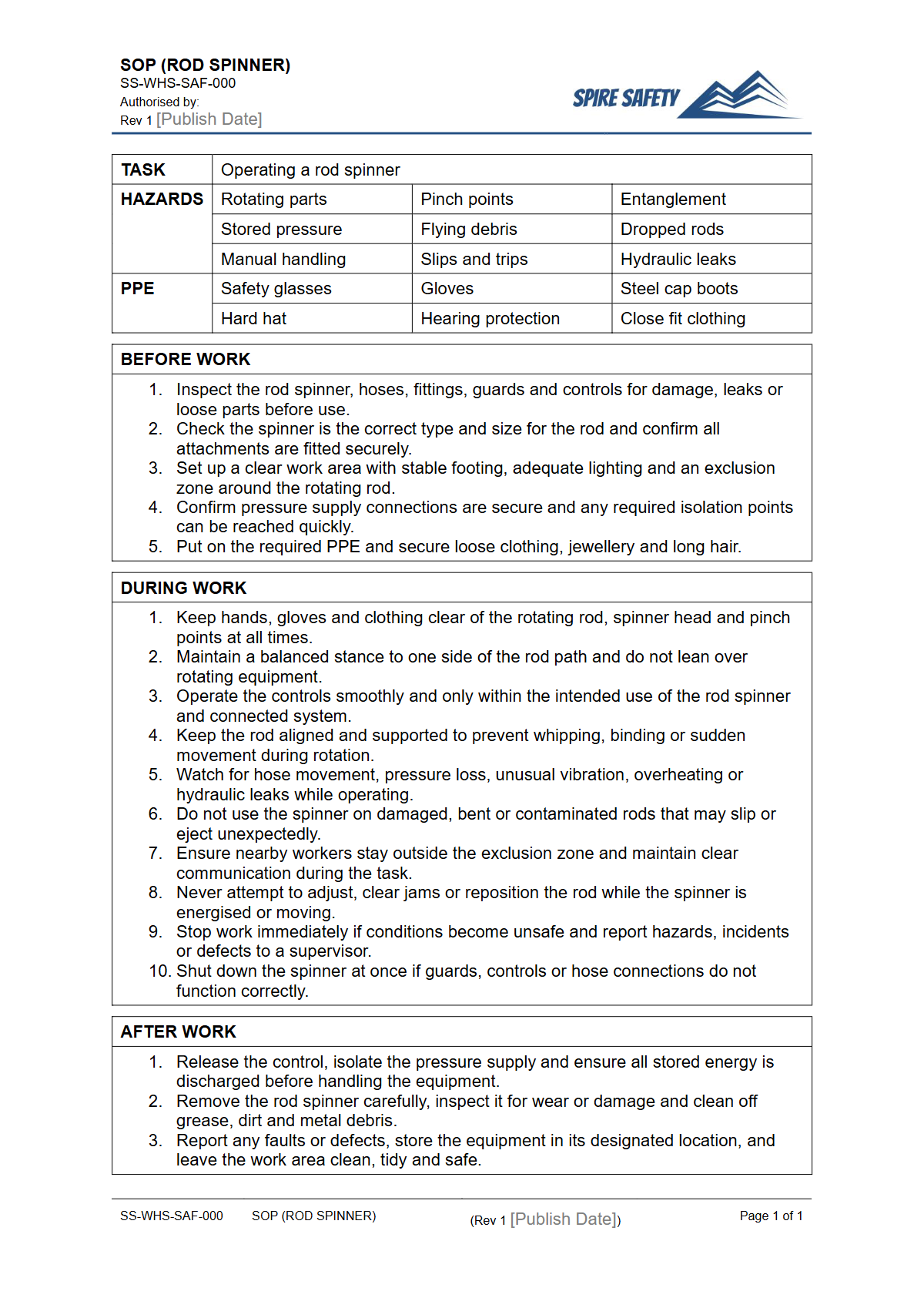
Download our free Safe Operating Procedure (Rod Spinner) Template to define safe work methods. This customisable document helps standardise your processes.
Free Safe Operating Procedure (Rod Spinner) Template
DOCX • 126 KB + PDF
Updated Oct 2026
No signup required
Purpose of the Free Safe Operating Procedure (Rod Spinner) Template
This Free Safe Operating Procedure (Rod Spinner) Template provides a structured foundation for documenting the safe use of rod spinners in your workplace. Rod spinners, used to connect and disconnect drill rods, present significant risks, including entanglement, crushing, and striking hazards.
A well-developed Safe Operating Procedure (SOP) is essential for controlling these risks and ensuring operators understand the required safety protocols and expected behaviour.
The primary purpose of this SOP is to provide a clear, step-by-step guide for operators to perform their tasks safely and efficiently. By standardising the process, you can significantly reduce the risk of incidents and injuries associated with rotating equipment.
A documented SOP serves as a critical training tool for new workers and a reference for experienced operators, reinforcing safe work practices. It forms a key component of a broader WHS management system, helping your organisation meet its duty of care under Australian WHS legislation.
Video walkthrough
How to use the Free Safe Operating Procedure (Rod Spinner) Template
Download this document in your preferred format (DOCX for easy editing or PDF for distribution). The template is pre-formatted with sections covering potential hazards, required personal protective equipment (PPE), pre-operational checks, operational steps, and emergency procedures.
You must adapt this document to your specific context. This includes adding details about your particular model of rod spinner, the work environment, and any site-specific rules.
It's crucial to consult with the workers who operate the equipment to ensure the procedure is practical and reflects actual work practices. Documenting procedures for all site equipment is vital, similar to the process outlined in our Free Air Compressor SOP Template.
Important: Customise to Your Workplace
This document is a template only. It must be thoroughly reviewed and customised by a competent person to suit the specific make and model of equipment used, the task, the work environment, and your organisation's safety procedures.
We are not liable for the outcomes of the final implemented document.
When to use a Safe Operating Procedure
The SOP for a rod spinner should be used as a primary reference document at several key stages. It is essential during the induction and training of new operators to ensure they learn the correct, safe method from the outset.
It should also be readily available in the work area for quick reference by all personnel. Furthermore, the SOP is a critical tool for incident investigations, helping to identify any deviations from established safe procedures.
It should also be reviewed during regular safety meetings or toolbox talks to reinforce best practices and discuss any potential improvements. This forms part of a suite of safety documents needed on a worksite, alongside procedures for other plant like those covered in our FREE Trencher SOP Template.
Who should use this Safe Operating Procedure
This SOP is intended for a range of personnel within your organisation.
Operators
Workers who directly operate the rod spinner must be trained on and follow the SOP to ensure their own safety and the safety of those around them. They should be consulted during the drafting and review process to ensure the procedure is accurate and practical.
Supervisors and Managers
Line managers and supervisors are responsible for ensuring that operators are trained, competent, and adhere to the SOP. They use it to conduct observations, enforce safety standards, and provide coaching.
A robust SOP supports them in fulfilling their supervisory duties under WHS law.
WHS Personnel and Trainers
Work Health and Safety advisors and trainers use the SOP as a foundational document for developing training programs, conducting risk assessments, and performing safety audits. The effectiveness of these procedures can be verified through periodic WHS compliance auditing to ensure they are being implemented correctly on the ground.
You can find more templates for various plant and equipment to build a comprehensive safety library in our free WHS resources library.
Common mistakes
Common mistakes to avoid
- Using a generic template without customising it for the specific make, model, and work environment.
- Failing to consult with operators and supervisors during the drafting and review process.
- Not providing adequate training to all relevant personnel on the finalised SOP.
- Storing the SOP in an office instead of making it readily accessible at the point of use.
Legal references
Legal considerations
The following legal requirements may be relevant to this type of work.
- Work Health and Safety Act (Harmonised) — Provides the primary duties for protecting workers and other people from work health and safety risks.
- Work Health and Safety Regulations (Harmonised) — Sets out requirements supporting the management of workplace hazards and risks.
The following codes may be relevant to this type of work.
- Managing WHS Risks Code of Practice — Provides practical guidance on identifying hazards, assessing risks and applying effective controls.
- Work Health and Safety Consultation, Cooperation and Coordination Code of Practice — Provides practical guidance on consulting workers and coordinating with other duty holders.
- Managing the Work Environment and Facilities Code of Practice — Provides practical guidance on safe work environments, workplace facilities and related controls.
Did you know
Guarding is Critical
Entanglement in rotating machinery parts is a leading cause of serious and fatal injuries in industrial workplaces. Australian regulations mandate that dangerous moving parts of plant must be guarded to prevent access.
FAQ
Frequently asked questions
01What are the main hazards of operating a rod spinner?
02Is a Safe Operating Procedure a legal requirement for a rod spinner in Australia?
03Who is responsible for writing a rod spinner SOP?
04How often should a rod spinner SOP be reviewed?
Share this resource
Free Safe Operating Procedure (Rod Spinner) Template
Browse Categories
How To Use It
- 1Download and open in Word or PDF.
- 2Replace the placeholders with your business details.
- 3Get it reviewed by a WHS specialist before rollout.
Need it customised?
Our WHS consultants can adapt this template to your site, run a gap analysis, or audit what you already have in place.
Book a Free Consultation WHS consulting servicesor call 1300 156 382
Related templates
- Free Safe Operating Procedure (Roll Cage Handling) Template
- Free Safe Operating Procedure (Roll Cage Loading) Template
- Free Safe Operating Procedure (Roll Cage Unloading) Template
- Free Safe Operating Procedure (Roller Door Cleaning) Template
- Free Safe Operating Procedure (Roller Door Operation) Template
- Free Safe Operating Procedure (Roller Painting) Template