
Free Safe Operating Procedure (Rock Anchor Drill) Template
Streamline your safety protocols for geotechnical work with our free Rock Anchor Drill Safe Operating Procedure template. Download the customisable DOCX now.
Free Safe Operating Procedure (Rock Anchor Drill) Template
DOCX • 126 KB + PDF
Updated Oct 2026
No signup required
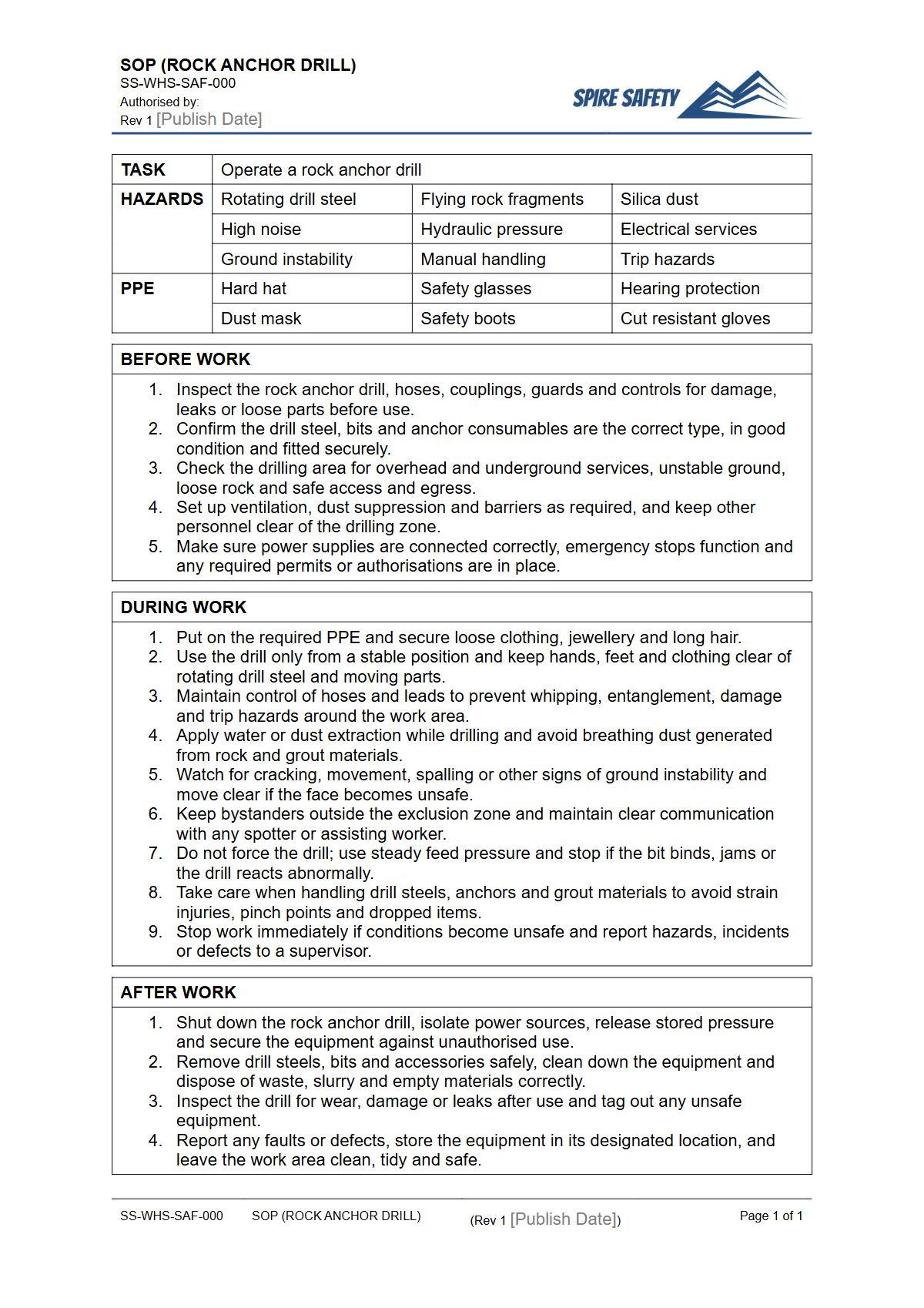
Purpose of the Free Safe Operating Procedure (Rock Anchor Drill) Template
Operating a rock anchor drill is a high-risk activity common in construction, civil engineering, and mining. This free Safe Operating Procedure (Rock Anchor Drill) Template provides a structured framework for documenting the required safety controls for this task.
It helps your organisation identify hazards, assess risks, and implement control measures to protect workers from dangers such as equipment failure, ground instability, excessive noise, vibration, and exposure to hazardous dust like respirable crystalline silica. Using a clear SOP demonstrates a commitment to a safe system of work and is a key part of effective WHS management.
Video walkthrough
How to use the Free Safe Operating Procedure (Rock Anchor Drill) Template
This document is a template and must be customised to your specific workplace. Download the DOCX file and adapt it to reflect your site conditions, the specific model of rock anchor drill in use, the ground materials being drilled, and your organisation's internal safety policies.
Fill in the required fields, including site details, personnel responsibilities, and emergency procedures. Successful implementation involves consulting with operators and supervisors to ensure the procedure is practical and understood by everyone involved. Integrating this SOP is a crucial step in developing a comprehensive WHS management system.
The template guides you through documenting key safety stages, including:
- Required PPE: Specifies personal protective equipment like hard hats, hearing protection, safety glasses, and respiratory protection.
- Pre-Operational Checks: Lists essential inspections for the drill, power pack, hoses, and work area before starting.
- Step-by-Step Operating Guide: Outlines the sequence for safely setting up, drilling, installing anchors, and grouting.
- Post-Operational Tasks: Details procedures for shutdown, cleaning, and maintenance.
- Identified Hazards and Control Measures: Provides a section to document risks and the controls you have put in place.
When to use a Rock Anchor Drill SOP
A Safe Operating Procedure for rock anchor drilling should be in place and actively used before any such work begins on a project. It serves as a primary training document for new operators and a refresher for experienced workers.
The SOP is a critical reference tool during daily pre-start meetings and toolbox talks to reinforce safe work habits. It should also be reviewed as part of any incident investigation or when there is a change in equipment, personnel, or drilling conditions.
For other specialised plant, you may also require specific procedures, such as telehandler safe operating procedures for materials handling on site.
Who should use this procedure
This SOP is intended for use by multiple roles within a project. Site supervisors and project managers use it to plan and oversee work safely.
WHS and safety officers use it to ensure and verify that control measures are implemented correctly. Most importantly, the drill operators and their assistants must use it as their guide for performing the task safely.
Competency and adherence to the SOP are critical for preventing incidents. In a similar way, defining a clear process is essential for other high-risk earthmoving tasks, as outlined in our safe operating procedure for trenchers.
Key Hazards in Rock Anchor Drilling
Beyond the immediate mechanical risks, operating a rock anchor drill presents several significant health and safety hazards. The process often uses compressed air, which requires its own safety protocols detailed in documents like an SOP for air compressors. Key hazards specific to rock drilling include high levels of noise that can cause permanent hearing loss, and hand-arm vibration (HAV) from holding the drill, which can lead to long-term neurovascular damage.
The most serious chronic risk is often exposure to respirable crystalline silica (RCS) dust, which can cause the incurable lung disease silicosis. Effective dust suppression systems, such as water injection or dust extraction, are non-negotiable controls. Verifying these controls are in place and effective is a key function of regular WHS compliance audits.
By systematically addressing these risks in your Safe Operating Procedure, you create a safer environment for everyone on site. You can explore our entire free WHS resources library for more templates to support your safety management system.
Common mistakes
Common mistakes to avoid
- Failing to conduct a thorough pre-start inspection of the drill, hoses, and fittings.
- Using inadequate dust suppression measures, leading to dangerous silica dust exposure.
- Neglecting to establish and maintain clear exclusion zones around the drilling area.
- Using the SOP as a generic document without customising it for the specific site, drill model, and ground conditions.
Legal references
Legal considerations
The following legal requirements may be relevant to this type of work.
- Work Health and Safety Act (Harmonised) — Provides the primary duties for protecting workers and other people from work health and safety risks.
- Work Health and Safety Regulations (Harmonised) — Sets out requirements supporting the management of workplace hazards and risks.
The following codes may be relevant to this type of work.
- Managing WHS Risks Code of Practice — Provides practical guidance on identifying hazards, assessing risks and applying effective controls.
- Work Health and Safety Consultation, Cooperation and Coordination Code of Practice — Provides practical guidance on consulting workers and coordinating with other duty holders.
- Managing the Work Environment and Facilities Code of Practice — Provides practical guidance on safe work environments, workplace facilities and related controls.
Did you know
Silica Dust Risk
Rock drilling can generate high levels of respirable crystalline silica (RCS), a hazardous dust that can cause silicosis, an incurable and often fatal lung disease. Effective water suppression or dust extraction during drilling is a critical control.
Ground Stabilisation
Rock anchors, also known as rock bolts, are a critical engineering control used to stabilise rock excavations. They function by tensioning the rock mass, increasing its shear strength and preventing layers of rock from sliding or falling.
FAQ
Frequently asked questions
01What is a rock anchor drill used for?
02Is a Safe Operating Procedure legally required for rock anchor drilling in Australia?
03What PPE is required for operating a rock anchor drill?
04How often should a rock anchor drill SOP be reviewed?
Share this resource
Free Safe Operating Procedure (Rock Anchor Drill) Template
Browse Categories
How To Use It
- 1Download and open in Word or PDF.
- 2Replace the placeholders with your business details.
- 3Get it reviewed by a WHS specialist before rollout.
Need it customised?
Our WHS consultants can adapt this template to your site, run a gap analysis, or audit what you already have in place.
Book a Free Consultation WHS consulting servicesor call 1300 156 382
Related templates
- Free Safe Operating Procedure (Rock Drill) Template
- Free Safe Operating Procedure (Rock Garden Maintenance) Template
- Free Safe Operating Procedure (Rock Scaling) Template
- Free Safe Operating Procedure (Rod Spinner) Template
- Free Safe Operating Procedure (Roll Cage Handling) Template
- Free Safe Operating Procedure (Roll Cage Loading) Template