
Free Safe Operating Procedure (Roadside Litter Pickup) Template
Effectively manage the risks of working near traffic with our free Safe Operating Procedure (Roadside Litter Pickup) Template.
Free Safe Operating Procedure (Roadside Litter Pickup) Template
DOCX • 126 KB + PDF
Updated Oct 2026
No signup required
Purpose of the Free Safe Operating Procedure (Roadside Litter Pickup) Template
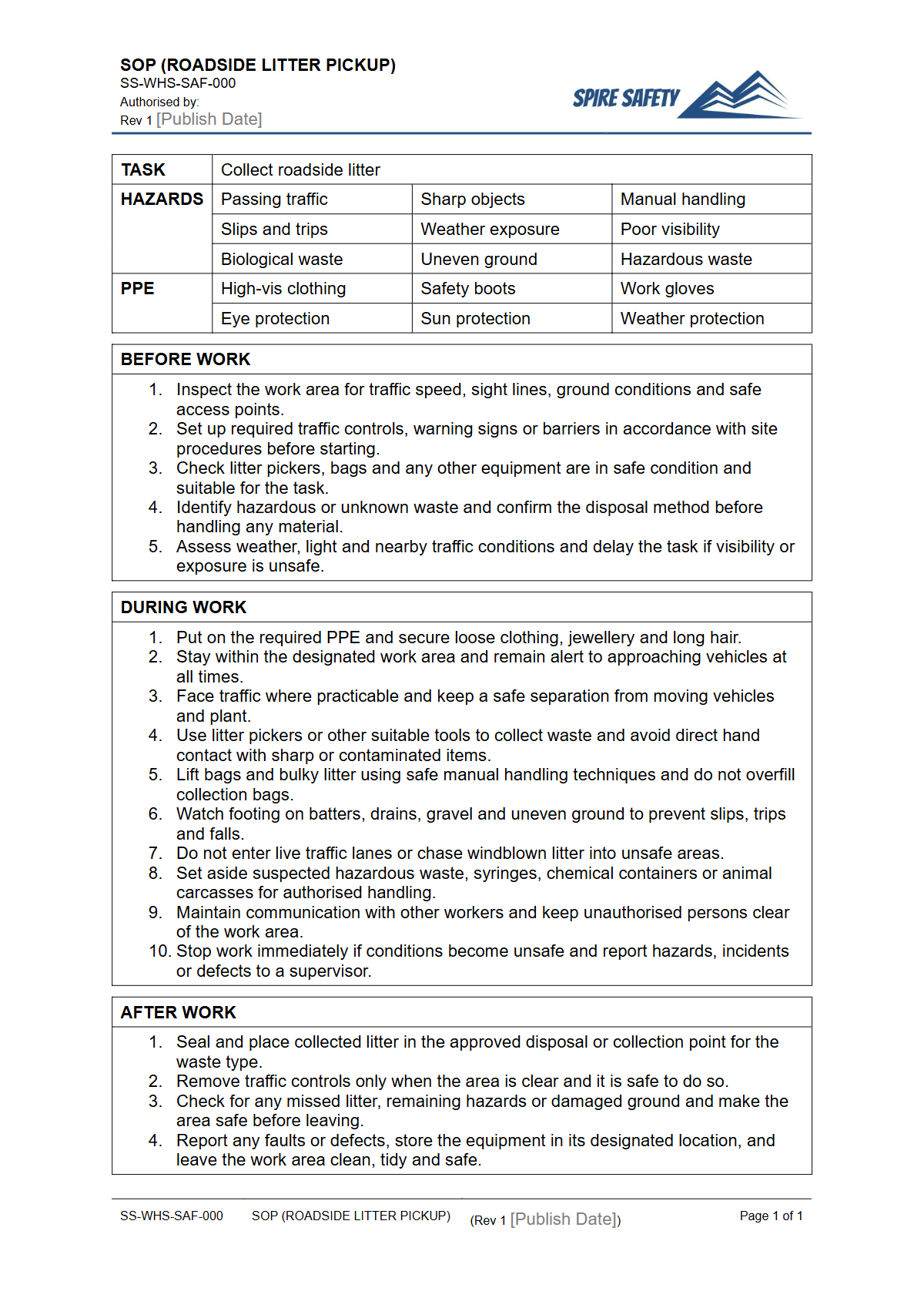
Working near active roadways presents significant health and safety risks, from traffic hazards to exposure to unknown substances. This Free Safe Operating Procedure (Roadside Litter Pickup) Template provides a structured starting point for documenting a safe system of work for this common but high-risk task.
It is designed to help your organisation identify potential hazards, outline step-by-step instructions, and specify the control measures required to protect your workers. Using this SOP helps demonstrate a commitment to fulfilling your WHS duties by formalising procedures for tasks that involve live traffic, manual handling, and potential biohazards.
The document is formatted as a ready-to-use template for councils, volunteer organisations, and road maintenance contractors. It prompts you to detail essential safety elements such as required Personal Protective Equipment (PPE), traffic management setups, communication protocols, and emergency response actions.
Integrating this SOP into your broader WHS management systems ensures a consistent approach to safety across all operations.
Video walkthrough
How to use the Free Safe Operating Procedure (Roadside Litter Pickup) Template
This document is provided in both DOCX and PDF formats for your convenience. To implement it effectively, you should download the DOCX version and systematically work through each section, adding details specific to your workplace, equipment, and the unique conditions of your work sites.
This includes specifying the types of roads, expected traffic volumes, communication devices used, and the exact PPE to be worn.
Important: This document is a template and does not constitute legal advice. We have not been to your worksite or assessed your specific risks.
You must customise this SOP to reflect your actual operational environment and consult with your workers throughout the process. Their direct input is invaluable for creating a practical and effective safety document.
Once customised, the SOP should be approved by a manager, and all relevant personnel must be trained on its contents before commencing work.
When to use it
A Safe Operating Procedure for roadside litter pickup should be developed and implemented before any worker or volunteer is assigned to collect rubbish adjacent to roads. It is particularly critical when work is performed near high-speed or high-volume traffic, at night, or in low-visibility conditions.
It should be used as a primary reference for worker training and induction, as well as a tool for supervisors to conduct pre-start briefings and monitor on-site safety compliance. This SOP should also be reviewed and updated following any incident or near-miss.
While this SOP focuses on manual collection, roadside maintenance often involves machinery. For tasks involving earthmoving, you might also require a FREE Grader SOP (Safe Operating Procedure) Template to manage associated equipment risks.
Who should use it
This SOP is intended for a range of personnel within an organisation:
- Supervisors and Team Leaders: To plan work, train their teams, conduct risk assessments, and ensure procedures are followed correctly on-site.
- Workers and Volunteers: As a clear, step-by-step guide on how to perform their tasks safely, understand the risks, and use the correct protective equipment.
- WHS Managers and Safety Officers: To standardise safety procedures across the organisation and use as a basis for audits and safety reviews. Regularly reviewing your SOPs is a key part of maintaining standards, often verified through a formal WHS compliance auditing process.
- Managers and PCBUs (Persons Conducting a Business or Undertaking): To help meet their primary duty of care under WHS legislation by ensuring safe systems of work are established and maintained.
Key Hazards and Controls
Roadside litter collection exposes workers to a unique combination of hazards that require specific controls:
- Traffic: The most severe risk. Controls include advance warning signs, designated safety zones, use of a spotter, high-visibility clothing, and avoiding peak traffic hours.
- Sharps and Biohazards: Needles, broken glass, and medical waste pose a serious risk. Controls include using litter-picking tools, wearing puncture-resistant gloves, and having designated sharps containers.
- Hazardous Substances: Unidentified containers of chemicals or other hazardous materials. Workers should be instructed not to handle suspicious items and to report them to a supervisor immediately.
- Manual Handling: Bending, reaching, and lifting heavy bags can cause musculoskeletal injuries. Controls include proper lifting techniques, job rotation, and using carts or vehicles to transport filled bags.
For more intensive civil works that may occur near roadways, such as excavating for utilities, a specific FREE Trencher SOP (Safe Operating Procedure) Template is crucial for managing machinery-related dangers.
If you need assistance customising this template or developing a more comprehensive safety plan for high-risk work, our WHS consulting team can provide expert guidance. You can also explore hundreds of other templates and guides in our complete free WHS resources library.
Common mistakes
Common mistakes to avoid
- Using a generic template without customising it for specific site conditions and traffic levels.
- Failing to implement adequate traffic management controls, such as advance warning signs and safety cones.
- Not providing or enforcing the use of appropriate PPE, especially puncture-resistant gloves for handling sharps.
- Neglecting to consult with workers during the development and review of the procedure.
Legal references
Legal considerations
The following legal requirements may be relevant to this type of work.
- Work Health and Safety Act (Harmonised) — Provides the primary duties for protecting workers and other people from work health and safety risks.
- Work Health and Safety Regulations (Harmonised) — Sets out requirements supporting the management of workplace hazards and risks.
The following codes may be relevant to this type of work.
- Managing WHS Risks Code of Practice — Provides practical guidance on identifying hazards, assessing risks and applying effective controls.
- Work Health and Safety Consultation, Cooperation and Coordination Code of Practice — Provides practical guidance on consulting workers and coordinating with other duty holders.
- Managing the Work Environment and Facilities Code of Practice — Provides practical guidance on safe work environments, workplace facilities and related controls.
Did you know
High Visibility Standards
Australian Standard AS/NZS 4602.1 classifies high-visibility garments into Day (D), Night (N), or Day/Night (D/N) use, specifying colour and retroreflective material requirements to ensure worker safety in different light conditions.
Common Roadside Debris
According to Keep Australia Beautiful, cigarette butts are the most littered item nationwide. However, plastic bottles, fast food packaging, and other plastics make up a significant volume of the rubbish collected from roadsides.
FAQ
Frequently asked questions
01What should be included in a roadside litter pickup SOP?
02How often should we review a Safe Operating Procedure for roadside work?
03Is an SOP legally required for picking up litter?
04What is the difference between an SOP and a SWMS for this task?
Share this resource
Free Safe Operating Procedure (Roadside Litter Pickup) Template
Browse Categories
How To Use It
- 1Download and open in Word or PDF.
- 2Replace the placeholders with your business details.
- 3Get it reviewed by a WHS specialist before rollout.
Need it customised?
Our WHS consultants can adapt this template to your site, run a gap analysis, or audit what you already have in place.
Book a Free Consultation WHS consulting servicesor call 1300 156 382
Related templates
- Free Safe Operating Procedure (Robot Cell Entry) Template
- Free Safe Operating Procedure (Rock Anchor Drill) Template
- Free Safe Operating Procedure (Rock Drill) Template
- Free Safe Operating Procedure (Rock Garden Maintenance) Template
- Free Safe Operating Procedure (Rock Scaling) Template
- Free Safe Operating Procedure (Rod Spinner) Template