
Free Safe Operating Procedure (Robot Cell Entry) Template
Effectively manage the risks of entering automated work areas with our free Safe Operating Procedure (Robot Cell Entry) template. Download your copy now.
Free Safe Operating Procedure (Robot Cell Entry) Template
DOCX • 126 KB + PDF
Updated Oct 2026
No signup required
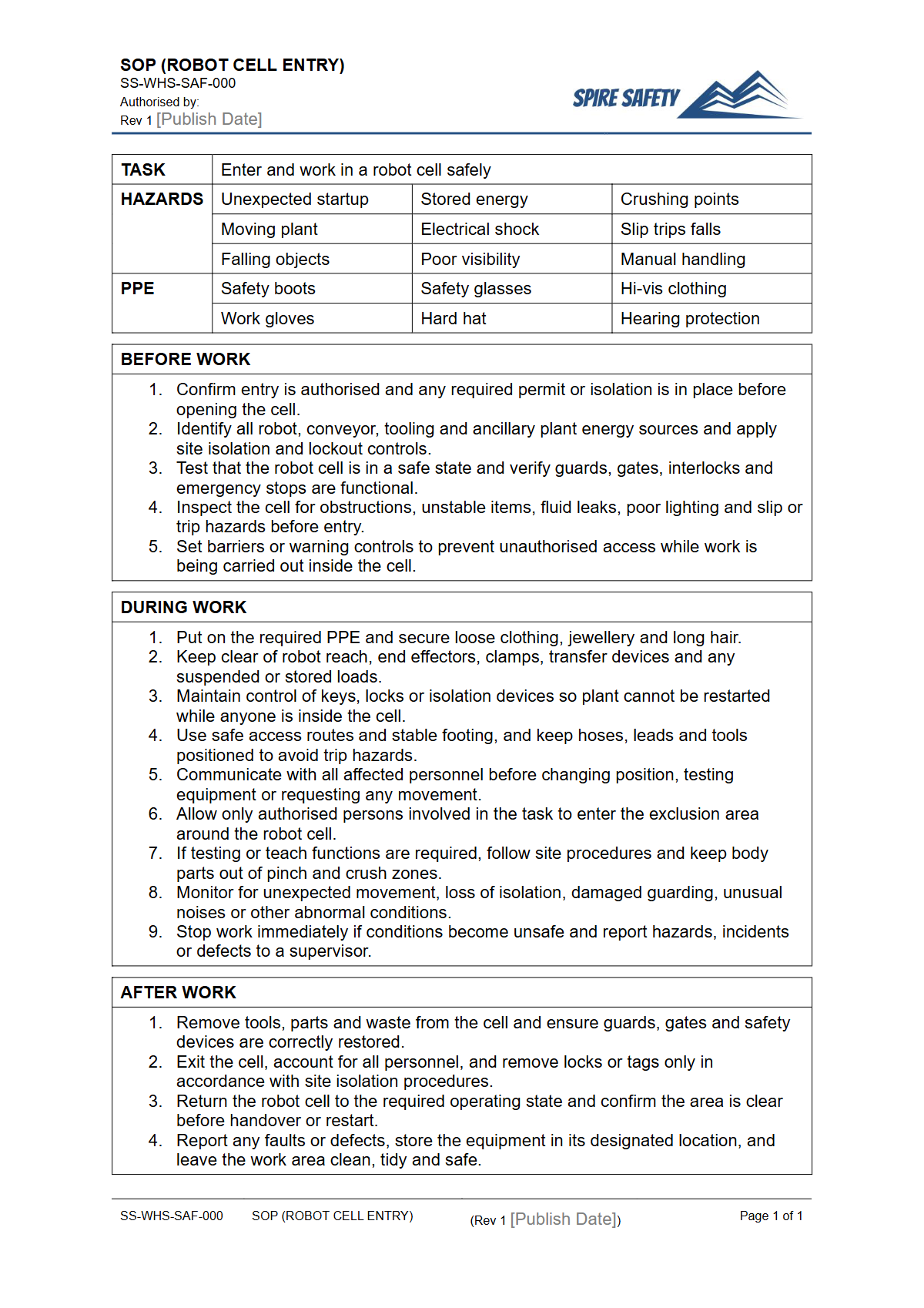
Purpose of the Free Safe Operating Procedure (Robot Cell Entry) Template
Industrial robots operate with high speed and force, creating significant risks for anyone entering their workspace. This Free Safe Operating Procedure (Robot Cell Entry) Template provides a structured framework for documenting the essential steps to safely enter and work within a guarded robot cell.
Its primary purpose is to control hazards like crushing, impact, trapping, entanglement, and electrical shock by establishing a clear, repeatable process for de-energisation, isolation, and verification.
A well-developed Safe Operating Procedure (SOP) is a cornerstone of workplace safety, translating risk assessments into practical, actionable controls. By using this template, your organisation can standardise procedures, ensure workers are aware of all hazards, and demonstrate a commitment to safety.
This document is a critical component for integrating safe work practices into a comprehensive WHS management system, ensuring that interactions with high-risk machinery are managed effectively.
Video walkthrough
How to use the Free Safe Operating Procedure (Robot Cell Entry) Template
This downloadable template outlines the fundamental sections required for a robust Robot Cell Entry SOP. To make it effective for your workplace, you must add specific details relevant to your equipment, tasks, and environment.
Generic procedures are not sufficient; customisation is essential for controlling your specific risks.
Please note: This document is a starting point and must be customised to reflect the specific machinery, tasks, and control measures at your workplace. We recommend a competent person completes this process, referencing the manufacturer's instructions and a site-specific risk assessment.
Its effectiveness depends entirely on your organisation's customisation and implementation.
Before Customisation
Begin by gathering all relevant information. This includes:
- The robot manufacturer's operating and maintenance manuals.
- Site-specific risk assessments for the robot cell and associated tasks.
- Details of all energy sources (electrical, pneumatic, hydraulic, gravitational, etc.).
- Locations of all emergency stops, isolation points, and energy-dissipating devices.
- Specific entry procedures, including interlock keys and lock-out/tag-out (LOTO) protocols.
If you need assistance with the risk assessment process or tailoring the document to meet your operational needs, engaging with WHS consulting services can provide valuable, expert guidance.
Completing the Template
Work through each section of the Word document, replacing the placeholder text with your site-specific information. Be precise and unambiguous.
Detail the step-by-step process for isolation, locking, testing for zero energy, performing the work, and safely restoring power. Many robot cells work in conjunction with other automated equipment, such as those detailed in our conveyer system SOP template, and these interactions must also be considered.
When to use a Robot Cell Entry SOP
This Safe Operating Procedure should be used every time a person needs to cross the plane of a fixed guard or enter a robot's operating envelope. It is not intended for routine, automated operation. The procedure is mandatory for non-routine tasks such as:
- Scheduled preventive maintenance.
- Troubleshooting faults or errors.
- Clearing product jams or blockages.
- Cleaning the robot or surrounding equipment.
- Tool or end-effector changes.
- Reprogramming or teaching the robot from within the cell.
The consistent use of this SOP for all applicable tasks is a key indicator of a healthy safety culture. Its application should be regularly verified through workplace inspections and formal WHS compliance auditing to ensure procedures are being followed correctly.
Who should use it
This SOP is intended for all personnel who are trained and authorised to enter a robot cell. This typically includes:
- Maintenance Technicians (Mechanical and Electrical)
- Automation Engineers or Programmers
- Authorised Operators
- Supervisors overseeing work within the cell
All individuals using this procedure must be deemed competent, having received specific training on the robot cell's hazards, isolation procedures, and emergency responses. Competency should be verified and documented before any individual is permitted to enter the cell. Ancillary equipment, like compressed air systems, also requires its own safe work procedures, which can be developed using our free Air Compressor SOP template.
For more procedural documents and safety guides, you can explore our complete free WHS resources library, which offers a wide range of tools to support your safety management efforts.
Common mistakes
Common mistakes to avoid
- Failing to properly isolate all energy sources, including electrical, pneumatic, and hydraulic power.
- Entering the cell without personally verifying that the robot is in a safe, non-operational state.
- Overlooking stored or potential energy hazards after the primary power is switched off.
- Using a generic SOP from another machine without customising it for the specific robot, task, and cell layout.
Legal references
Legal considerations
The following legal requirements may be relevant to this type of work.
- Work Health and Safety Act (Harmonised) — Provides the primary duties for protecting workers and other people from work health and safety risks.
- Work Health and Safety Regulations (Harmonised) — Sets out requirements supporting the management of workplace hazards and risks.
The following codes may be relevant to this type of work.
- Managing WHS Risks Code of Practice — Provides practical guidance on identifying hazards, assessing risks and applying effective controls.
- Work Health and Safety Consultation, Cooperation and Coordination Code of Practice — Provides practical guidance on consulting workers and coordinating with other duty holders.
- Managing the Work Environment and Facilities Code of Practice — Provides practical guidance on safe work environments, workplace facilities and related controls.
Did you know
Stored Energy Risks
Even after a robot is powered down, systems like hydraulic or pneumatic accumulators can hold hazardous stored energy. A thorough SOP must include steps to safely release or block this energy before entry.
Collaborative Robots
Newer 'cobots' are designed to work alongside humans without traditional caging, but this does not eliminate risk. They still require a detailed risk assessment and may need specific SOPs for maintenance and non-collaborative tasks.
FAQ
Frequently asked questions
01What is a robot cell?
02What is the most critical part of a robot cell entry procedure?
03Is an SOP legally required for robot cells in Australia?
04Can I use this template for any type of industrial robot?
Share this resource
Free Safe Operating Procedure (Robot Cell Entry) Template
Browse Categories
How To Use It
- 1Download and open in Word or PDF.
- 2Replace the placeholders with your business details.
- 3Get it reviewed by a WHS specialist before rollout.
Need it customised?
Our WHS consultants can adapt this template to your site, run a gap analysis, or audit what you already have in place.
Book a Free Consultation WHS consulting servicesor call 1300 156 382
Related templates
- Free Safe Operating Procedure (Rock Anchor Drill) Template
- Free Safe Operating Procedure (Rock Drill) Template
- Free Safe Operating Procedure (Rock Garden Maintenance) Template
- Free Safe Operating Procedure (Rock Scaling) Template
- Free Safe Operating Procedure (Rod Spinner) Template
- Free Safe Operating Procedure (Roll Cage Handling) Template