
Free Safe Operating Procedure (Road Stabiliser) Template
Effectively manage risks associated with road stabilisers using our free template. Download your customisable Safe Operating Procedure to get started.
Free Safe Operating Procedure (Road Stabiliser) Template
DOCX • 126 KB + PDF
Updated Oct 2026
No signup required
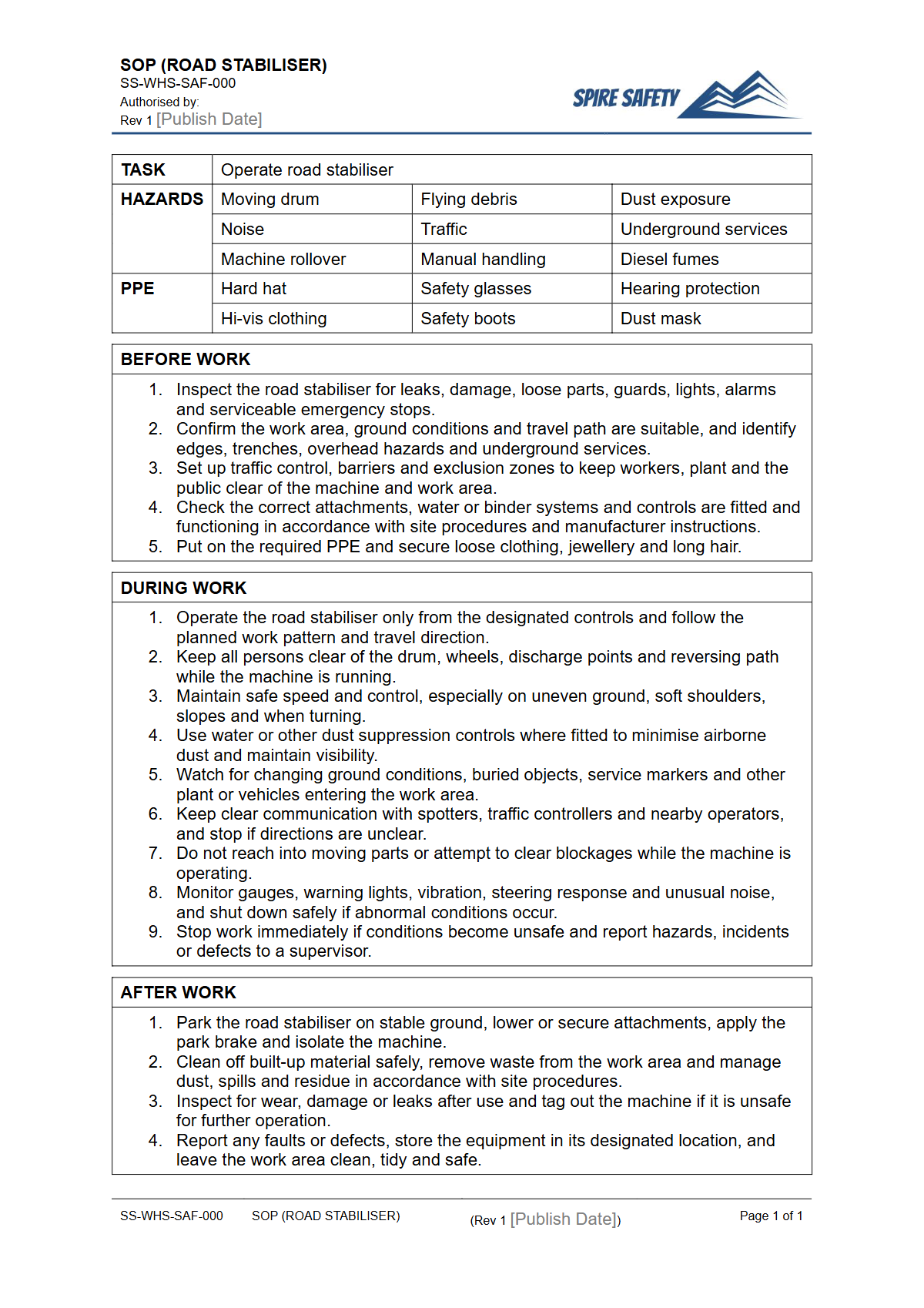
Purpose of the Free Safe Operating Procedure (Road Stabiliser) Template
This Free Safe Operating Procedure (Road Stabiliser) Template provides a structured starting point for documenting the safe use of road stabilising machinery in your workplace. Its purpose is to help your organisation outline a step-by-step process for operators, minimise health and safety risks, and ensure consistent operational standards.
Using a comprehensive Safe Operating Procedure (SOP) is a fundamental part of managing hazards associated with heavy plant, including mechanical failure, operator error, dust exposure, and interaction with other vehicles or ground crew. Documenting these procedures is a critical component of robust WHS management systems, demonstrating a commitment to proactive risk management.
Video walkthrough
How to use the Free Safe Operating Procedure (Road Stabiliser) Template
Our template is provided in both DOCX and PDF formats for your convenience. The DOCX file is fully editable, allowing you to tailor the content to your specific operational needs.
To use this template effectively, you must replace the placeholder text with information relevant to the make and model of your equipment, the specific materials being used (e.g., lime, cement, bitumen), and the unique environmental conditions of your worksite. Many civil construction projects involve a range of heavy machinery; you may also find our FREE Grader SOP Template useful for standardising procedures across different plant.
Important: This document is a template only. It is essential that you customise it to reflect the specific equipment, processes, and risks present in your workplace.
We are not responsible for the outcomes of the use or misuse of this document. The final responsibility for creating a comprehensive and accurate SOP that meets your legal obligations rests with the Person Conducting a Business or Undertaking (PCBU).
When to use a Safe Operating Procedure
A Safe Operating Procedure for a road stabiliser should be used as a primary reference document in several key situations. It forms the basis of operator training for new and existing employees, ensuring everyone is taught the same safe method of work.
It should be readily available at the worksite for quick reference during pre-start checks, routine operation, and shutdown. The SOP is also a critical tool for incident investigations, helping to determine if established procedures were followed.
Furthermore, it should be reviewed and updated whenever there is a change in equipment, processes, or after a near miss or incident occurs. Similar principles apply to other earthmoving equipment, as outlined in our FREE Scraper SOP Template.
Who should use it
This template is designed for use by several key personnel within an organisation. WHS managers and supervisors will use it to standardise procedures and meet their due diligence obligations.
Equipment operators must use the finalised SOP as their guide for safe, day-to-day operation. It provides them with clear, unambiguous instructions on how to perform their tasks without endangering themselves or others.
Training coordinators can also integrate the SOP into their induction and competency verification programs. For organisations needing expert assistance in developing and implementing these critical documents, Spire Safety offers professional WHS consulting services.
Key Elements of a Road Stabiliser SOP
A comprehensive SOP for this type of equipment should always include the following sections, all of which are included as prompts in the template:
- Required Personal Protective Equipment (PPE): Specifies necessary gear such as high-visibility clothing, steel-capped boots, respiratory protection (e.g., P2 masks for dust), hearing protection, and safety glasses.
- Pre-Operational Safety Checks: A detailed checklist covering fluid levels, tyre condition, hydraulic systems, guards, controls, and emergency stops.
- Step-by-Step Operating Sequence: A logical flow of tasks from start-up to shutdown, including binder application, mixing, and compaction processes. This should also reference procedures for working on slopes or uneven ground, which may share techniques with those in a FREE Trencher SOP Template.
- Potential Hazards and Control Measures: Identification of risks like airborne dust (silica), chemical burns from binders, noise, vibration, rollovers, and traffic interaction, along with the hierarchy of controls to mitigate them.
- Emergency Procedures: Clear instructions for responding to machine failure, fire, medical emergencies, or chemical spills.
By thoroughly completing each section, you create a valuable tool that not only guides safe behaviour but also serves as a key compliance document. You can explore our complete range of document templates in our free WHS resources library.
Common mistakes
Common mistakes to avoid
- Using a generic SOP without customising it for the specific machine and site conditions.
- Failing to consult with operators during the drafting and review process.
- Not providing adequate training on the contents of the finalised SOP.
- Neglecting to review and update the procedure after an incident or equipment change.
Legal references
Legal considerations
The following legal requirements may be relevant to this type of work.
- Work Health and Safety Act (Harmonised) — Provides the primary duties for protecting workers and other people from work health and safety risks.
- Work Health and Safety Regulations (Harmonised) — Sets out requirements supporting the management of workplace hazards and risks.
The following codes may be relevant to this type of work.
- Managing WHS Risks Code of Practice — Provides practical guidance on identifying hazards, assessing risks and applying effective controls.
- Work Health and Safety Consultation, Cooperation and Coordination Code of Practice — Provides practical guidance on consulting workers and coordinating with other duty holders.
- Managing the Work Environment and Facilities Code of Practice — Provides practical guidance on safe work environments, workplace facilities and related controls.
Did you know
Dust Hazards
Road stabilisation can release significant amounts of airborne dust, including respirable crystalline silica from base materials and caustic dust from binders like lime or cement, posing serious long-term health risks if not controlled.
Machine Power
Modern road stabilisers are powerful machines capable of mixing soil and binding agents to depths of over 500mm in a single pass, requiring highly skilled operators and strict safety protocols.
FAQ
Frequently asked questions
01What is a Safe Operating Procedure for a road stabiliser?
02Is this road stabiliser SOP template compliant with Australian WHS laws?
03How often should a road stabiliser SOP be reviewed?
04Who is responsible for writing a Safe Operating Procedure?
Share this resource
Free Safe Operating Procedure (Road Stabiliser) Template
Browse Categories
How To Use It
- 1Download and open in Word or PDF.
- 2Replace the placeholders with your business details.
- 3Get it reviewed by a WHS specialist before rollout.
Need it customised?
Our WHS consultants can adapt this template to your site, run a gap analysis, or audit what you already have in place.
Book a Free Consultation WHS consulting servicesor call 1300 156 382
Related templates
- Free Safe Operating Procedure (Roadside Litter Pickup) Template
- Free Safe Operating Procedure (Robot Cell Entry) Template
- Free Safe Operating Procedure (Rock Anchor Drill) Template
- Free Safe Operating Procedure (Rock Drill) Template
- Free Safe Operating Procedure (Rock Garden Maintenance) Template
- Free Safe Operating Procedure (Rock Scaling) Template