
Free Safe Operating Procedure (Rigging Gear Storage) Template
Define safe storage procedures for your workplace's rigging equipment to prevent damage and accidents. Download our free Safe Operating Procedure template.
Free Safe Operating Procedure (Rigging Gear Storage) Template
DOCX • 126 KB + PDF
Updated Oct 2026
No signup required
Purpose of the Free Safe Operating Procedure (Rigging Gear Storage) Template
Proper storage of rigging gear is a critical but often overlooked aspect of workplace safety. Incorrectly stored slings, shackles, chains, and hoists can be damaged by corrosion, UV degradation, crushing, or chemical exposure, leading to catastrophic failure under load.
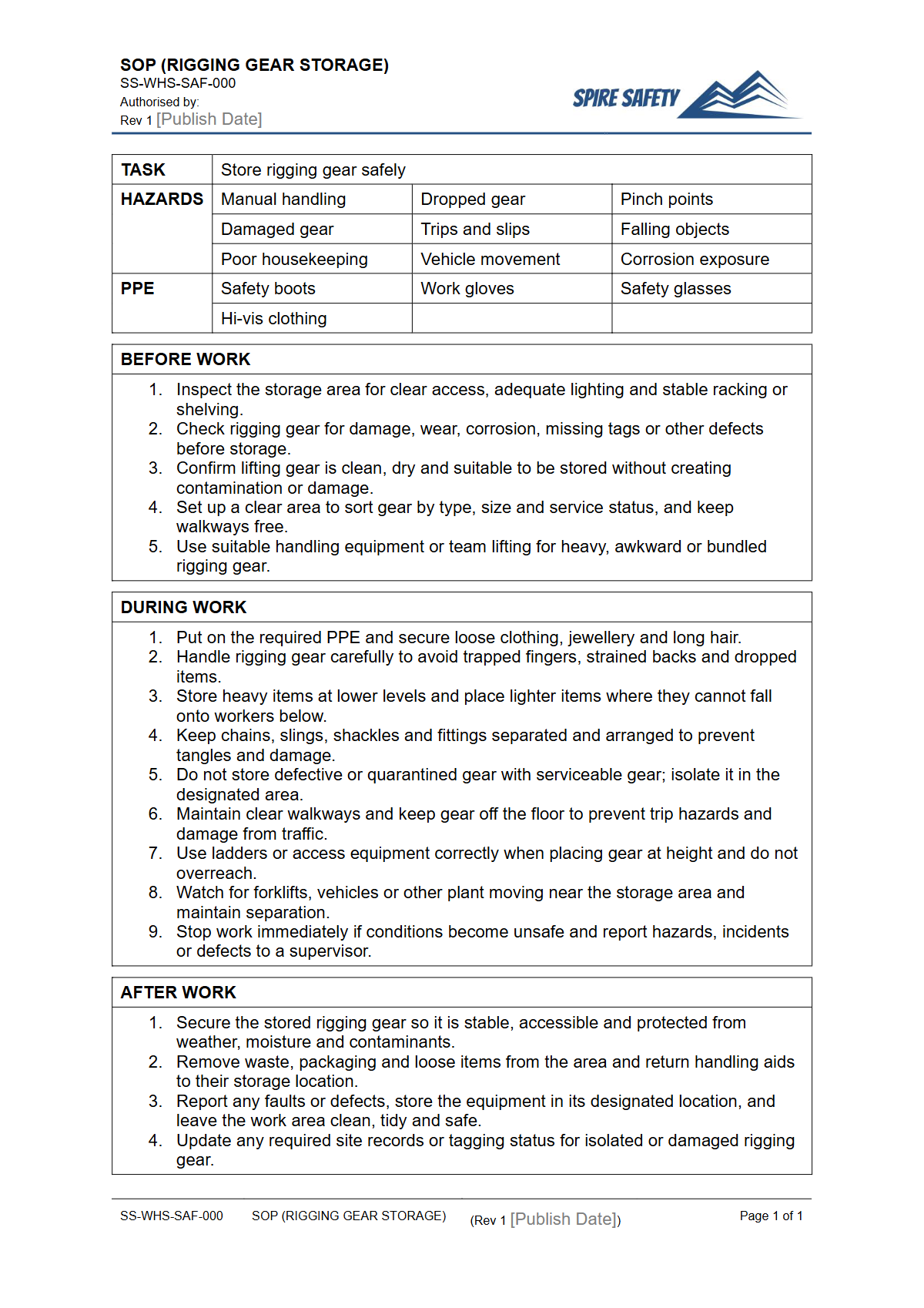
This free Safe Operating Procedure (Rigging Gear Storage) Template provides a structured framework for documenting the specific steps required to store, handle, and inspect your equipment correctly. Using a formalised procedure helps protect valuable assets from premature wear, ensures gear is fit-for-purpose when needed, and demonstrates a proactive approach to risk management.
A well-defined SOP is a fundamental component of a robust safety framework. It helps an organisation meet its primary duty of care under WHS legislation by providing clear, actionable instructions to workers. Implementing systematic procedures for all high-risk tasks contributes to a stronger safety culture and forms a key part of your overall WHS management system.
Key Elements of a Rigging Gear Storage SOP
An effective SOP for this task should cover several key areas to ensure comprehensiveness:
- Designated Storage Area: The procedure should specify a clean, dry, well-ventilated area away from direct sunlight, extreme temperatures, and corrosive substances.
- Storage Methods: It should detail how different types of gear are stored. For example, fibre slings should be hung on non-abrasive, rounded pegs, while chains can be stored on racks that prevent tangling and damage.
- Inspection Before Storage: Outline the requirement for a visual inspection after use and before gear is put away, identifying any damage that requires the item to be quarantined.
- Segregation of Damaged Gear: The SOP must define a clear process and location for quarantining faulty or damaged equipment, ensuring it cannot be accidentally returned to service.
- Record Keeping: Detail the logs required for inspection, maintenance, and quarantine to maintain a clear history for each piece of equipment. Using such procedures is also essential for complex machinery, as seen in our FREE Telehandler SOP Template.
Video walkthrough
How to Use the Free Safe Operating Procedure (Rigging Gear Storage) Template
This downloadable template is provided in both DOCX and PDF formats to suit your needs. The DOCX file is fully editable, allowing you to adapt the content to the specific realities of your worksite.
The procedure is based on principles from the model WHS framework and Australian Standards to provide a solid starting point. However, compliance is not automatic; it depends on how you tailor and implement the document.
It is important to remember that this is a template, not a finished document. We have designed it as a starting point, and you must customise it to reflect the specific rigging equipment, storage facilities, environmental conditions, and operational risks present in your workplace.
We strongly recommend consulting with the workers and supervisors who handle the rigging gear daily during the customisation process. Their direct experience is invaluable for creating a practical and effective procedure.
After customisation, a periodic review as part of a WHS compliance audit can ensure the SOP remains relevant.
When to Use This Safe Operating Procedure
A Safe Operating Procedure for rigging gear storage should be a living document integrated into your daily operations. It is particularly crucial in several scenarios:
- Training and Induction: Use it as a primary training tool for new employees, apprentices, and any worker tasked with handling rigging equipment.
- Toolbox Talks: Refer to the SOP during safety meetings to refresh knowledge and reinforce correct practices.
- Incident Investigation: If an incident or near-miss involving rigging equipment occurs, the SOP should be reviewed as part of the investigation to identify any procedural gaps.
- Workplace Inspections: Use the document as a checklist during routine inspections of the storage area to ensure procedures are being followed correctly.
- Purchasing New Equipment: When new types of rigging gear are introduced, the SOP should be updated to include any specific storage requirements recommended by the manufacturer. This systematic approach is also vital for other key site tasks, as shown in our FREE Grader SOP (Safe Operating Procedure) Template.
Who Should Use This SOP
This SOP is intended for use by multiple roles within an organisation to create a shared understanding of safety requirements.
- PCBU (Person Conducting a Business or Undertaking): The PCBU or their management team is responsible for ensuring adequate resources and systems are in place, including the implementation of this SOP.
- Supervisors and Team Leaders: These individuals are responsible for enforcing the procedure, providing training, and ensuring workers on their team follow the documented steps.
- WHS/HSE Officers: Safety professionals use the SOP to conduct audits, deliver training, and integrate storage protocols into the broader safety management system. Proper material handling procedures extend beyond rigging, as you can explore with resources like our FREE Conveyer System SOP.
- Workers and Operators: All personnel who handle, inspect, or use rigging gear must be trained on and follow the SOP to ensure their own safety and that of their colleagues.
By making these procedures accessible, you empower everyone on site to contribute to a safer work environment. For more templates and safety guides, you can browse our complete free WHS resources library.
Common mistakes
Common mistakes to avoid
- Storing slings and other gear on the floor or ground.
- Hanging slings on nails, bolts, or sharp hooks that cause cuts and abrasion.
- Failing to clean equipment before storage, trapping abrasive dirt and corrosive moisture.
- Storing different types of equipment (e.g., chains and synthetic slings) tangled together, causing damage.
Legal references
Legal considerations
The following legal requirements may be relevant to this type of work.
- Work Health and Safety Act (Harmonised) — Provides the primary duties for protecting workers and other people from work health and safety risks.
- Work Health and Safety Regulations (Harmonised) — Sets out requirements supporting the management of workplace hazards and risks.
The following codes may be relevant to this type of work.
- Managing WHS Risks Code of Practice — Provides practical guidance on identifying hazards, assessing risks and applying effective controls.
- Work Health and Safety Consultation, Cooperation and Coordination Code of Practice — Provides practical guidance on consulting workers and coordinating with other duty holders.
- Managing the Work Environment and Facilities Code of Practice — Provides practical guidance on safe work environments, workplace facilities and related controls.
Did you know
The Hidden Damage
According to industry reports, improper storage is one of the leading causes of synthetic sling degradation. UV light exposure can reduce a sling's strength by up to 50% in just a few months, often with no obvious visual signs.
Quarantine is Critical
A significant portion of rigging-related incidents involve equipment that was previously identified as damaged but was not properly quarantined. A dedicated, clearly marked 'sin bin' for faulty gear is a simple but critical control measure.
FAQ
Frequently asked questions
01What should be included in an SOP for rigging gear storage?
02How often should rigging gear be inspected?
03Why can't I store rigging gear on the ground?
04Is a Safe Operating Procedure a legal requirement in Australia?
Share this resource
Free Safe Operating Procedure (Rigging Gear Storage) Template
Browse Categories
How To Use It
- 1Download and open in Word or PDF.
- 2Replace the placeholders with your business details.
- 3Get it reviewed by a WHS specialist before rollout.
Need it customised?
Our WHS consultants can adapt this template to your site, run a gap analysis, or audit what you already have in place.
Book a Free Consultation WHS consulting servicesor call 1300 156 382
Related templates
- Free Safe Operating Procedure (Rigging Setup) Template
- Free Safe Operating Procedure (Road Broom) Template
- Free Safe Operating Procedure (Road Marking Machine) Template
- Free Safe Operating Procedure (Road Profiler) Template
- Free Safe Operating Procedure (Road Saw) Template
- Free Safe Operating Procedure (Road Stabiliser) Template