
Free Safe Operating Procedure (Road Profiler) Template
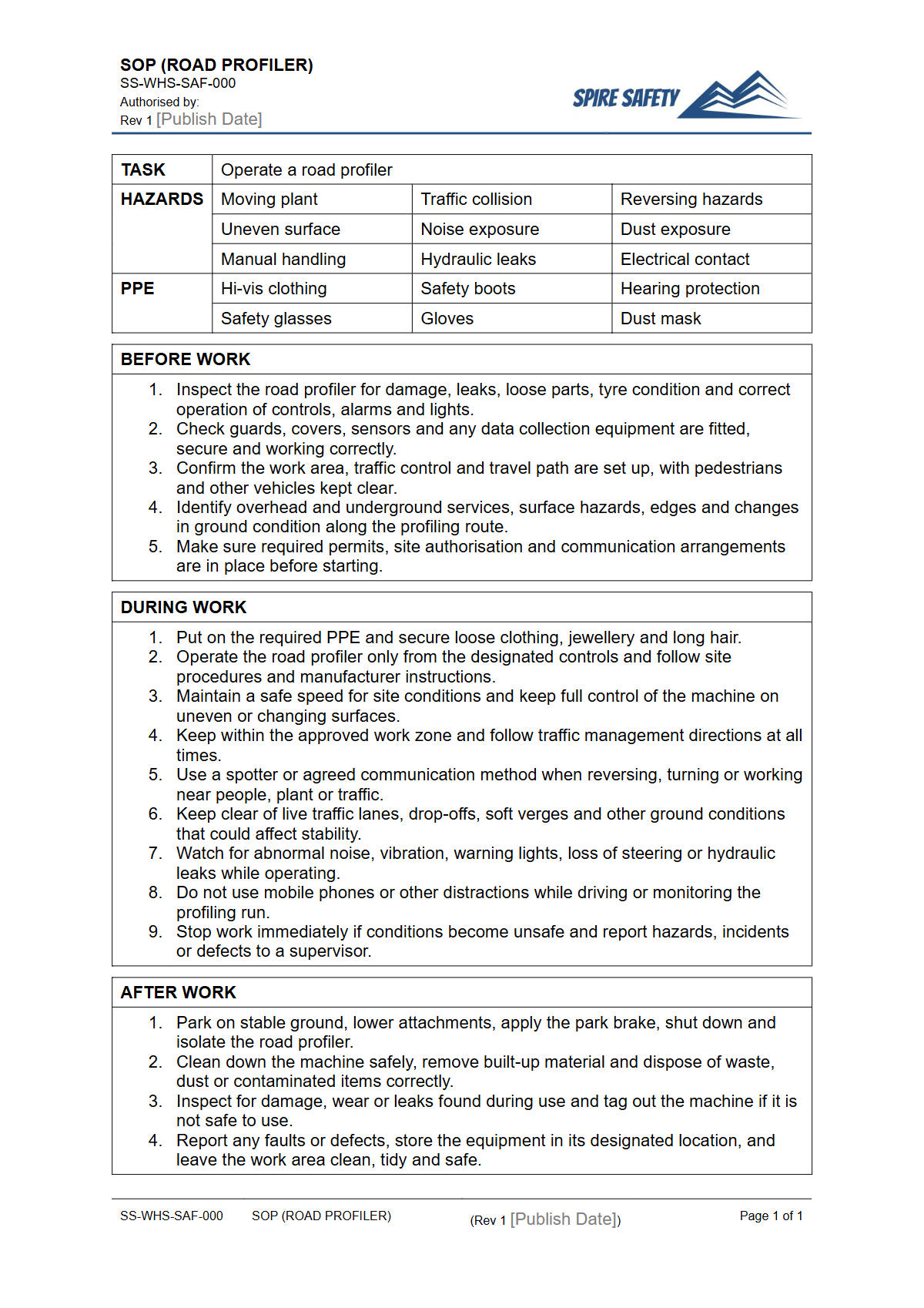
Our Safe Operating Procedure (Road Profiler) template provides a structured format for documenting safety protocols. Download this free resource to start today.
Free Safe Operating Procedure (Road Profiler) Template
DOCX • 126 KB + PDF
Updated Oct 2026
No signup required
Purpose of the Free Safe Operating Procedure (Road Profiler) Template
Operating a road profiler involves significant risks, including exposure to traffic, airborne contaminants like silica dust, high noise levels, and mechanical hazards. This Free Safe Operating Procedure (Road Profiler) Template provides a structured starting point for documenting the required steps to operate this machinery safely.
It is designed to help your organisation establish and formalise control measures, standardise operator training, and demonstrate a commitment to managing workplace health and safety risks effectively. A clear SOP is a fundamental tool for risk management, ensuring that every operator understands the approved methods for performing tasks safely and efficiently.
Video walkthrough
How to use the Free Safe Operating Procedure (Road Profiler) Template
To implement this Safe Operating Procedure, download the DOCX file and adapt it to your specific operational context. This involves a thorough review of your workplace, the specific make and model of the road profiler in use, and any site-specific hazards.
You will need to add detailed information regarding required Personal Protective Equipment (PPE), pre-start checks, emergency shutdown procedures, and routine maintenance schedules. The goal is to create a practical, user-friendly document that becomes an integral part of your WHS management system.
Important: This document is a template and not a complete Safe Operating Procedure. We have provided a framework based on common industry practice, but you must customise it to reflect the unique equipment, risks, and control measures relevant to your specific workplace and activities.
Its effectiveness is entirely dependent on accurate and thorough customisation.
When to use it
A Road Profiler SOP should be used as a primary reference document in several key situations. It forms the basis of operator training and competency assessments, ensuring all workers are taught the same safe method of work.
It should be readily accessible and referred to during pre-start meetings and daily toolbox talks to reinforce safety standards. The SOP also serves as a critical reference when developing a Safe Work Method Statement (SWMS) for high-risk construction work involving the profiler.
Following an incident or near-miss, the SOP should be reviewed as part of the investigation to identify any procedural gaps. For similar heavy equipment tasks, a document like a Grader SOP template serves a comparable purpose in standardising safe operation.
Who should use it
This template is intended for use by personnel responsible for health and safety in civil construction, roadworks, and infrastructure maintenance. This includes WHS Advisors, Site Supervisors, Project Managers, and Company Directors.
They are responsible for adapting the template and ensuring it is implemented correctly. Once finalised, the Safe Operating Procedure is a critical tool for the equipment operators themselves.
It provides them with clear, step-by-step instructions on how to perform their work without endangering themselves or others, acting as a daily guide for safe and compliant operation.
Key Elements of a Road Profiler SOP
A robust SOP for road profiling should be comprehensive and easy to understand. This template prompts you to detail several critical safety areas, ensuring a holistic approach to risk management:
- Pre-Operational Checks: Outlines a systematic inspection of the profiler's mechanical, hydraulic, and safety systems before work begins. This is similar to the checks required in our Scraper SOP template.
- Step-by-Step Operating Procedures: Details the sequence for starting, operating, and stopping the machine safely. This section must be customised to include specifics on managing traffic, controlling dust (especially silica), monitoring for underground services, and coordinating with spotters and other personnel.
- Post-Operational Procedures: Covers safe shutdown, cleaning, refuelling, and parking of the equipment.
- Emergency Procedures: Defines clear actions for foreseeable emergencies such as mechanical failure, fire, or medical incidents.
- Maintenance Requirements: Specifies the schedule for routine servicing and inspections to maintain the plant in safe working order. Properly maintained documentation is essential for passing a WHS compliance audit.
By customising each of these sections, you create a document that not only guides behaviour but also serves as a key record of your risk management process. For other specialised plant, you might find our free Trencher SOP a useful reference.
If you need more templates or checklists, you can explore our complete free WHS resources library for further support.
Common mistakes
Common mistakes to avoid
- Using the template without customising it for specific site conditions and profiler model.
- Failing to adequately train operators and supervisors on the finalised SOP content.
- Not reviewing and updating the document after an incident, near-miss, or change in process.
- Neglecting to include specific control measures for hazardous dusts like crystalline silica.
Legal references
Legal considerations
The following legal requirements may be relevant to this type of work.
- Work Health and Safety Act (Harmonised) — Provides the primary duties for protecting workers and other people from work health and safety risks.
- Work Health and Safety Regulations (Harmonised) — Sets out requirements supporting the management of workplace hazards and risks.
The following codes may be relevant to this type of work.
- Managing WHS Risks Code of Practice — Provides practical guidance on identifying hazards, assessing risks and applying effective controls.
- Work Health and Safety Consultation, Cooperation and Coordination Code of Practice — Provides practical guidance on consulting workers and coordinating with other duty holders.
- Managing the Work Environment and Facilities Code of Practice — Provides practical guidance on safe work environments, workplace facilities and related controls.
Did you know
Recycling Power
The milled material produced by a road profiler, known as Reclaimed Asphalt Pavement (RAP), is highly valuable and is frequently recycled into new asphalt mixes, reducing waste and the need for virgin materials.
Precision Engineering
Modern road profilers use sophisticated grade and slope control systems, often guided by GPS or lasers, to remove pavement with millimetre-level accuracy, ensuring a precise surface for repaving.
FAQ
Frequently asked questions
01What is the difference between a SWMS and an SOP for a road profiler?
02Does this template cover crystalline silica dust exposure from profiling?
03How often should a Safe Operating Procedure for a road profiler be reviewed?
04Can I use this template for any brand of road profiler?
Share this resource
Free Safe Operating Procedure (Road Profiler) Template
Browse Categories
How To Use It
- 1Download and open in Word or PDF.
- 2Replace the placeholders with your business details.
- 3Get it reviewed by a WHS specialist before rollout.
Need it customised?
Our WHS consultants can adapt this template to your site, run a gap analysis, or audit what you already have in place.
Book a Free Consultation WHS consulting servicesor call 1300 156 382
Related templates
- Free Safe Operating Procedure (Road Saw) Template
- Free Safe Operating Procedure (Road Stabiliser) Template
- Free Safe Operating Procedure (Roadside Litter Pickup) Template
- Free Safe Operating Procedure (Robot Cell Entry) Template
- Free Safe Operating Procedure (Rock Anchor Drill) Template
- Free Safe Operating Procedure (Rock Drill) Template