
Free Safe Operating Procedure (Road Broom) Template
Get a structured starting point for managing road broom hazards with our free template. Download your customisable Safe Operating Procedure today to improve safety.
Free Safe Operating Procedure (Road Broom) Template
DOCX • 126 KB + PDF
Updated Oct 2026
No signup required
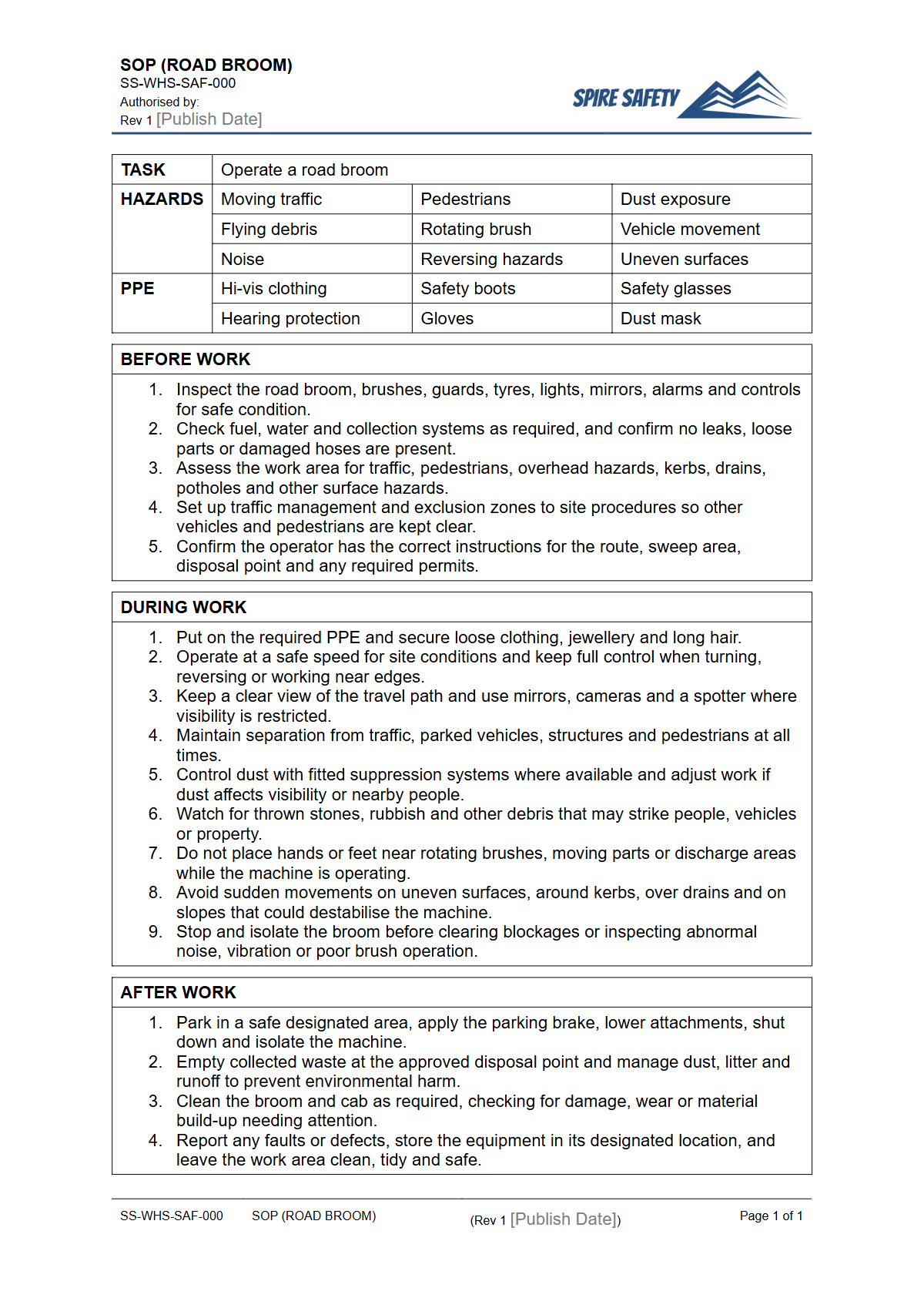
Purpose of the Free Safe Operating Procedure (Road Broom) Template
Operating a road broom involves significant risks, including interaction with traffic, exposure to hazardous dust, and mechanical failures. A formalised Safe Operating Procedure (SOP) is a critical tool for any organisation using this equipment.
This Free Safe Operating Procedure (Road Broom) Template provides a structured framework to document safe work methods, helping to ensure consistent and safe operation every time. It prompts you to detail pre-start checks, step-by-step operating instructions, shutdown processes, and emergency responses, forming a key part of your safe system of work.
By implementing a clear SOP, you standardise procedures, reduce the likelihood of incidents, and demonstrate a commitment to fulfilling your WHS duties. A well-developed SOP is an essential document for training new operators and serves as a vital reference for experienced personnel.
It acts as a baseline for safe behaviour, similar to how our free Grader SOP template helps manage the risks of other common roadwork machinery.
Video walkthrough
How to use the Free Safe Operating Procedure (Road Broom) Template
This resource is available for immediate download in both DOCX and PDF formats. The DOCX version is fully editable, allowing you to tailor it directly to your workplace's specific needs.
Simply add your company branding, and then work through each section to insert details relevant to your machinery and operational environment. This includes specifying the exact make and model of the road broom, detailing site-specific traffic management rules, and listing the required Personal Protective Equipment (PPE).
Important: This document is a template, not a finished procedure. It is crucial to adapt this document to the specific models of road brooms used in your organisation, the unique site conditions, and your existing WHS management systems. We have provided a framework based on Australian WHS principles, but you must complete the final risk assessment and procedural details to ensure it is effective for your context.
When Should You Use a Road Broom SOP?
A road broom SOP is not a document to be filed away and forgotten. It is an active tool used in daily operations to reinforce safety.
It should be used during the induction and training of new operators to establish a strong foundation of safe practice. It also serves as the primary checklist for conducting mandatory pre-operational inspections, ensuring the machine is fit for service before each shift.
Furthermore, the SOP should be readily accessible to operators as a reference guide in the workplace. It is also an invaluable document during incident investigations or when conducting safety observations, providing a clear benchmark against which actual work practices can be compared.
Using SOPs for related machinery, such as those in our Scraper SOP template, helps build a consistent safety culture across all plant operations.
Who Should Use This Template?
This template is designed for anyone responsible for workplace safety and machinery operation. This includes WHS Managers, Site Supervisors, Operations Managers, and business owners in sectors like civil construction, local government, road maintenance, and large-scale facility management.
It provides a professional, structured starting point that saves time and effort in document creation.
Team leaders and trainers will find it essential for developing training programs and verifying the competency of their operators. By customising procedures for different types of heavy equipment, such as by also using a Trencher SOP for excavation work, an organisation can build a comprehensive library of procedural documents that enhances overall site safety.
Key Elements of an Effective SOP
A comprehensive SOP for a road broom should cover several key areas to be effective. The template guides you through these sections, ensuring critical information is not overlooked. Key elements include:
- Hazard Identification: Clearly listing potential hazards such as traffic, moving parts, hydraulic systems, noise, vibration, and airborne contaminants like silica dust.
- Personal Protective Equipment (PPE): Specifying mandatory PPE, which may include high-visibility clothing, safety footwear, hearing protection, safety glasses, and respiratory protection (RPE).
- Pre-Operational Checks: A detailed checklist covering fluid levels, tyre condition, warning devices (lights and alarms), broom condition, and emergency stop functionality.
- Safe Operating Steps: A sequential guide to operation, including mounting and dismounting, managing the sweeping area, dust suppression techniques, and interacting with other vehicles or personnel.
- Shutdown and Cleaning: Documenting the correct procedure for powering down the machine, securing it against unauthorised use, and performing routine clean-down tasks safely.
Regularly reviewing that these procedures are being followed is a core part of safety management. This can be verified through processes like WHS compliance auditing to ensure the SOP remains a living document that reflects actual safe practice on site.
By thoroughly completing each section of this template, you create a robust safety document that is practical, relevant, and effective. You can find many other helpful documents in our complete free WHS resources library to support your safety management system.
Common mistakes
Common mistakes to avoid
- Failing to customise the template for specific broom models and unique site conditions.
- Neglecting to operate or maintain dust suppression systems, creating respiratory hazards.
- Inadequate training on the specific emergency shutdown procedures for the machine.
- Poor communication and traffic management in the work area, leading to collision risks.
Legal references
Legal considerations
The following legal requirements may be relevant to this type of work.
- Work Health and Safety Act (Harmonised) — Provides the primary duties for protecting workers and other people from work health and safety risks.
- Work Health and Safety Regulations (Harmonised) — Sets out requirements supporting the management of workplace hazards and risks.
The following codes may be relevant to this type of work.
- Managing WHS Risks Code of Practice — Provides practical guidance on identifying hazards, assessing risks and applying effective controls.
- Work Health and Safety Consultation, Cooperation and Coordination Code of Practice — Provides practical guidance on consulting workers and coordinating with other duty holders.
- Managing the Work Environment and Facilities Code of Practice — Provides practical guidance on safe work environments, workplace facilities and related controls.
Did you know
Dust Suppression is Critical
Modern road brooms use water spray systems not just to aid cleaning, but to suppress airborne dust. This is a crucial control for preventing worker exposure to hazardous respirable crystalline silica, a major cause of occupational disease in Australia.
Pre-Start Checks Prevent Failure
A thorough pre-start inspection, as outlined in an SOP, can identify over 80% of potential mechanical failures before they cause an incident or costly breakdown during a shift.
FAQ
Frequently asked questions
01What are the main hazards of operating a road broom?
02Is a Safe Operating Procedure a legal requirement for road brooms in Australia?
03How often should a road broom SOP be reviewed?
04Can this template be used for all types of road brooms?
Share this resource
Free Safe Operating Procedure (Road Broom) Template
Browse Categories
How To Use It
- 1Download and open in Word or PDF.
- 2Replace the placeholders with your business details.
- 3Get it reviewed by a WHS specialist before rollout.
Need it customised?
Our WHS consultants can adapt this template to your site, run a gap analysis, or audit what you already have in place.
Book a Free Consultation WHS consulting servicesor call 1300 156 382
Related templates
- Free Safe Operating Procedure (Road Marking Machine) Template
- Free Safe Operating Procedure (Road Profiler) Template
- Free Safe Operating Procedure (Road Saw) Template
- Free Safe Operating Procedure (Road Stabiliser) Template
- Free Safe Operating Procedure (Roadside Litter Pickup) Template
- Free Safe Operating Procedure (Robot Cell Entry) Template