
Free Safe Operating Procedure (Road Marking Machine) Template
Download our free Safe Operating Procedure (Road Marking Machine) Template to formalise your safety processes.
Free Safe Operating Procedure (Road Marking Machine) Template
DOCX • 126 KB + PDF
Updated Oct 2026
No signup required
Purpose of the Free Safe Operating Procedure (Road Marking Machine) Template
Effectively managing workplace health and safety requires clear, documented processes for high-risk tasks. This free Safe Operating Procedure (Road Marking Machine) Template provides a structured starting point for your business to formalise instructions for the safe use of this specialised plant.
An SOP outlines step-by-step instructions, identifies potential hazards, and specifies control measures to minimise risks to operators and others. Implementing a documented SOP helps ensure operational consistency, assists in training new workers, and demonstrates a commitment to proactive safety management.
A well-developed SOP is a critical component of a functional safety framework. It serves as a practical tool for workers on the ground and provides essential documentation that integrates into your organisation's broader WHS management systems. By clearly defining safe work methods, you reduce the likelihood of incidents caused by procedural errors or lack of knowledge.
Video walkthrough
How to Use the Free Safe Operating Procedure (Road Marking Machine) Template
This resource is available for immediate download in both DOCX and PDF formats. The DOCX file is fully editable, allowing you to tailor the content to your specific operational needs.
The PDF version can be used as a stable reference or for immediate distribution once your customisations are complete. Begin by downloading the template and opening the DOCX file.
Systematically work through each section, replacing the placeholder text with information relevant to your specific road marking machine model, the types of materials used (e.g., thermoplastic, waterborne paint), and the typical environments where work is performed.
Please note: This template provides a solid foundation aligned with Australian WHS principles, but it is not a finished document. We have designed it to be customised.
You must review, edit, and adapt every section to reflect the specific machinery, site conditions, and unique working environment of your organisation. It is vital to consult with experienced operators, supervisors, and health and safety representatives during the customisation process to ensure the final SOP is practical and effective.
This collaborative approach ensures the procedure is not only technically correct but also understood and accepted by those who will use it.
Key Elements of a Road Marking Machine SOP
A robust SOP for mobile plant like a road marking machine should be comprehensive, covering every phase of its use. This template guides you through documenting essential safety information, ensuring no critical step is overlooked.
Key sections you will need to customise include pre-operational checks, safe operating steps, and post-operational procedures. This structured approach helps formalise safety in a way that is easy for operators to follow, similar to the requirements outlined in our grader SOP.
The main components include:
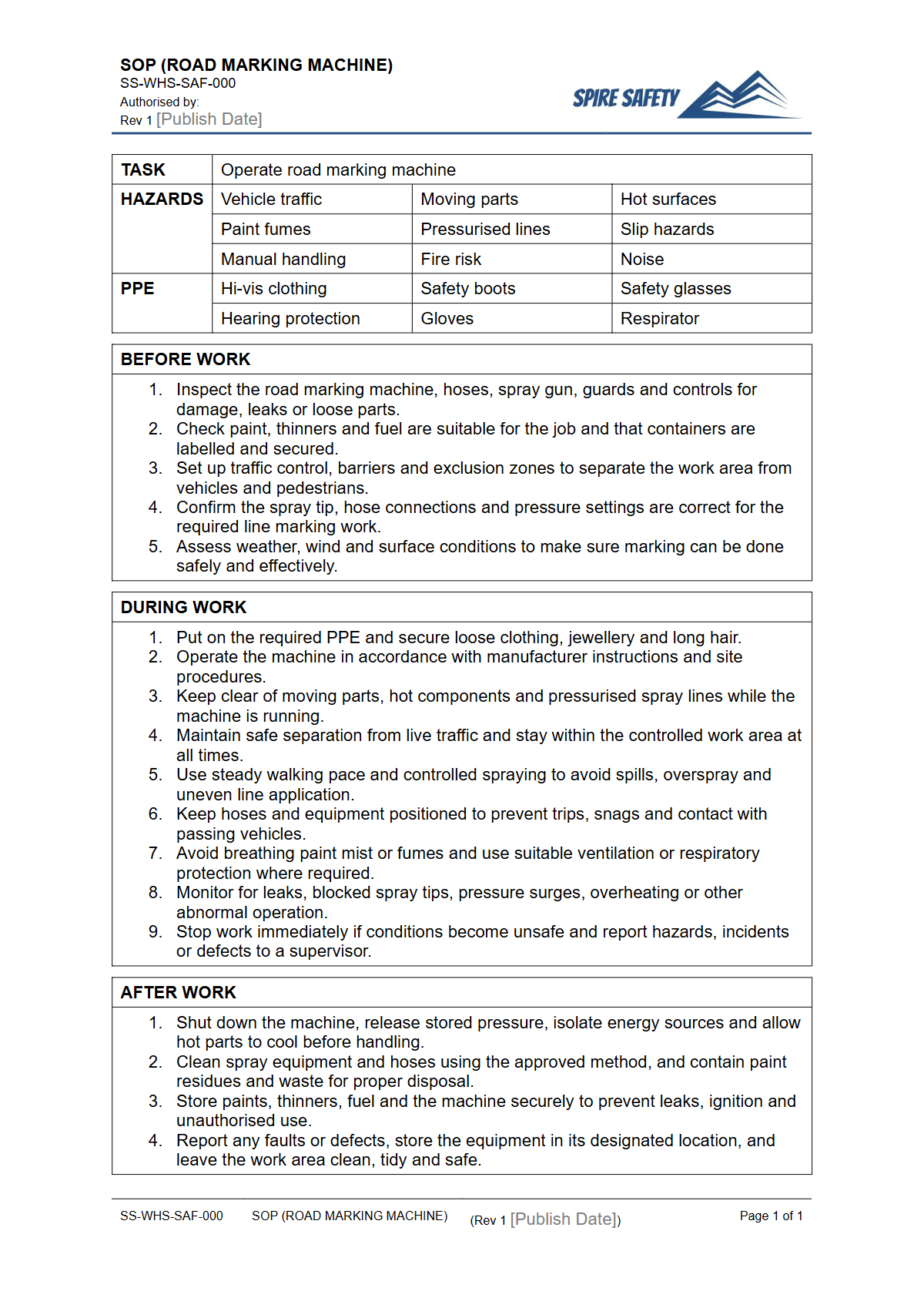
- Required PPE: List all personal protective equipment required, such as high-visibility clothing, safety footwear, respiratory protection (for fumes), and eye protection.
- Hazard Identification: Detail potential hazards like traffic, hot materials, chemical exposure, mechanical moving parts, and noise.
- Pre-Operational Checks: Create a checklist for inspecting the machine before use, covering aspects like fluid levels, tyre condition, safety guards, emergency stops, and the application system.
- Step-by-Step Operating Instructions: Clearly describe the sequence for safely starting, operating, and shutting down the machine. This includes traffic management setup, surface preparation, material handling, and application techniques.
- Post-Operational Procedures: Outline requirements for cleaning the machine, disposing of waste materials safely, and securing the equipment for storage.
- Emergency Procedures: Detail actions to take in case of a fire, chemical spill, mechanical failure, or medical emergency.
Thoroughly detailing each of these stages provides operators with a clear and unambiguous guide to performing their work safely. Just as with other specialised equipment, a detailed procedure is non-negotiable, a principle that applies whether you're using a road marker or require a trencher SOP template for excavation work.
When to Use This Safe Operating Procedure
A Safe Operating Procedure is not a document that should be filed away and forgotten. It is a live document that should be actively used in day-to-day operations to guide safe work practices.
It should be the primary reference document for all tasks involving the road marking machine. Its use is particularly critical during operator training and induction, ensuring new team members learn the correct, safe methods from the start.
The SOP should also be used for conducting refresher training, investigating incidents or near misses, and as a benchmark during workplace inspections. Regular reviews of the SOP against actual work practices are essential for identifying any gaps or needs for improvement in your safety processes.
This proactive use is a cornerstone of effective safety management and is a key focus during any formal WHS compliance auditing activities.
Who Should Use It
This SOP is intended for a range of personnel within an organisation. Primarily, it is for the operators of the road marking machine, providing them with clear, authoritative instructions.
Supervisors and team leaders should also use the document to oversee work, enforce safety standards, and deliver toolbox talks or on-the-job training. WHS managers and coordinators will use the SOP as a key part of their risk management toolkit, ensuring that controls for identified hazards are documented and communicated effectively.
Maintenance personnel should also refer to relevant sections of the SOP, particularly those related to safe shutdown, isolation, and cleaning, before commencing any service or repair work. The principles of documenting safe use for mobile plant are universal, which is why we also provide resources like a Telehandler SOP template for businesses using different types of high-risk equipment.
If your operations involve other machinery, such as for preparing the road surface, you may need additional documentation. For example, if compressed air is used for cleaning, a specific Air Compressor SOP would be required to manage the associated risks.
You can find a wide range of templates covering various plant and equipment in our free WHS resources library to build out your safety documentation.
Common mistakes
Common mistakes to avoid
- Failing to implement an adequate traffic management plan, exposing workers to live traffic.
- Neglecting proper surface preparation, such as cleaning and drying, leading to poor line adhesion and premature failure.
- Using a generic SOP without customising it for the specific machine model and materials in use.
- Inadequate ventilation or respiratory protection when working with heated materials or paints, leading to fume inhalation.
Legal references
Legal considerations
The following legal requirements may be relevant to this type of work.
- Work Health and Safety Act (Harmonised) — Provides the primary duties for protecting workers and other people from work health and safety risks.
- Work Health and Safety Regulations (Harmonised) — Sets out requirements supporting the management of workplace hazards and risks.
The following codes may be relevant to this type of work.
- Managing WHS Risks Code of Practice — Provides practical guidance on identifying hazards, assessing risks and applying effective controls.
- Work Health and Safety Consultation, Cooperation and Coordination Code of Practice — Provides practical guidance on consulting workers and coordinating with other duty holders.
- Managing the Work Environment and Facilities Code of Practice — Provides practical guidance on safe work environments, workplace facilities and related controls.
Did you know
Retroreflectivity
Road markings are not just paint; they contain tiny glass beads that act as retroreflectors. These beads bend light from a vehicle's headlights and reflect it directly back to the driver, making the lines appear bright and visible at night.
Material Matters
Thermoplastic road marking material is a common choice for high-traffic areas. It is heated to over 200°C before application, creating a durable bond with the pavement that can last for several years, far outlasting standard paint.
FAQ
Frequently asked questions
01What are the main hazards of operating a road marking machine?
02Is a specific licence required to operate a road marking machine in Australia?
03How often should an SOP for a road marking machine be reviewed?
04What PPE is required for road marking operations?
Share this resource
Free Safe Operating Procedure (Road Marking Machine) Template
Browse Categories
How To Use It
- 1Download and open in Word or PDF.
- 2Replace the placeholders with your business details.
- 3Get it reviewed by a WHS specialist before rollout.
Need it customised?
Our WHS consultants can adapt this template to your site, run a gap analysis, or audit what you already have in place.
Book a Free Consultation WHS consulting servicesor call 1300 156 382
Related templates
- Free Safe Operating Procedure (Road Profiler) Template
- Free Safe Operating Procedure (Road Saw) Template
- Free Safe Operating Procedure (Road Stabiliser) Template
- Free Safe Operating Procedure (Roadside Litter Pickup) Template
- Free Safe Operating Procedure (Robot Cell Entry) Template
- Free Safe Operating Procedure (Rock Anchor Drill) Template