
Free Safe Operating Procedure (Rigging Setup) Template
Download our free Safe Operating Procedure (Rigging Setup) Template to formalise your lifting operations.
Free Safe Operating Procedure (Rigging Setup) Template
DOCX • 126 KB + PDF
Updated Oct 2026
No signup required
Purpose of the Free Safe Operating Procedure (Rigging Setup) Template
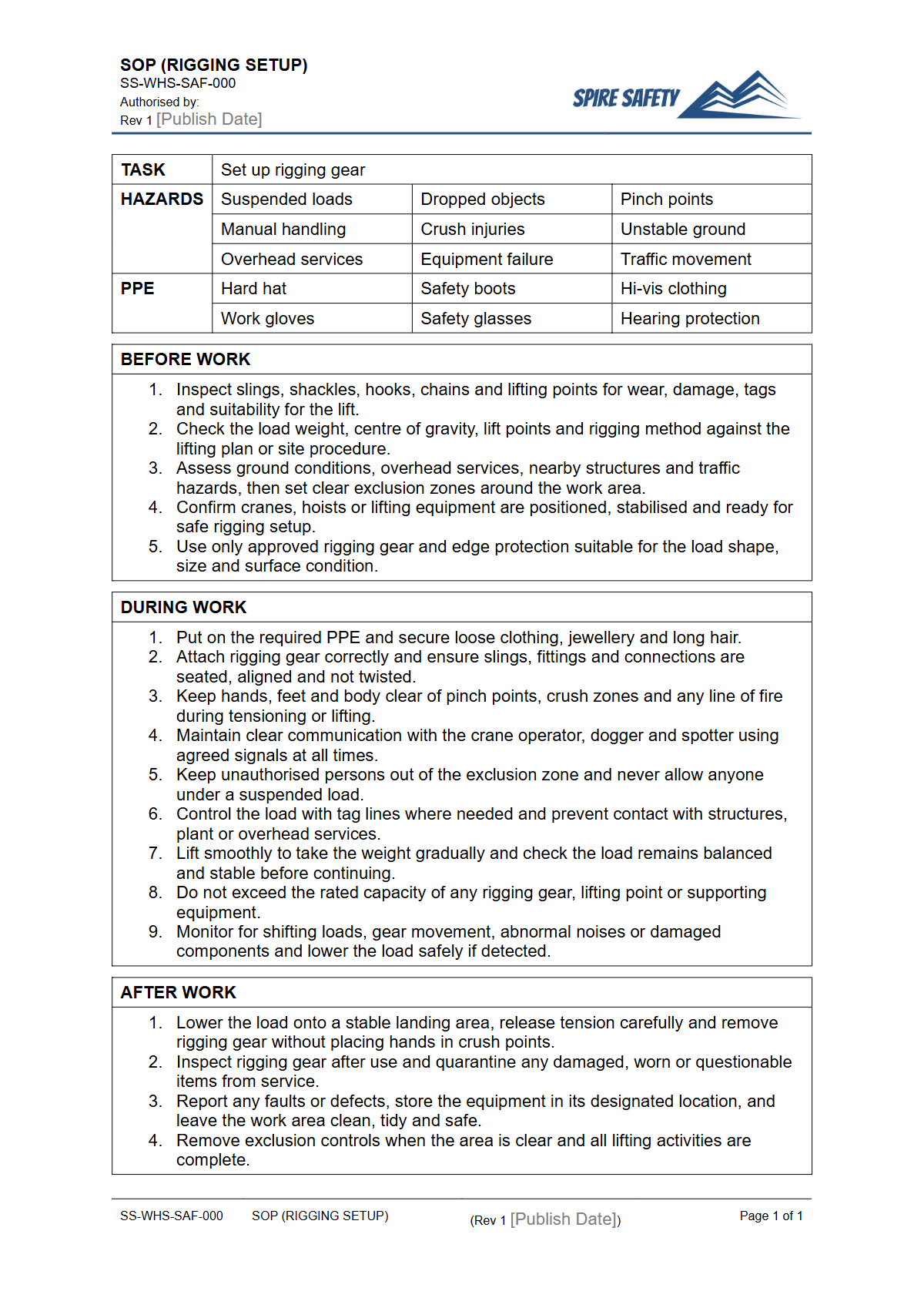
This Free Safe Operating Procedure (Rigging Setup) Template provides a structured framework for documenting the steps required to safely prepare, install, and use rigging equipment for lifting operations. Rigging and lifting are inherently hazardous activities, with risks including dropped loads, equipment failure, and crush injuries.
Using a standardised SOP helps to mitigate these risks by ensuring all workers follow a consistent, pre-approved process. It serves as a vital tool for worker training, competency verification, and operational consistency.
By clearly defining pre-operational checks, load calculation considerations, and correct attachment methods, this Safe Operating Procedure helps embed safety into your daily workflow. It forms a crucial part of your overall WHS management systems, demonstrating a commitment to proactive risk control.
This document is designed to be a practical, on-the-ground resource that supports your broader safety strategy and helps you meet your duty of care obligations.
Video walkthrough
How to use the Free Safe Operating Procedure (Rigging Setup) Template
This template is available in DOCX format for easy editing and customisation, as well as a print-ready PDF. To use it effectively, you must adapt its content to the specific context of your workplace.
This involves a thorough review and inclusion of details relevant to your unique equipment, tasks, and environment. A generic procedure is not sufficient for ensuring safety.
Key sections to customise include:
- Plant and Equipment: List the specific types of rigging gear used (e.g., synthetic slings, chain slings, shackles, eye bolts).
- Pre-Operational Checks: Detail the inspection criteria for your specific equipment, including checks for wear, damage, and valid inspection tags.
- Step-by-Step Procedure: Outline the exact sequence of actions for a rigging task, from selecting the right gear to attaching it to the load and the lifting appliance. This might involve tasks that use other plant, so referencing your free Telehandler SOP template could be relevant here.
- Post-Operational Tasks: Describe procedures for cleaning, inspecting, and storing equipment correctly after use.
Important: This document is a template and must be customised. We provide this as a starting point, but its effectiveness depends on you tailoring it to your specific site, machinery, and operational risks.
You must consult with your workers during this process to ensure the procedure is practical and reflects how the work is actually done.
When to use it
A Safe Operating Procedure for rigging setup should be used before any lifting operation that involves slinging a load. It is a primary reference document that should be readily accessible to all personnel involved in the lift, including riggers, doggers, crane operators, and supervisors.
It's particularly critical when preparing for complex or non-routine lifts. This SOP can also be integrated into pre-start meetings and toolbox talks to refresh workers' knowledge of correct procedures.
Furthermore, it should be a core component of your training and induction program for new employees or those new to rigging tasks. In the event of an incident or near-miss, the SOP serves as a benchmark against which actual work practices can be compared during an investigation.
Regular reviews, as part of a WHS compliance auditing program, ensure the procedure remains current with new equipment or regulations.
Who should use it
This Safe Operating Procedure should be developed and approved by a competent person, such as a WHS Manager, Site Supervisor, or an experienced Rigger. Its day-to-day users are the workers directly performing the rigging tasks.
They rely on the SOP for clear, unambiguous instructions to ensure their safety and the safety of those around them. Supervisors and team leaders use the document to oversee work, enforce safe practices, and conduct informal checks on operator behaviour.
Engaging a professional to help draft site-specific documents can ensure all technical and regulatory nuances are covered. Spire Safety offers expert WHS consulting services to assist businesses in developing robust safety documentation.
The development process should always involve consultation with the workers who will be using the procedure, as their hands-on experience is invaluable for creating a practical and effective document. This can be used alongside other documents in your safety system, such as our free Circular Saw SOP template for related site tasks. To see our full range of documents, visit our free WHS resources library.
Common mistakes
Common mistakes to avoid
- Using damaged, uninspected, or untagged rigging equipment.
- Exceeding the Working Load Limit (WLL) of slings or hardware.
- Failing to account for sling angles when calculating load tension.
- Not using taglines to control suspended loads, leading to loss of control.
Legal references
Legal considerations
The following legal requirements may be relevant to this type of work.
- Work Health and Safety Act (Harmonised) — Provides the primary duties for protecting workers and other people from work health and safety risks.
- Work Health and Safety Regulations (Harmonised) — Sets out requirements supporting the management of workplace hazards and risks.
The following codes may be relevant to this type of work.
- Managing WHS Risks Code of Practice — Provides practical guidance on identifying hazards, assessing risks and applying effective controls.
- Work Health and Safety Consultation, Cooperation and Coordination Code of Practice — Provides practical guidance on consulting workers and coordinating with other duty holders.
- Managing the Work Environment and Facilities Code of Practice — Provides practical guidance on safe work environments, workplace facilities and related controls.
Did you know
Sling Angle Matters
Increasing the angle of a sling from the vertical dramatically increases the tension on it. At a 60-degree angle between legs (30° from vertical), the tension in each leg is still significantly more than half the total load.
Colour Coded Tags
Many Australian worksites use a colour-coded tagging system for periodic inspection of lifting and rigging gear. This provides a quick visual confirmation that equipment has passed its latest inspection.
FAQ
Frequently asked questions
01What's the difference between an SOP and a SWMS for rigging?
02Does this rigging SOP template cover load calculations?
03Is this template suitable for all types of rigging equipment?
04Who is considered a 'competent person' to perform rigging?
Share this resource
Free Safe Operating Procedure (Rigging Setup) Template
Browse Categories
How To Use It
- 1Download and open in Word or PDF.
- 2Replace the placeholders with your business details.
- 3Get it reviewed by a WHS specialist before rollout.
Need it customised?
Our WHS consultants can adapt this template to your site, run a gap analysis, or audit what you already have in place.
Book a Free Consultation WHS consulting servicesor call 1300 156 382
Related templates
- Free Safe Operating Procedure (Road Broom) Template
- Free Safe Operating Procedure (Road Marking Machine) Template
- Free Safe Operating Procedure (Road Profiler) Template
- Free Safe Operating Procedure (Road Saw) Template
- Free Safe Operating Procedure (Road Stabiliser) Template
- Free Safe Operating Procedure (Roadside Litter Pickup) Template