
Free Safe Operating Procedure (Rice Cooker) Template
Download our free Safe Operating Procedure (Rice Cooker) template to manage risks in your kitchen. Customise this structured DOCX or PDF to suit your workplace.
Free Safe Operating Procedure (Rice Cooker) Template
DOCX • 126 KB + PDF
Updated Oct 2026
No signup required
Purpose of the Free Safe Operating Procedure (Rice Cooker) Template
A rice cooker is a common appliance in many commercial kitchens, from restaurants and catering businesses to childcare centres and aged care facilities. While seemingly simple, its use presents several workplace hazards.
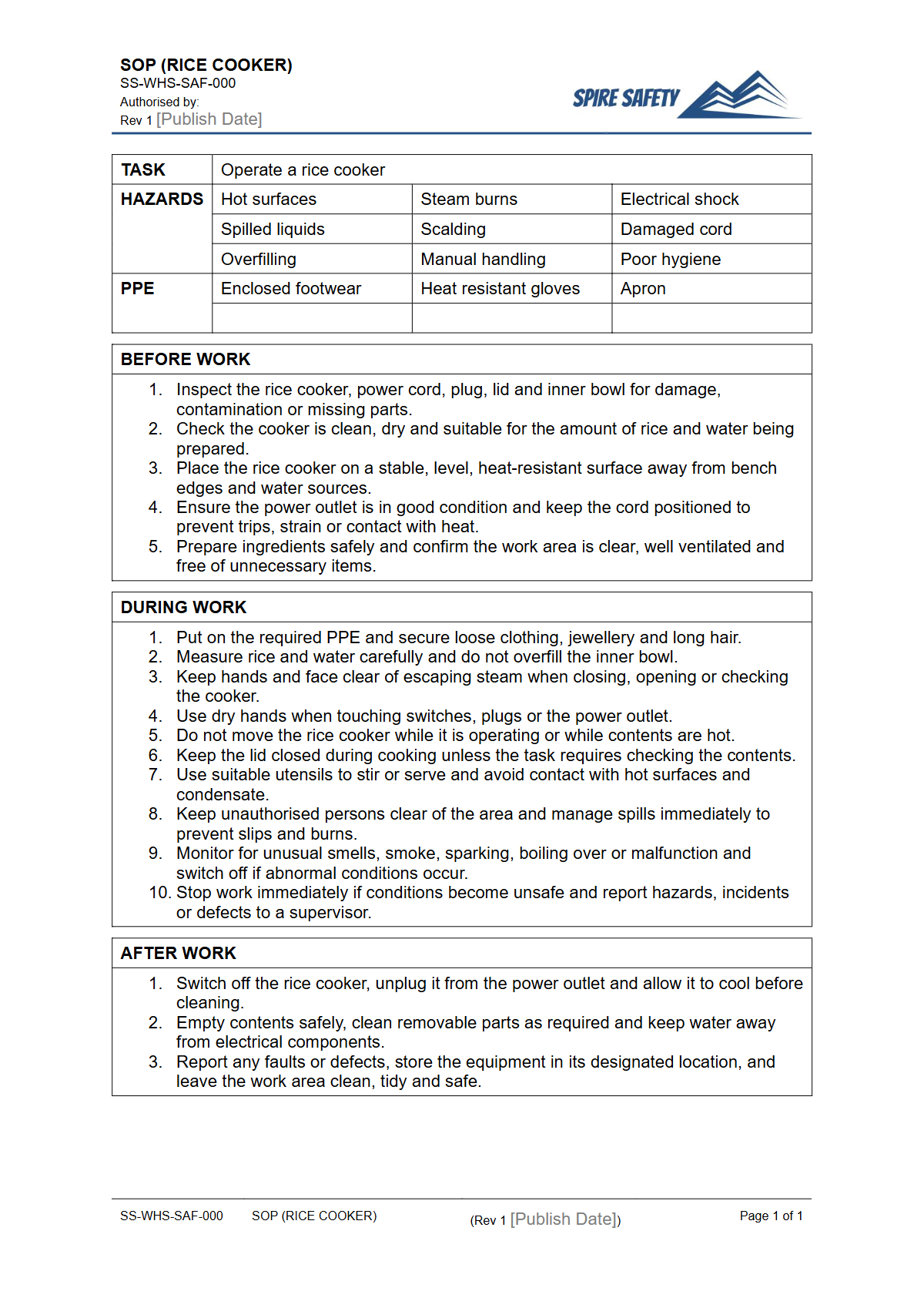
This Free Safe Operating Procedure (Rice Cooker) Template provides a structured starting point for documenting the risks and outlining the safest way to perform this task. An effective Safe Operating Procedure (SOP) is a critical administrative control for fulfilling your WHS duties.
Using this template helps a Person Conducting a Business or Undertaking (PCBU) systematically identify hazards such as thermal burns from steam and hot surfaces, electrical risks from faulty cords or wet environments, manual handling injuries from lifting heavy pots, and hygiene risks from improper cleaning. Documenting control measures ensures all workers follow a consistent, safe process. This approach is fundamental to managing risks for all kitchen equipment, as shown in resources like our free Safe Operating Procedure for deep fryers.
Hazards Associated with Rice Cooker Operation
- Electrical hazards: Risk of electric shock from damaged cords, plugs, or internal faults, particularly in wet kitchen environments.
- Burns: Contact with hot surfaces, water, or steam released during and after the cooking cycle.
- Manual handling: Strains from lifting and carrying heavy, hot pots filled with rice and water.
- Slips, trips, and falls: Spilled water or rice can create slippery surfaces.
- Hygiene hazards: Improper cleaning can lead to bacterial growth (e.g., Bacillus cereus) and food contamination.
Video walkthrough
How to use the Free Safe Operating Procedure (Rice Cooker) Template
To effectively implement this Safe Operating Procedure, you must adapt it to your specific operational context. Download the DOCX file and begin by conducting a risk assessment in consultation with the workers who use the equipment daily.
They often have the most practical insights into the real-world hazards and challenges.
Important: This is a template only. We have designed it as a starting point, but you must customise it to reflect the specific rice cooker models, tasks, and environment in your workplace.
A generic document will not adequately control your specific risks. Fill in the pre-operational checks, step-by-step operating instructions, and post-operational cleaning procedures relevant to your organisation.
If you need assistance formalising your safety processes, consider engaging professional WHS consulting to ensure your approach is robust.
The completed SOP should be integrated into your a comprehensive WHS management system, serving as a key document for training, supervision, and incident investigation. Make the document easily accessible to all relevant staff, either as a physical copy near the appliance or digitally through your internal systems.
When to use it
A Safe Operating Procedure for a rice cooker should be used as a primary training tool for new employees before they are permitted to operate the equipment. It also serves as a valuable resource for refresher training to prevent complacency and ensure consistent practice among all staff.
The SOP should be reviewed and updated whenever a new model of rice cooker is introduced, if the work environment changes, or following any incident or near miss involving the appliance.
Formalising procedures for all types of powered equipment creates a consistent safety culture. Whether your team is using a simple kitchen appliance or more complex machinery covered by documents like our free Air Compressor SOP template, a clear SOP is essential.
Regular reviews, typically on an annual basis, should be scheduled to ensure the procedure remains current and effective.
Who should use it
This Safe Operating Procedure is intended for several key roles within an organisation:
- Workers and Kitchen Staff: Must read, understand, and consistently follow the steps outlined in the SOP to ensure their own safety and that of their colleagues.
- Supervisors and Managers: Are responsible for providing training based on the SOP, ensuring it is followed, and conducting regular spot-checks to verify compliant behaviour. They also lead the review and update process.
- WHS Representatives and Officers: Use the SOP as a benchmark for workplace inspections and as a tool for promoting safety conversations with workers.
Ultimately, the PCBU holds the primary duty of care to provide and maintain a safe system of work. A well-developed and properly implemented SOP is a practical demonstration of this duty in action.
These documents provide critical evidence during WHS compliance audits that an organisation has a formal process for managing operational risks.
By standardising the operation of common equipment, you create a foundation of safety that protects your team and your business. For more tools to help build your safety system, explore our full library of free WHS resources.
Common mistakes
Common mistakes to avoid
- Using the template without customising it for the specific rice cooker model and kitchen environment.
- Failing to include detailed cleaning, sanitising, and food storage instructions in the procedure.
- Not training workers on the SOP and verifying their understanding and competence.
- Neglecting to have domestic-grade appliances professionally tested and tagged for commercial use.
Legal references
Legal considerations
The following legal requirements may be relevant to this type of work.
- Work Health and Safety Act (Harmonised) — Provides the primary duties for protecting workers and other people from work health and safety risks.
- Work Health and Safety Regulations (Harmonised) — Sets out requirements supporting the management of workplace hazards and risks.
The following codes may be relevant to this type of work.
- Managing WHS Risks Code of Practice — Provides practical guidance on identifying hazards, assessing risks and applying effective controls.
- Work Health and Safety Consultation, Cooperation and Coordination Code of Practice — Provides practical guidance on consulting workers and coordinating with other duty holders.
- Managing the Work Environment and Facilities Code of Practice — Provides practical guidance on safe work environments, workplace facilities and related controls.
Did you know
A Bacterial Risk
Cooked rice can be a breeding ground for the bacterium Bacillus cereus if left at room temperature. A thorough SOP should include specific instructions for rapid cooling and proper refrigerated storage to prevent foodborne illness.
Japanese Innovation
The first commercially successful automated electric rice cooker was introduced by Toshiba in Japan in 1955. It used a simple bimetallic strip thermostat that switched off the cooker when all the water was absorbed.
FAQ
Frequently asked questions
01What are the main hazards of using a commercial rice cooker?
02Is a Safe Operating Procedure legally required for a rice cooker in Australia?
03How often should I review our rice cooker SOP?
04Can I use this template for a domestic rice cooker used at work?
Share this resource
Free Safe Operating Procedure (Rice Cooker) Template
Browse Categories
How To Use It
- 1Download and open in Word or PDF.
- 2Replace the placeholders with your business details.
- 3Get it reviewed by a WHS specialist before rollout.
Need it customised?
Our WHS consultants can adapt this template to your site, run a gap analysis, or audit what you already have in place.
Book a Free Consultation WHS consulting servicesor call 1300 156 382
Related templates
- Free Safe Operating Procedure (Ride-On Mower Operation) Template
- Free Safe Operating Procedure (Rigging Gear Storage) Template
- Free Safe Operating Procedure (Rigging Setup) Template
- Free Safe Operating Procedure (Road Broom) Template
- Free Safe Operating Procedure (Road Marking Machine) Template
- Free Safe Operating Procedure (Road Profiler) Template