
Free Safe Operating Procedure (Rewinder) Template
Download our free Safe Operating Procedure (Rewinder) Template to document safe work methods. A structured starting point for managing risks on high-risk plant.
Free Safe Operating Procedure (Rewinder) Template
DOCX • 126 KB + PDF
Updated Oct 2026
No signup required
Purpose of the Free Safe Operating Procedure (Rewinder) Template
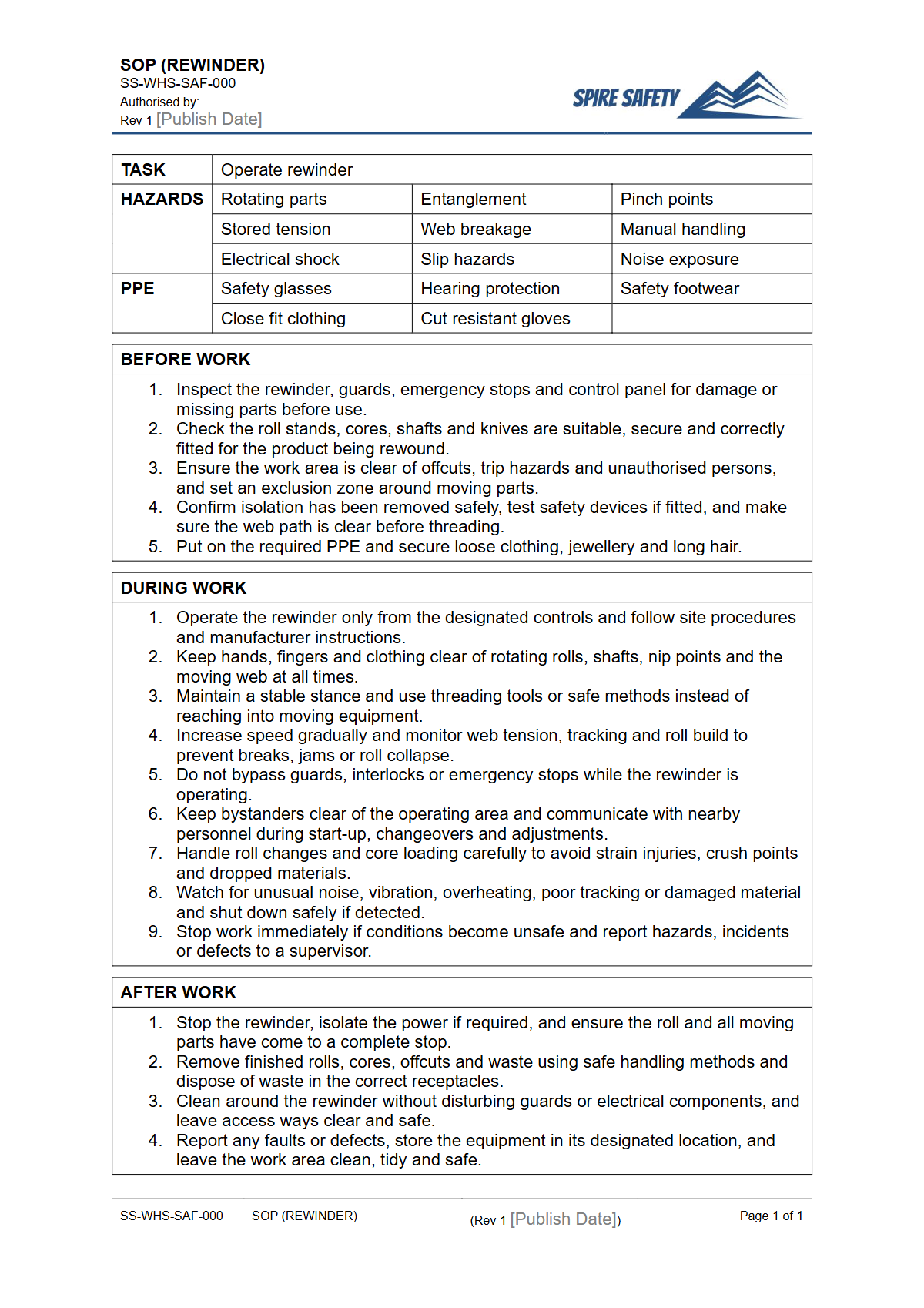
Effectively managing workplace hazards starts with clear, actionable guidance. Our Free Safe Operating Procedure (Rewinder) Template provides a structured framework for documenting the safe use of rewinder machinery in your workplace.
Rewinders, used across manufacturing, printing, and packaging industries, present significant risks, including entanglement in rotating parts, crushing from in-running nip points, and musculoskeletal injuries from handling heavy rolls. This template helps you formalise step-by-step instructions to control these hazards, ensuring tasks are performed safely and consistently.
A comprehensive Safe Operating Procedure (SOP) is a critical component of any effective WHS management system. It serves as a practical tool for worker training, a reference for supervisors, and evidence of your organisation’s commitment to providing a safe system of work.
An SOP is an administrative control within the hierarchy of risk control. While essential, it should support higher-level controls like fixed guarding (an engineering control) that physically prevent access to hazards.
Your SOP should detail how to check these engineering controls are functioning correctly before starting work. This layered approach is vital for managing risks associated with all types of machinery, from industrial rewinders to common tools detailed in our FREE Circular Saw SOP Template.
Video walkthrough
How to use the Free Safe Operating Procedure (Rewinder) Template
To get the most value from this Safe Operating Procedure (Rewinder) Template, it requires careful customisation. Download the DOCX file and adapt it to the specific context of your operations.
This involves consulting with the workers who operate the machinery daily, as their practical knowledge is invaluable for creating a procedure that is both safe and workable.
Important: It is crucial to remember that this document is a template. We have not been to your workplace, so you must customise this SOP to reflect your specific rewinder model, work environment, tasks, and control measures identified in your risk assessment.
Key Sections to Customise
- Required Personal Protective Equipment (PPE): List the specific PPE required for operating the rewinder, such as cut-resistant gloves, safety glasses, hearing protection, and steel-capped boots. Be specific about standards (e.g., AS/NZS standards).
- Pre-Operational Checks: Detail the safety checks operators must perform before starting the machine. This includes verifying that all guards are in place and secure, emergency stops are functional, and the surrounding area is clear of trip hazards and clutter.
- Step-by-Step Operating Procedures: Document the entire process from loading a parent roll to doffing finished rolls. Include instructions for threading material, setting web tension, managing splice joints, and monitoring the machine during operation. If finished rolls are moved via automated systems, your procedures should interface with documents like a conveyer system SOP.
- Shutdown, Cleaning and Maintenance: Outline the correct shutdown sequence, including lockout/tagout (LOTO) procedures that must be followed before any cleaning, jam-clearing, or maintenance work begins. If compressed air is used for cleaning, reference the safe use of that equipment, as detailed in an Air Compressor SOP.
When to use a Safe Operating Procedure
A well-developed SOP for a rewinder should be a living document integrated into your daily operations. Its primary uses include:
- Training and Induction: Use the SOP as the foundation for training new operators and for initial site or equipment inductions.
- Refresher Training: Revisit the SOP during regular refresher training sessions to prevent procedural drift and reinforce safe work habits.
- Incident Investigation: After a near miss or incident, the SOP should be reviewed and updated to incorporate any lessons learned.
- Audits and Inspections: The procedure serves as a benchmark during internal and external safety audits. Regular WHS compliance auditing can help verify that the documented procedure is being followed correctly in practice.
- Process Changes: Update the SOP whenever the rewinder machinery, materials, or associated work processes are modified.
Who should use this SOP template
The development and use of a Safe Operating Procedure for a rewinder is a collaborative effort involving several roles within an organisation:
- PCBU / Business Owner: Ultimately responsible for ensuring safe systems of work are in place.
- WHS Managers/Officers: Responsible for developing, implementing, and reviewing WHS documentation as part of the overall safety management system.
- Supervisors and Team Leaders: Responsible for ensuring operators are trained on the SOP and adhere to it during every shift.
- Operators: The end-users of the SOP. They must be consulted during its creation and trained in its content to ensure they understand and can follow the required steps.
If you lack the internal expertise to conduct the necessary risk assessments or develop robust procedures, engaging external WHS consultants can provide the specialised support you need. For more templates and safety documents to support your WHS framework, feel free to browse our complete free WHS resources library.
Common mistakes
Common mistakes to avoid
- Using the downloaded template without customising it to the specific machine and site conditions.
- Failing to consult with and involve the machine operators who have practical, hands-on experience.
- Not providing practical, competency-based training on the finalised SOP.
- Forgetting to schedule and conduct regular reviews, leaving the procedure outdated.
Legal references
Legal considerations
The following legal requirements may be relevant to this type of work.
- Work Health and Safety Act (Harmonised) — Provides the primary duties for protecting workers and other people from work health and safety risks.
- Work Health and Safety Regulations (Harmonised) — Sets out requirements supporting the management of workplace hazards and risks.
The following codes may be relevant to this type of work.
- Managing WHS Risks Code of Practice — Provides practical guidance on identifying hazards, assessing risks and applying effective controls.
- Work Health and Safety Consultation, Cooperation and Coordination Code of Practice — Provides practical guidance on consulting workers and coordinating with other duty holders.
- Managing the Work Environment and Facilities Code of Practice — Provides practical guidance on safe work environments, workplace facilities and related controls.
Did you know
Nip Point Dangers
In-running nip points, common on rewinders, can pull a worker's hand, loose clothing, or hair into a machine faster than human reaction time—often in less than half a second.
The 'Swiss Cheese' Model
An SOP is an administrative control—one 'slice' of defence in a safety system. It works alongside other slices like engineering controls (guarding), PPE, and training to prevent a hazard from causing an incident.
FAQ
Frequently asked questions
01What are the main hazards associated with rewinder machines?
02Is a Safe Operating Procedure a legal requirement in Australia?
03How often should a Rewinder SOP be reviewed?
04Can I use this template for any type of rewinder?
Share this resource
Free Safe Operating Procedure (Rewinder) Template
Browse Categories
How To Use It
- 1Download and open in Word or PDF.
- 2Replace the placeholders with your business details.
- 3Get it reviewed by a WHS specialist before rollout.
Need it customised?
Our WHS consultants can adapt this template to your site, run a gap analysis, or audit what you already have in place.
Book a Free Consultation WHS consulting servicesor call 1300 156 382
Related templates
- Free Safe Operating Procedure (Rice Cooker) Template
- Free Safe Operating Procedure (Ride-On Mower Operation) Template
- Free Safe Operating Procedure (Rigging Gear Storage) Template
- Free Safe Operating Procedure (Rigging Setup) Template
- Free Safe Operating Procedure (Road Broom) Template
- Free Safe Operating Procedure (Road Marking Machine) Template