
Free Safe Operating Procedure (Retail Shelf Cleaning) Template
Download our free Safe Operating Procedure for retail shelf cleaning to manage risks like manual handling and chemical use.
Free Safe Operating Procedure (Retail Shelf Cleaning) Template
DOCX • 126 KB + PDF
Updated Oct 2026
No signup required
Purpose of the Free Safe Operating Procedure (Retail Shelf Cleaning) Template
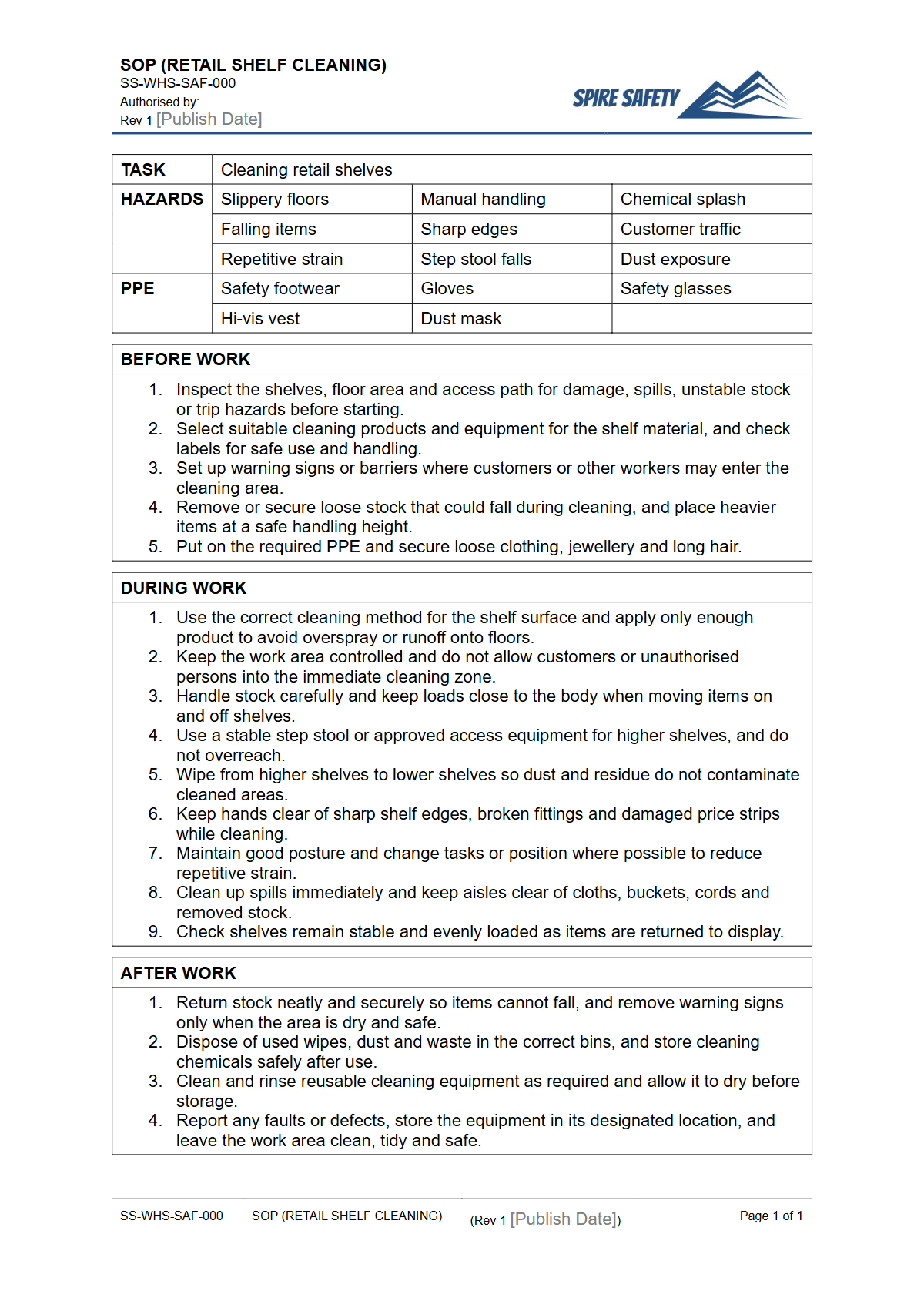
Maintaining a clean and organised retail environment is essential for both presentation and safety. This Free Safe Operating Procedure (Retail Shelf Cleaning) Template provides a structured framework for documenting the safe steps involved in cleaning shelves, stock rotation, and general housekeeping in a retail setting.
Using an SOP helps to standardise your process, ensuring every team member understands the established safe method for completing the task. It formally addresses common hazards such as hazardous manual tasks from lifting boxes, slips and trips from spills or clutter, the use of cleaning chemicals, and potential falls from step ladders.
A documented procedure is a key part of demonstrating how your organisation meets its primary duty of care. It acts as a control measure to manage identified risks and serves as a vital record within your overall safety framework.
Properly implemented SOPs are a cornerstone of effective WHS management systems, helping to create a safer and more consistent work environment for everyone.
Video walkthrough
How to use the Free Safe Operating Procedure (Retail Shelf Cleaning) Template
This resource is available for immediate download in both DOCX and PDF formats. The DOCX file is fully editable, allowing you to tailor the content to the specific equipment, chemicals, and layout of your workplace.
It is crucial that you customise this document to reflect your unique operational risks and control measures.
Important: This is a template only. You must consult with your workers and other relevant stakeholders to ensure the procedure is practical and effective for your site.
We cannot guarantee that the unmodified template will be suitable for your specific needs. Once customised, the SOP should be used to train all relevant employees before they undertake the task.
In workplaces with food service areas, you might also require a Safe Operating Procedure for a deep fryer to cover all high-risk tasks.
Implementing the SOP
- Customise: Add your company name and logo. Review every section and update the steps, hazards, and controls to match your store's environment, including the specific cleaning agents used and personal protective equipment (PPE) required.
- Consult: Share the draft procedure with staff who perform the cleaning tasks. Their feedback is invaluable for ensuring the SOP is accurate, easy to understand, and practical to follow.
- Approve: Have a manager or supervisor formally approve the final version of the Safe Operating Procedure.
- Train: Induct and train all relevant workers on the finalised SOP. Keep records of this training for compliance purposes.
- Review: Schedule regular reviews of the SOP (e.g., annually) or whenever there is a change in equipment, chemicals, processes, or following any related incident.
When to use this Safe Operating Procedure
A Safe Operating Procedure for retail shelf cleaning should not just be filed away. It is an active document used to support day-to-day safety.
It should be referenced during new employee induction to establish safe work habits from the start. It's also a valuable tool for refresher training to prevent complacency among experienced staff.
Supervisors can use it as a checklist to conduct observations and confirm that the correct procedures are being followed.
The SOP should be readily accessible in the workplace, whether in a printed folder in the break room or digitally on a company server. If your retail operation is part of a larger warehouse, you may need to develop procedures for other equipment, such as a Conveyer System SOP, to cover all routine high-risk activities.
Who should use this Safe Operating Procedure
This SOP is intended for all workers assigned to cleaning and merchandising tasks in a retail store. This includes casual staff, part-time employees, full-time retail assistants, and team leaders.
It provides them with clear, step-by-step instructions on how to perform their duties safely. Managers and supervisors should also use the document to guide training, monitor performance, and enforce safety standards within their teams.
Work Health and Safety (WHS) representatives and committee members can use the SOP as a reference during workplace inspections and risk assessments. It provides a benchmark against which actual work practices can be compared.
The effectiveness of your documented procedures is a key area of focus during formal WHS compliance auditing. For more complex safety challenges, our expert WHS consulting services can provide tailored support for your business. You can also explore our complete free WHS resources library for more templates and guides.
Common mistakes
Common mistakes to avoid
- Using a generic template without customising it for specific workplace hazards, chemicals, and equipment.
- Failing to adequately train all relevant workers on the finalised SOP and document the training.
- Not making the SOP easily accessible to workers in their primary work area.
- Forgetting to review and update the SOP after an incident, or when processes or cleaning products change.
Legal references
Legal considerations
The following legal requirements may be relevant to this type of work.
- Work Health and Safety Act (Harmonised) — Provides the primary duties for protecting workers and other people from work health and safety risks.
- Work Health and Safety Regulations (Harmonised) — Sets out requirements supporting the management of workplace hazards and risks.
The following codes may be relevant to this type of work.
- Managing WHS Risks Code of Practice — Provides practical guidance on identifying hazards, assessing risks and applying effective controls.
- Work Health and Safety Consultation, Cooperation and Coordination Code of Practice — Provides practical guidance on consulting workers and coordinating with other duty holders.
- Managing the Work Environment and Facilities Code of Practice — Provides practical guidance on safe work environments, workplace facilities and related controls.
Did you know
Slips, Trips, and Falls
According to Safe Work Australia, slips, trips, and falls are the second most common cause of serious workers' compensation claims, making housekeeping and clear walkways critical in retail environments.
Duty to Consult
The model WHS laws require a PCBU (Person Conducting a Business or Undertaking) to consult with workers on health and safety matters, including when developing or changing procedures like an SOP.
FAQ
Frequently asked questions
01What hazards are involved in cleaning retail shelves?
02Do I need a Safe Operating Procedure for a simple task like cleaning?
03How often should workers be trained on this SOP?
04Who is responsible for creating and reviewing an SOP?
Share this resource
Free Safe Operating Procedure (Retail Shelf Cleaning) Template
Browse Categories
How To Use It
- 1Download and open in Word or PDF.
- 2Replace the placeholders with your business details.
- 3Get it reviewed by a WHS specialist before rollout.
Need it customised?
Our WHS consultants can adapt this template to your site, run a gap analysis, or audit what you already have in place.
Book a Free Consultation WHS consulting servicesor call 1300 156 382
Related templates
- Free Safe Operating Procedure (Retail Stock Handling) Template
- Free Safe Operating Procedure (Retaining Wall Clean) Template
- Free Safe Operating Procedure (Return Freight Handling) Template
- Free Safe Operating Procedure (Returned Goods Handling) Template
- Free Safe Operating Procedure (Rewinder) Template
- Free Safe Operating Procedure (Rice Cooker) Template