
Free Safe Operating Procedure (Retail Stock Handling) Template
Download our free Safe Operating Procedure for Retail Stock Handling.
Free Safe Operating Procedure (Retail Stock Handling) Template
DOCX • 126 KB + PDF
Updated Oct 2026
No signup required
Purpose of the Free Safe Operating Procedure (Retail Stock Handling) Template
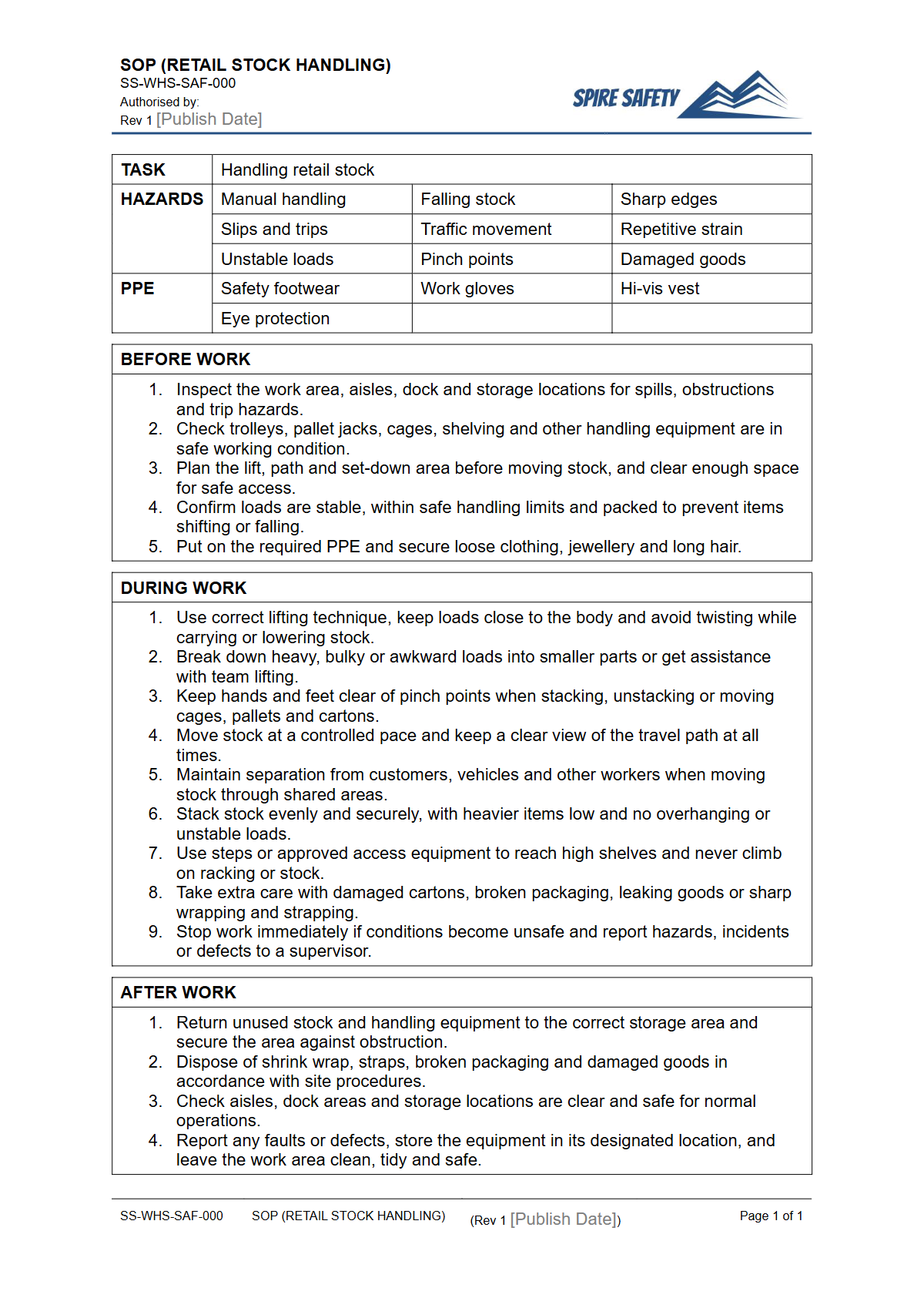
This Safe Operating Procedure (SOP) template provides a structured framework for documenting the agreed safe method for handling stock in a retail environment. Using our free Safe Operating Procedure (Retail Stock Handling) template helps your business standardise practices, meet training obligations, and systematically manage the risks associated with manual tasks.
Retail stock handling often involves repetitive lifting, carrying, bending, and reaching, which are leading causes of musculoskeletal injuries. A clear SOP is a critical control measure to protect your workers.
The procedure guides users in identifying hazards, assessing risks, and implementing controls for all stages of stock handling, from receiving deliveries to shelf stacking. This includes tasks that may require specific equipment, for which a dedicated step ladder SOP might also be necessary.
A documented procedure ensures every team member understands the expected safety standards and work methods, promoting a consistent safety culture and reducing the likelihood of costly workplace incidents.
Video walkthrough
How to use the Free Safe Operating Procedure (Retail Stock Handling) Template
This document is provided in both DOCX and PDF formats for your convenience. The DOCX file is fully editable, allowing you to tailor the content to the specific hazards, equipment, and layout of your retail store.
To use it effectively, you should consult with the workers who actually perform the stock handling tasks. Their direct experience is invaluable for identifying practical risks and effective control measures.
This collaborative approach not inly improves the quality of the SOP but also increases worker buy-in and compliance.
Important: This is a template only and must be customised to your specific workplace. We are not responsible for the safety outcomes of your organisation.
You must consult with your team, add site-specific details, identify relevant hazards, and implement control measures that are unique to your operations. Integrating this procedure into your overall WHS management system is a key step towards creating a robust safety framework.
When to use a Retail Stock Handling SOP
A Safe Operating Procedure for retail stock handling should be a living document, used actively within your business. It serves as a primary reference during worker induction and onboarding, ensuring new starters learn the correct procedures from day one.
It should also be used for regular refresher training and as a basis for toolbox talks to reinforce key safety messages.
Furthermore, the SOP is a vital tool for risk management. It should be reviewed and updated whenever there is a change in work practices, new equipment is introduced, the store layout is altered, or after a near-miss or incident occurs.
Incorporating SOP reviews into regular WHS compliance audits ensures they remain current and effective.
Who should use this SOP
This SOP should be developed and used by a range of personnel within a retail business. Store managers and department supervisors are responsible for implementing and enforcing the procedure.
WHS representatives and committee members should be involved in its development and review to ensure it aligns with broader safety initiatives. Most importantly, the workers who perform stock handling tasks are the primary users.
The SOP must be written in clear, simple language and be readily accessible to them in their work area.
Effectively documenting procedures is a cornerstone of good WHS practice. Beyond this specific task, you can explore our library of free WHS resources for other templates that can support your safety management system.
Each template provides a solid starting point for creating customised, site-specific documentation.
Key Elements in the Stock Handling SOP
A comprehensive SOP for stock handling should cover several key areas to be effective. This template prompts you to consider:
- Hazard Identification: Pinpointing potential sources of harm, such as heavy or awkward items, trip hazards in the stockroom, and risks from delivery vehicles. For tasks involving vehicle unloading, a specific body truck SOP may provide additional useful detail.
- Risk Assessment: Evaluating the likelihood and severity of injuries from identified hazards, particularly musculoskeletal disorders from hazardous manual tasks.
- Control Measures: Detailing the practical steps to eliminate or minimise risks. This includes using mechanical aids like pallet jacks or trolleys, setting weight limits for single-person lifts, ensuring clear pathways, and mandating team lifts for bulky items.
- Personal Protective Equipment (PPE): Specifying required PPE, such as enclosed non-slip footwear, gloves, or high-visibility vests when working in loading bays.
- Training and Competency: Outlining the training requirements for workers to ensure they understand and can apply the SOP correctly.
By customising each section, you create a procedure that is not only a compliance document but a practical tool for everyday safety. If your organisation requires expert assistance in developing a comprehensive suite of safety documents, seeking professional WHS consulting can provide tailored support and guidance.
Common mistakes
Common mistakes to avoid
- Using the template as-is without customising it for the specific store, stock types, and equipment.
- Failing to train all relevant workers on the contents of the finalised SOP.
- Not reviewing or updating the SOP after an incident, or when processes or equipment change.
- Developing the SOP in isolation without consulting the workers who perform the tasks.
Legal references
Legal considerations
The following legal requirements may be relevant to this type of work.
- Work Health and Safety Act (Harmonised) — Provides the primary duties for protecting workers and other people from work health and safety risks.
- Work Health and Safety Regulations (Harmonised) — Sets out requirements supporting the management of workplace hazards and risks.
The following codes may be relevant to this type of work.
- Managing WHS Risks Code of Practice — Provides practical guidance on identifying hazards, assessing risks and applying effective controls.
- Work Health and Safety Consultation, Cooperation and Coordination Code of Practice — Provides practical guidance on consulting workers and coordinating with other duty holders.
- Managing the Work Environment and Facilities Code of Practice — Provides practical guidance on safe work environments, workplace facilities and related controls.
Did you know
A Leading Cause of Injury
According to Safe Work Australia, injuries resulting from manual handling are the most common type of work-related injury in the country, with the retail trade industry being one of the most affected sectors.
FAQ
Frequently asked questions
01What is a Safe Operating Procedure for retail?
02Are SOPs a legal requirement in Australia?
03How do I reduce manual handling injuries in my retail store?
04Can I use this template for other tasks in my store?
Share this resource
Free Safe Operating Procedure (Retail Stock Handling) Template
Browse Categories
How To Use It
- 1Download and open in Word or PDF.
- 2Replace the placeholders with your business details.
- 3Get it reviewed by a WHS specialist before rollout.
Need it customised?
Our WHS consultants can adapt this template to your site, run a gap analysis, or audit what you already have in place.
Book a Free Consultation WHS consulting servicesor call 1300 156 382
Related templates
- Free Safe Operating Procedure (Retaining Wall Clean) Template
- Free Safe Operating Procedure (Return Freight Handling) Template
- Free Safe Operating Procedure (Returned Goods Handling) Template
- Free Safe Operating Procedure (Rewinder) Template
- Free Safe Operating Procedure (Rice Cooker) Template
- Free Safe Operating Procedure (Ride-On Mower Operation) Template