
Free Safe Operating Procedure (Retaining Wall Clean) Template
Download our free Safe Operating Procedure (Retaining Wall Clean) template.
Free Safe Operating Procedure (Retaining Wall Clean) Template
DOCX • 126 KB + PDF
Updated Oct 2026
No signup required
Purpose of the Free Safe Operating Procedure (Retaining Wall Clean) Template
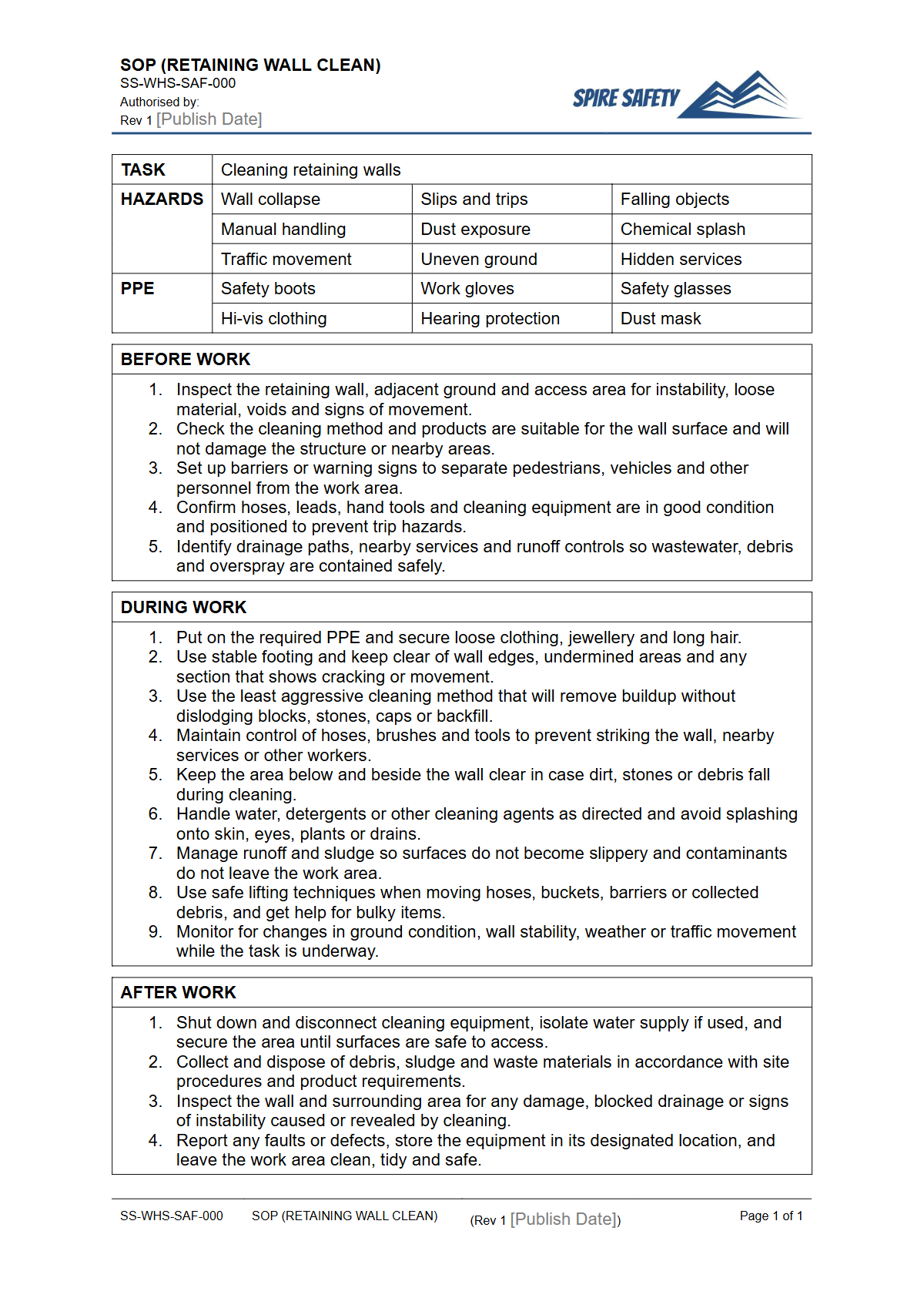
This Safe Operating Procedure (SOP) provides a structured framework for safely cleaning retaining walls, typically using high-pressure water cleaners. Developing a formal procedure is a critical step in managing workplace health and safety.
Our free Safe Operating Procedure (Retaining Wall Clean) template outlines the hazards, risks, and control measures associated with the task, helping you establish a consistent and safe system of work.
Using this template helps you meet your duty of care by documenting key safety steps, from pre-operational checks on equipment to the correct use of personal protective equipment (PPE) and emergency procedures. It addresses common hazards such as slips and trips from wet surfaces, injuries from high-pressure water injection, electrical risks, chemical exposure, and potential falls from height.
Video walkthrough
How to use the Free Safe Operating Procedure (Retaining Wall Clean) Template
This downloadable document is a starting point, not a finished safety solution. It must be adapted to your specific operational context.
Download the DOCX file and customise it to reflect the unique equipment, chemicals, work environment, and personnel at your workplace. A generic procedure is not sufficient to ensure safety.
To be effective, we recommend you customise this template in consultation with your team. Site-specific risks, the type of pressure washer being used, and the skills of your workers must be considered.
This collaborative approach not only improves the quality of the SOP but also increases worker buy-in and adherence. For organisations seeking expert assistance in tailoring documents, our WHS consulting services can provide tailored support.
When to use this Safe Operating Procedure
An SOP for cleaning retaining walls should be used as a primary reference document for the task. It should be integrated into your daily operations and broader safety framework.
Specific applications include worker training and induction, pre-task planning and risk assessments, and as a guide for supervisors monitoring work.
Procedures like this are foundational components of effective WHS management systems. They serve as practical tools that translate your safety policies into safe work practices on the ground. The SOP should also be reviewed periodically, especially after an incident or when new equipment or cleaning agents are introduced.
Who should use it
This template is designed for use by Persons Conducting a Business or Undertaking (PCBUs), managers, and supervisors responsible for ensuring a safe work environment. It provides a clear method for them to provide the necessary information, training, and instruction to workers.
Workers who perform retaining wall cleaning tasks are the end-users of the finalised procedure. They should be trained on the SOP's contents to ensure they understand the expected sequence of work and all required safety precautions.
Using and following the SOP helps everyone fulfil their WHS responsibilities.
Key Hazards and Control Measures
Cleaning retaining walls introduces several significant hazards that require robust controls. High-pressure water can cause severe injection injuries if it contacts skin, and splashback can propel debris into the eyes.
Slips, trips, and falls are a major risk on wet, uneven, or debris-strewn ground. Using ladders or platforms to reach higher sections of a wall introduces the risk of falls from height; always ensure workers are competent and a step ladder SOP is in place for such tasks.
Other hazards include electric shock from damaged power leads or water ingress into equipment, musculoskeletal injuries from handling heavy machinery, and exposure to noise. If using cleaning chemicals or working on walls with mould, there are also risks of skin irritation and respiratory issues.
Controls include using the correct PPE (e.g., waterproof boots, eye protection, gloves), maintaining equipment, good housekeeping, and using residual current devices (RCDs).
Implementing the Procedure
Before work begins, a supervisor should conduct a pre-start check. This involves inspecting the pressure washer, hoses, and electrical cords for damage.
The work area must be assessed for hazards and an exclusion zone established to protect other workers and the public. Regular reviews of your procedures are often a key focus of WHS compliance audits.
During the task, operators must follow the sequence outlined in your customised SOP. This includes maintaining a safe distance from the wall, managing hoses to prevent trip hazards, and being aware of their surroundings. The principles of managing high-pressure equipment are universal, whether for cleaning or cutting, as detailed in our Safe Operating Procedure for waterjet cutter use. After the work is complete, the procedure should cover the safe shutdown, cleaning, and storage of equipment. This ensures the equipment is safe for the next user and the work area is left in a tidy state. For more templates to build out your safety systems, browse our complete free WHS resources library.
Common mistakes
Common mistakes to avoid
- Using a petrol-powered pressure washer indoors or in a poorly ventilated space, leading to carbon monoxide poisoning risk.
- Failing to establish an exclusion zone, putting other workers or members of the public at risk from high-pressure spray and flying debris.
- Neglecting to inspect the structural integrity of an old or damaged retaining wall before applying high pressure.
- Using electrical equipment with damaged leads or without protection from a residual current device (RCD) in wet conditions.
Legal references
Legal considerations
The following legal requirements may be relevant to this type of work.
- Work Health and Safety Act (Harmonised) — Provides the primary duties for protecting workers and other people from work health and safety risks.
- Work Health and Safety Regulations (Harmonised) — Sets out requirements supporting the management of workplace hazards and risks.
The following codes may be relevant to this type of work.
- Managing WHS Risks Code of Practice — Provides practical guidance on identifying hazards, assessing risks and applying effective controls.
- Work Health and Safety Consultation, Cooperation and Coordination Code of Practice — Provides practical guidance on consulting workers and coordinating with other duty holders.
- Managing the Work Environment and Facilities Code of Practice — Provides practical guidance on safe work environments, workplace facilities and related controls.
Did you know
Injection Injury Risk
A high-pressure water jet from a pressure washer can penetrate skin and underlying tissues, causing a serious injection injury that may not appear severe initially but requires immediate medical attention.
Slips, Trips and Falls
According to Safe Work Australia, slips, trips and falls are a leading cause of serious workplace injuries, making good housekeeping and non-slip footwear critical when working on wet surfaces.
FAQ
Frequently asked questions
01What are the main hazards when cleaning a retaining wall?
02Is a Safe Operating Procedure legally required for this task?
03Can I use a pressure washer while standing on a ladder?
04What PPE is generally required for pressure washing a retaining wall?
Share this resource
Free Safe Operating Procedure (Retaining Wall Clean) Template
Browse Categories
How To Use It
- 1Download and open in Word or PDF.
- 2Replace the placeholders with your business details.
- 3Get it reviewed by a WHS specialist before rollout.
Need it customised?
Our WHS consultants can adapt this template to your site, run a gap analysis, or audit what you already have in place.
Book a Free Consultation WHS consulting servicesor call 1300 156 382
Related templates
- Free Safe Operating Procedure (Return Freight Handling) Template
- Free Safe Operating Procedure (Returned Goods Handling) Template
- Free Safe Operating Procedure (Rewinder) Template
- Free Safe Operating Procedure (Rice Cooker) Template
- Free Safe Operating Procedure (Ride-On Mower Operation) Template
- Free Safe Operating Procedure (Rigging Gear Storage) Template