
Free Safe Operating Procedure (Respirator Cleaning) Template
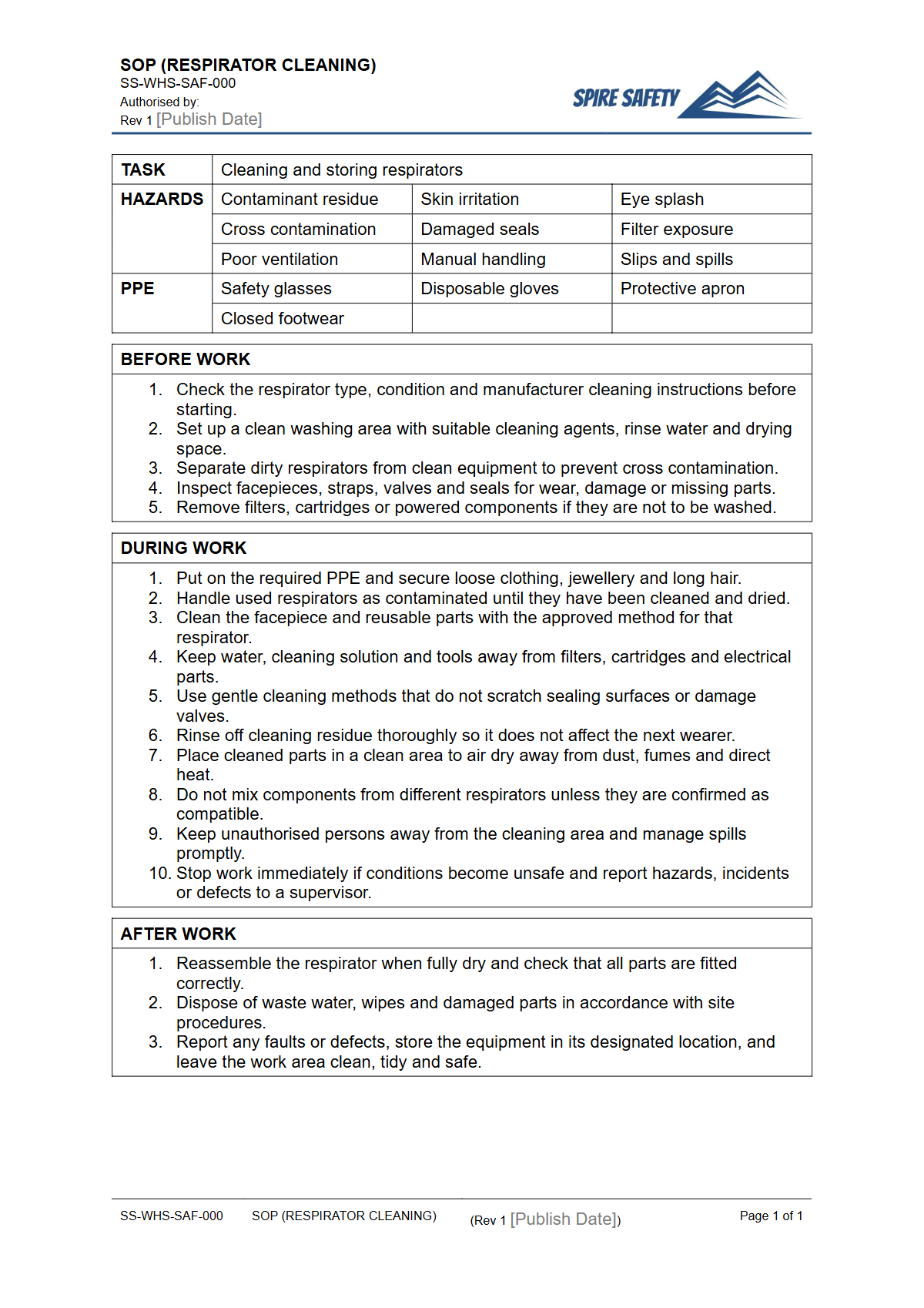
Ensure your team follows correct hygiene protocols with our Free Safe Operating Procedure (Respirator Cleaning) Template. Download your customisable DOCX now.
Free Safe Operating Procedure (Respirator Cleaning) Template
DOCX • 126 KB + PDF
Updated Oct 2026
No signup required
Purpose of the Free Safe Operating Procedure (Respirator Cleaning) Template
Proper cleaning and maintenance of Respiratory Protective Equipment (RPE) is critical for worker safety. A contaminated or poorly maintained respirator fails to provide the intended protection, exposing workers to airborne hazards like dust, fumes, and vapours.
This Free Safe Operating Procedure (Respirator Cleaning) Template provides a structured starting point for organisations to develop a clear, consistent process for cleaning, inspecting, and storing respirators. Following a documented procedure helps ensure RPE remains effective, extends its service life, and supports your duty of care under Australian WHS legislation.
Using this template helps you outline step-by-step instructions that minimise the risk of cross-contamination between users and prevent damage to sensitive respirator components. A formal SOP ensures everyone responsible for this task performs it to the same standard, every time.
It forms a key part of your overall respiratory protection program, alongside fit testing and user training. In environments where airborne contaminants are generated by equipment, having clear procedures for all machinery, such as a free Air Compressor SOP, is equally important.
Video walkthrough
How to use the Free Safe Operating Procedure (Respirator Cleaning) Template
This document is a template, not a finished procedure. To make it effective, you must adapt it to the specific equipment and conditions at your workplace.
Download the DOCX file and customise it by adding your company name, logo, and site-specific details. Consult the manufacturer’s instructions for your particular respirator models to specify the correct cleaning agents, water temperatures, and disassembly steps.
You should also clearly define who is responsible, the frequency of cleaning, and the exact location for clean respirator storage.
We strongly recommend you consult with the workers who will be using the procedure during the drafting process. Their practical experience is invaluable for creating a process that is both safe and workable.
Once finalised, this Safe Operating Procedure should be used as a training tool for all relevant personnel. Remember, a document alone does not create a safe workplace; consistent implementation and supervision are essential.
Integrating SOPs into your broader WHS management systems ensures they are regularly reviewed and updated.
When to use it
This Safe Operating Procedure should be followed whenever a non-disposable respirator requires cleaning. The frequency depends on the type of work, the level of contamination, and whether the respirator is assigned to an individual or shared. Best practice generally requires cleaning:
- After each use for respirators that are shared among employees.
- At the end of each shift for individually assigned respirators.
- Immediately if the respirator becomes obviously soiled or contaminated during a task.
- Before performing any maintenance or part replacement.
The procedure should also be referenced during routine workplace inspections and audits to verify that cleaning protocols are being followed correctly. Consistent application is crucial in industries where hazardous dust is common, such as construction sites that use equipment outlined in our free Circular Saw SOP.
Who should use it
This SOP is intended for several key roles within an organisation:
- Workers: Any employee required to wear and maintain their own non-disposable respirator should be trained on this procedure to ensure they clean it correctly.
- Supervisors and Team Leaders: Managers must understand the procedure to effectively supervise staff, enforce the rules, and ensure resources (like approved cleaning supplies and proper storage) are available.
- WHS Officers/Managers: Safety personnel will use this document to establish best practices, conduct training, and perform audits to supports your compliance efforts with the company's safety program.
- Maintenance or Stores Personnel: In some organisations, a specific person or department may be responsible for collecting, cleaning, and reissuing shared respirators.
For businesses seeking expert guidance on implementing procedures like this across their operations, our WHS consulting services can provide tailored support. The principles of safe equipment handling also apply in other sectors, such as hospitality, where an SOP for deep fryer operation addresses risks from fumes and heat. You can find more templates like this in our complete free WHS resources library.
Common mistakes
Common mistakes to avoid
- Using unauthorised cleaning chemicals that damage respirator materials.
- Storing a cleaned respirator in a contaminated toolbox or vehicle.
- Forgetting to inspect valves, straps, and seals for damage during cleaning.
- Sharing respirators between workers without thorough cleaning and disinfection.
Legal references
Legal considerations
The following legal requirements may be relevant to this type of work.
- Work Health and Safety Act (Harmonised) — Provides the primary duties for protecting workers and other people from work health and safety risks.
- Work Health and Safety Regulations (Harmonised) — Sets out requirements supporting the management of workplace hazards and risks.
The following codes may be relevant to this type of work.
- Managing WHS Risks Code of Practice — Provides practical guidance on identifying hazards, assessing risks and applying effective controls.
- Work Health and Safety Consultation, Cooperation and Coordination Code of Practice — Provides practical guidance on consulting workers and coordinating with other duty holders.
- Managing the Work Environment and Facilities Code of Practice — Provides practical guidance on safe work environments, workplace facilities and related controls.
Did you know
Degradation Risk
Using unapproved cleaning agents like solvents can cause microscopic cracks in respirator facepieces, leading to an ineffective face seal and exposing the user to hazards.
Inspection is Key
The cleaning process provides the perfect opportunity to inspect respirator components like straps, valves, and seals for signs of wear, distortion, or damage that could compromise safety.
FAQ
Frequently asked questions
01How often should respirators be cleaned according to Australian standards?
02What's the difference between cleaning, sanitising, and disinfecting a respirator?
03Can I use alcohol wipes or solvents to clean my respirator?
04Where should cleaned respirators be stored?
Share this resource
Free Safe Operating Procedure (Respirator Cleaning) Template
Browse Categories
How To Use It
- 1Download and open in Word or PDF.
- 2Replace the placeholders with your business details.
- 3Get it reviewed by a WHS specialist before rollout.
Need it customised?
Our WHS consultants can adapt this template to your site, run a gap analysis, or audit what you already have in place.
Book a Free Consultation WHS consulting servicesor call 1300 156 382
Related templates
- Free Safe Operating Procedure (Retail Bagging) Template
- Free Safe Operating Procedure (Retail Display Setup) Template
- Free Safe Operating Procedure (Retail Shelf Cleaning) Template
- Free Safe Operating Procedure (Retail Stock Handling) Template
- Free Safe Operating Procedure (Retaining Wall Clean) Template
- Free Safe Operating Procedure (Return Freight Handling) Template