
Free Safe Operating Procedure (Retail Bagging) Template
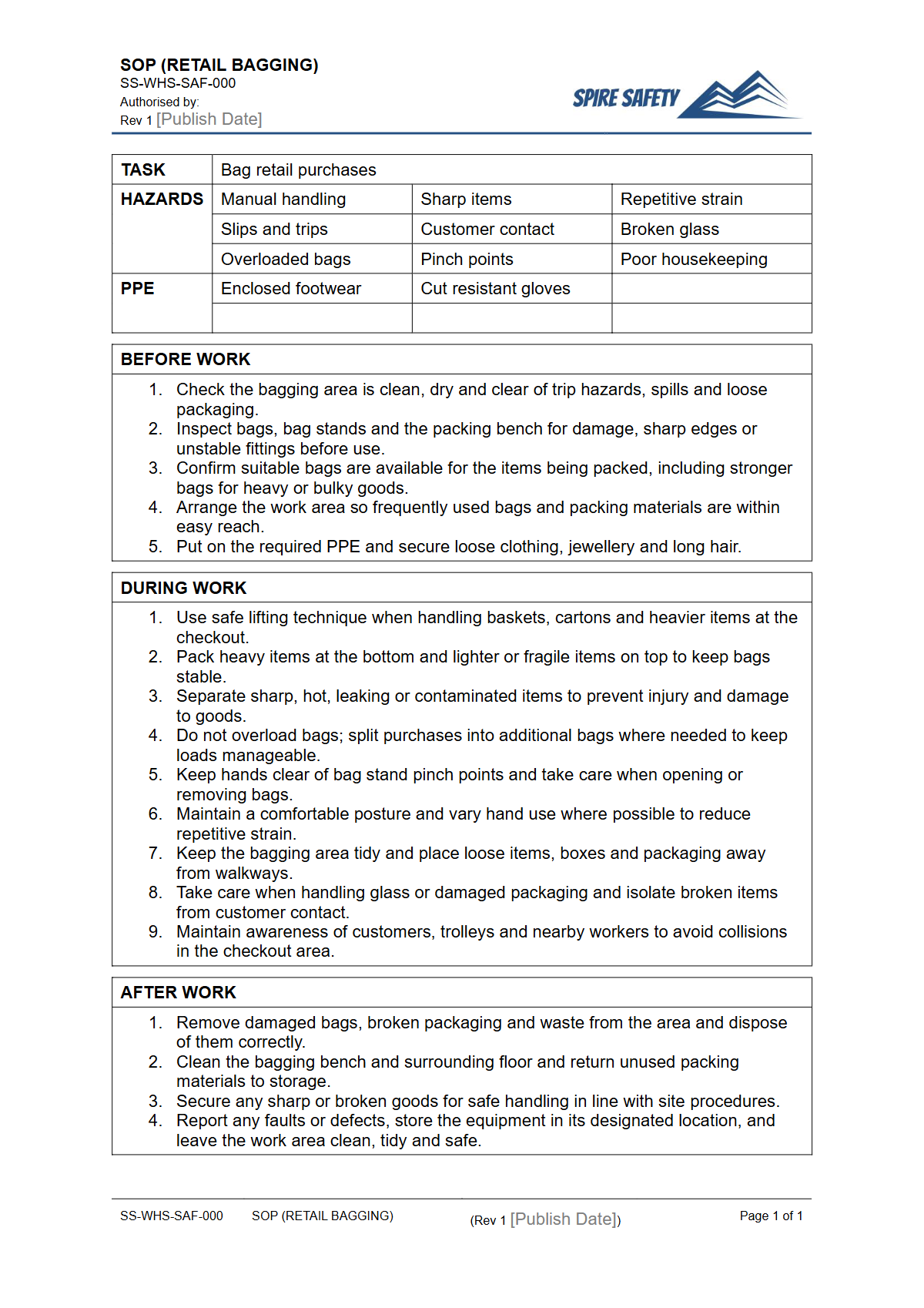
Download our free Safe Operating Procedure for retail bagging. This template helps document safety controls for tasks like lifting, packing, and manual handling.
Free Safe Operating Procedure (Retail Bagging) Template
DOCX • 126 KB + PDF
Updated Oct 2026
No signup required
Purpose of the Free Safe Operating Procedure (Retail Bagging) Template
Formalise your checkout process and minimise common workplace risks with our Free Safe Operating Procedure (Retail Bagging) Template. While bagging groceries or other retail items might seem like a low-risk task, it involves significant exposure to hazards like repetitive strain, awkward postures, and hazardous manual tasks.
These are leading causes of musculoskeletal disorders (MSDs), one of the most common and costly types of workplace injuries in Australia.
This Safe Operating Procedure template provides a structured format for documenting the safest way to perform bagging tasks. It helps standardise work methods across all staff, ensuring everyone understands the controls in place to protect them. Implementing a clear SOP is a fundamental part of demonstrating due diligence and is a critical element within broader WHS management systems.
Video walkthrough
How to use the Free Safe Operating Procedure (Retail Bagging) Template
This template is designed for immediate use and simple customisation. It is available in both DOCX format for easy editing in Microsoft Word or Google Docs, and as a PDF for quick printing and distribution.
To get the most value from this resource, you should:
- Identify the specific types of products, checkout counter layouts, and bagging equipment used in your store.
- Add, remove, or modify steps and safety precautions to match your unique operational context.
- Incorporate details about specific manual handling aids available, such as bag carousels or adjustable-height checkouts.
- Include any site-specific emergency contacts or procedures.
Important: This document is a starting-point template aligned with Australian WHS principles. It must be customised to your specific workplace.
We cannot provide a guarantee of compliance, as this depends on how you adapt and implement the procedure. For complex retail environments, seeking expert WHS consulting can help ensure all risks are adequately addressed.
When to use a Safe Operating Procedure
A customised SOP for retail bagging is a versatile document that should be used consistently throughout your business operations. Its primary applications include:
- New Employee Training: Use it as a core part of the induction process to ensure new team members learn the correct and safe procedure from day one.
- Refresher Training: Conduct periodic refresher sessions with existing staff to reinforce safe work habits and communicate any changes to the procedure.
- Performance Monitoring: Supervisors can use the SOP as a benchmark to observe staff and provide constructive feedback on their safety behaviour.
- Incident Investigation: If an injury occurs, the SOP serves as a critical reference to determine if procedures were followed and where they might need improvement.
- Audits and Reviews: The document provides clear evidence of your risk management process during internal safety checks or a formal WHS compliance auditing.
Who should use it
This Safe Operating Procedure is intended for use by anyone with responsibility for health and safety in a retail setting. Key users include:
- Store Managers and Owners: To fulfil their duty of care by implementing and enforcing safe work systems.
- Department Supervisors and Team Leaders: For training staff and overseeing daily operations at the checkout.
- Health and Safety Representatives (HSRs): As a tool for consulting with workers and management on safety matters.
- Checkout Operators: As a clear, accessible guide on how to perform their tasks safely to prevent injury.
While this SOP covers bagging, your retail environment may have other high-risk tasks. For instance, businesses with a deli or hot food section should document procedures for equipment, where our Safe Operating Procedure for deep fryer use can be a useful starting point.
Similarly, larger retail outlets managing stock with automated systems may find our free Conveyer System SOP relevant. This template is just one of many resources available in our comprehensive free WHS resources library, designed to help Australian businesses improve their safety practices.
Common mistakes
Common mistakes to avoid
- Using the template 'as is' without customising it for the specific checkout layout and equipment.
- Failing to provide practical training and competency checks for staff on the documented procedure.
- Overlooking ergonomic factors, such as the height of scanners, conveyors, and bagging areas.
- Not including steps for handling non-standard situations like bulky items, chemical spills, or broken glass.
Legal references
Legal considerations
The following legal requirements may be relevant to this type of work.
- Work Health and Safety Act (Harmonised) — Provides the primary duties for protecting workers and other people from work health and safety risks.
- Work Health and Safety Regulations (Harmonised) — Sets out requirements supporting the management of workplace hazards and risks.
The following codes may be relevant to this type of work.
- Managing WHS Risks Code of Practice — Provides practical guidance on identifying hazards, assessing risks and applying effective controls.
- Work Health and Safety Consultation, Cooperation and Coordination Code of Practice — Provides practical guidance on consulting workers and coordinating with other duty holders.
- Managing the Work Environment and Facilities Code of Practice — Provides practical guidance on safe work environments, workplace facilities and related controls.
Did you know
Repetitive Strain Injuries
According to Safe Work Australia, musculoskeletal disorders, often caused by repetitive tasks like those at a checkout, are the most common type of work-related injury in the country.
Retail Risk Profile
The retail trade industry has one of the highest rates of serious workers' compensation claims for injuries resulting from hazardous manual tasks, highlighting the importance of proper procedures.
FAQ
Frequently asked questions
01What hazards should be included in a retail bagging SOP?
02Is a Safe Operating Procedure legally required for retail bagging in Australia?
03How often should we review our retail bagging SOP?
04Can this template be used for training new employees?
Share this resource
Free Safe Operating Procedure (Retail Bagging) Template
Browse Categories
How To Use It
- 1Download and open in Word or PDF.
- 2Replace the placeholders with your business details.
- 3Get it reviewed by a WHS specialist before rollout.
Need it customised?
Our WHS consultants can adapt this template to your site, run a gap analysis, or audit what you already have in place.
Book a Free Consultation WHS consulting servicesor call 1300 156 382
Related templates
- Free Safe Operating Procedure (Retail Display Setup) Template
- Free Safe Operating Procedure (Retail Shelf Cleaning) Template
- Free Safe Operating Procedure (Retail Stock Handling) Template
- Free Safe Operating Procedure (Retaining Wall Clean) Template
- Free Safe Operating Procedure (Return Freight Handling) Template
- Free Safe Operating Procedure (Returned Goods Handling) Template