
Free Safe Operating Procedure (Resident Room Packdown) Template
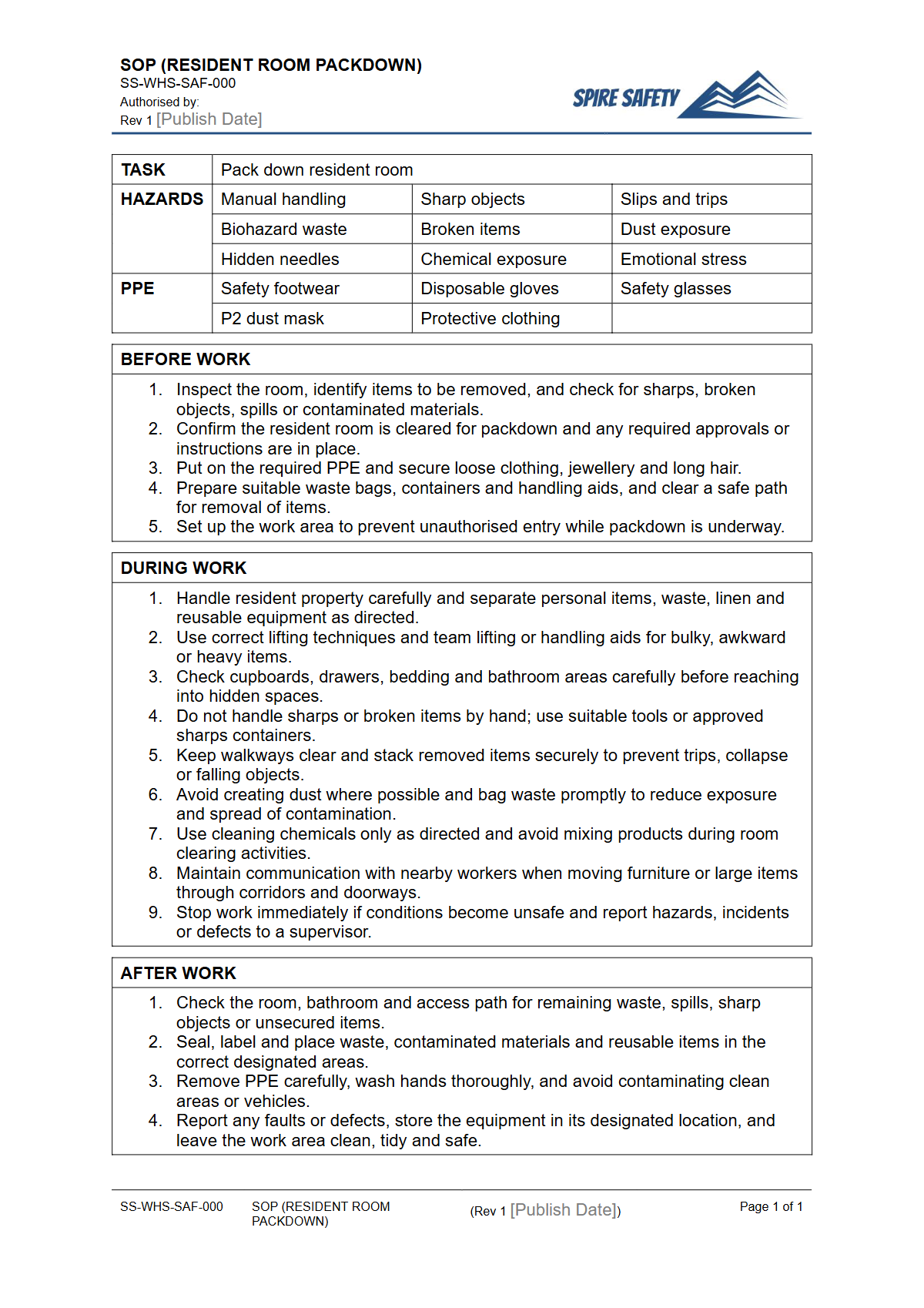
Standardise the process for packing down resident rooms in aged care or accommodation facilities.
Free Safe Operating Procedure (Resident Room Packdown) Template
DOCX • 126 KB + PDF
Updated Oct 2026
No signup required
Purpose of the Free Safe Operating Procedure (Resident Room Packdown) Template
Packing down a resident's room is a frequent and physically demanding task in aged care, supported accommodation, and healthcare settings. This process involves more than just cleaning; it carries significant WHS risks, including manual handling injuries, exposure to biological hazards, and contact with hazardous chemicals.
Our Free Safe Operating Procedure (Resident Room Packdown) Template provides a structured framework for managing these risks effectively. It helps organisations establish a consistent, safe, and respectful process for clearing, cleaning, and sanitising rooms after a resident has vacated.
By implementing a formal SOP, you can standardise tasks, ensure correct personal protective equipment (PPE) is used, and outline emergency procedures. This not only protects your workers from injury and illness but also ensures the process is handled with dignity and respect for the former resident and their belongings.
A documented procedure is a critical component of your overall safety management system, demonstrating a commitment to proactive risk management and supporting compliance with Australian WHS regulations. This process is fundamental to maintaining a safe environment for both staff and incoming residents.
Video walkthrough
How to use the Free Safe Operating Procedure (Resident Room Packdown) Template
This template is provided as a starting point in both DOCX and PDF formats. It is designed to be adapted to the specific context of your facility, including the types of rooms, the cleaning agents used, and your organisation's specific policies on handling personal effects.
Download the DOCX file to edit the content directly, adding or removing steps to align with your operational needs and the findings of your risk assessments.
Important: This is a template only. We are not familiar with your specific operational environment, equipment, or chemical inventory.
You must customise this document to reflect the unique hazards and control measures relevant to your workplace. We recommend a consultation process with the workers who perform the task, as they can provide invaluable insight into the practical risks involved.
Once customised, the SOP should be integrated into your broader WHS management systems, used for training, and regularly reviewed for effectiveness.
When to use this Safe Operating Procedure
This SOP should be followed whenever a resident's room needs to be completely cleared and prepared for a new occupant. This typically occurs after a resident is permanently discharged, transferred to a different level of care, or has passed away.
The procedure covers the entire workflow from the initial assessment of the room to the final sign-off that it is safe and ready for use.
It is not intended for routine daily or weekly cleaning tasks, which should be covered by separate, less comprehensive cleaning procedures. The packdown SOP is specifically for the 'terminal clean' or 'end-of-occupancy' process that requires a higher level of deep cleaning, sanitisation, and potential maintenance checks.
Regular reviews of this and other procedures can be verified through WHS compliance audits to ensure they remain current and effective.
Who should use this Safe Operating Procedure
This procedure is designed for any personnel involved in the room packdown process. This typically includes:
- Environmental Services Staff
- Cleaning and Housekeeping Teams
- Maintenance Personnel
- Aged Care Workers or Personal Care Assistants
- Supervisors and Facility Managers
All individuals responsible for these tasks must be trained in the finalised procedure before undertaking the work. Supervisors should use the SOP as a tool for training, monitoring performance, and investigating any incidents that may occur.
For complex environments or for assistance in developing a suite of tailored safety documents, engaging with specialist WHS consulting services can provide valuable expertise. You can also explore our free WHS resources library for other useful templates and guides.
Common mistakes
Common mistakes to avoid
- Using incorrect PPE or failing to change it between contaminated and clean tasks.
- Not properly segregating waste into general, clinical, sharps, and the resident's personal effects.
- Rushing the process and skipping steps, leading to an increased risk of musculoskeletal injury.
- Failing to allow adequate ventilation when using cleaning chemicals in an enclosed space.
Legal references
Legal considerations
The following legal requirements may be relevant to this type of work.
- Work Health and Safety Act (Harmonised) — Provides the primary duties for protecting workers and other people from work health and safety risks.
- Work Health and Safety Regulations (Harmonised) — Sets out requirements supporting the management of workplace hazards and risks.
The following codes may be relevant to this type of work.
- Managing WHS Risks Code of Practice — Provides practical guidance on identifying hazards, assessing risks and applying effective controls.
- Work Health and Safety Consultation, Cooperation and Coordination Code of Practice — Provides practical guidance on consulting workers and coordinating with other duty holders.
- Managing the Work Environment and Facilities Code of Practice — Provides practical guidance on safe work environments, workplace facilities and related controls.
Did you know
Healthcare's High Risk
The healthcare and social assistance industry has one of the highest rates of serious workers' compensation claims in Australia, with body stressing and manual handling being the leading cause of injury.
Terminal Cleaning
The process of 'terminal cleaning' a room after a resident leaves is a critical infection control measure designed to eliminate pathogens and prevent their spread to new occupants and staff.
FAQ
Frequently asked questions
01What are the main WHS hazards in a resident room packdown?
02How often should an SOP for room packdowns be reviewed?
03Can this SOP be used for hospital room cleaning?
04Who is responsible for training staff on this SOP?
Share this resource
Free Safe Operating Procedure (Resident Room Packdown) Template
Browse Categories
How To Use It
- 1Download and open in Word or PDF.
- 2Replace the placeholders with your business details.
- 3Get it reviewed by a WHS specialist before rollout.
Need it customised?
Our WHS consultants can adapt this template to your site, run a gap analysis, or audit what you already have in place.
Book a Free Consultation WHS consulting servicesor call 1300 156 382
Related templates
- Free Safe Operating Procedure (Resident Room Setup) Template
- Free Safe Operating Procedure (Resin Mixing) Template
- Free Safe Operating Procedure (Respirator Cleaning) Template
- Free Safe Operating Procedure (Retail Bagging) Template
- Free Safe Operating Procedure (Retail Display Setup) Template
- Free Safe Operating Procedure (Retail Shelf Cleaning) Template