
Free Safe Operating Procedure (Resident Laundry Sort) Template
Download our free Safe Operating Procedure for resident laundry sorting, a critical task in aged care and healthcare. Get your DOCX and PDF template now.
Free Safe Operating Procedure (Resident Laundry Sort) Template
DOCX • 126 KB + PDF
Updated Oct 2026
No signup required
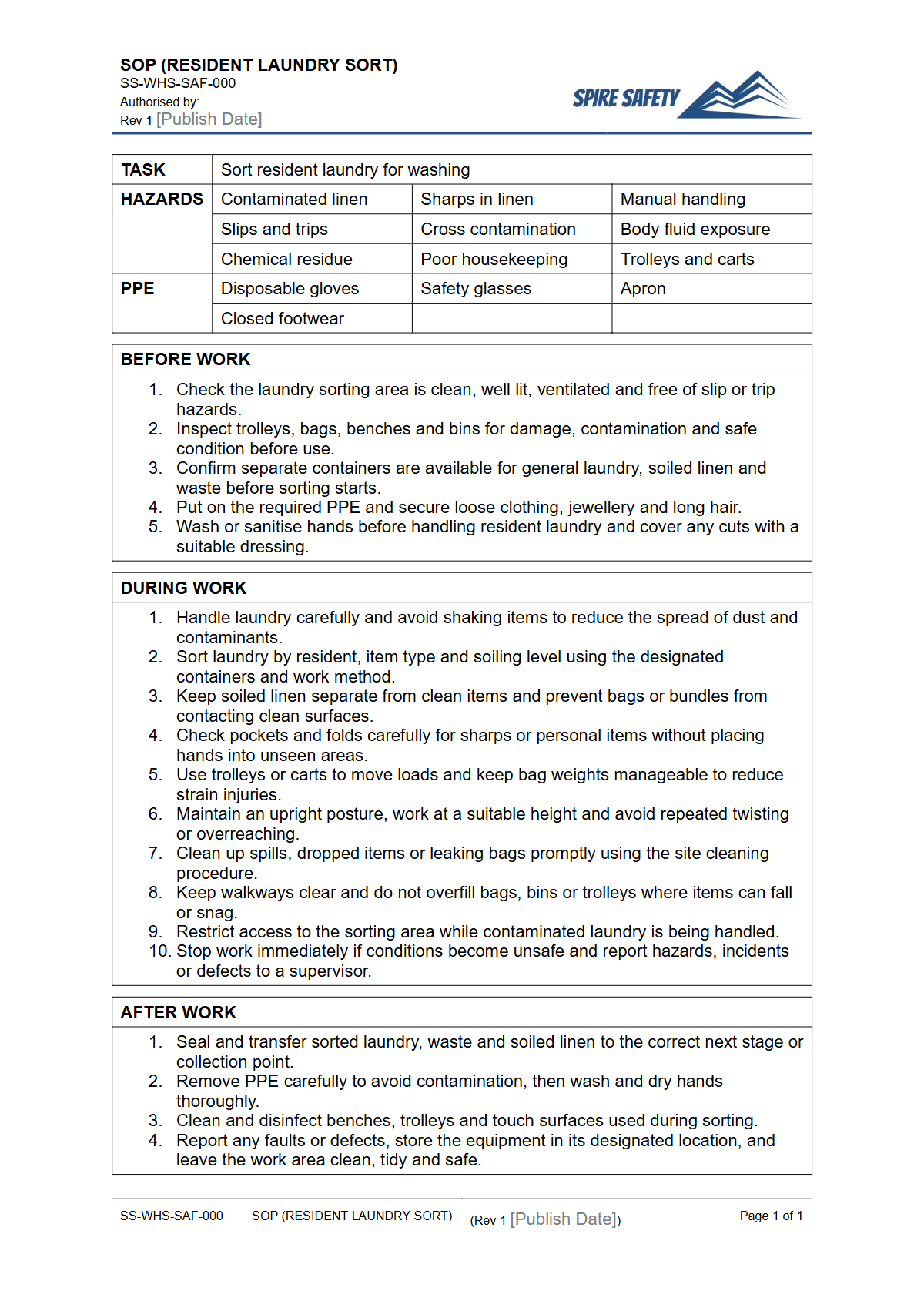
Purpose of the Free Safe Operating Procedure (Resident Laundry Sort) Template
Managing workplace health and safety in aged care, healthcare, or accommodation settings requires clear, documented processes for high-risk tasks. This Free Safe Operating Procedure (Resident Laundry Sort) Template provides a structured starting point for your organisation.
Sorting resident laundry involves significant risks, including exposure to biological hazards, sharps, chemicals, and ergonomic strain. A well-defined Safe Operating Procedure is essential for protecting your workers and ensuring a systematic approach to safety.
The primary purpose of this SOP is to provide a clear, step-by-step guide to performing laundry sorting tasks safely. It aims to control identified hazards, establish a consistent methodology for all personnel, and serve as a foundational document for training and competency assessment.
A robust SOP is a key component of effective WHS management systems, helping to demonstrate organisational due diligence in managing risks.
Video walkthrough
How to use the Free Safe Operating Procedure (Resident Laundry Sort) Template
This resource is available as a DOCX file for easy customisation and a PDF for straightforward distribution and printing. It is vital to adapt this document to your specific work environment by adding details about your site's layout, the types of laundry machinery in use, and any specific chemicals handled.
If your laundry facility uses equipment like large-scale washers or pneumatic systems, ensuring procedures for associated plant like an air compressor SOP are also in place is vital for comprehensive safety coverage.
IMPORTANT: This document is a template and must not be used as is. We recommend a competent person, in consultation with the workers who perform the task, customises this SOP to reflect the unique equipment, substances, and procedures of your workplace.
Your final document should include site-specific emergency contacts, details on required PPE, and clear reporting procedures for incidents or hazards.
Key Hazards in Resident Laundry Sorting
Handling and sorting laundry from residents, particularly in clinical or care environments, presents several serious hazards that this SOP helps to control. A thorough risk assessment should inform the final version of your procedure.
Hazards include:
- Biological Hazards: Exposure to bacteria, viruses, and fungi from linen soiled with blood, faeces, vomit, or other bodily fluids.
- Sharps Hazards: Risk of puncture wounds from hypodermic needles, lancets, broken personal items, or even medication patches inadvertently left in linen or pockets.
- Chemical Hazards: Skin contact or inhalation of industrial-strength detergents, disinfectants, and stain removers.
- Ergonomic Hazards: Musculoskeletal injuries from lifting heavy, wet laundry bags; repetitive motions during sorting; and awkward postures like bending or over-reaching.
Regularly assessing your adherence to these procedures is critical, often forming part of a scheduled WHS compliance auditing program to verify that controls are effective and being followed correctly.
When to Use This Safe Operating Procedure
A finalised SOP for resident laundry sorting is not a document to be filed away; it is an active tool for daily operational safety. It should be used during new employee inductions and for specific task training to ensure all workers understand the required safety protocols from day one.
It also serves as a critical reference for annual refresher training and can be used as a benchmark during safety observations or incident investigations. Just as a commercial kitchen requires a specific SOP for a deep fryer, any specialised task with significant hazards needs its own documented procedure to guide safe work.
Who Should Use This SOP Template
This template is designed for use by those responsible for workplace health and safety. This includes WHS Managers, Aged Care Facility Managers, Operations Managers, and Team Leaders or Supervisors.
Their role is to adapt the template into a site-specific procedure that is practical and effective. Once finalised and approved, the Safe Operating Procedure is for all employees who handle or sort resident laundry.
For complex facilities or if you lack in-house expertise, engaging external WHS consulting can provide valuable support in developing and implementing your safety systems.
By implementing a thorough Safe Operating Procedure for resident laundry sorting, you formalise your commitment to worker safety. This document serves as a critical tool for training, consistency, and risk management. Explore our full free WHS resources library for more templates to support your safety management system.
Common mistakes
Common mistakes to avoid
- Failing to use designated, colour-coded bags to segregate different types of soiled linen.
- Wearing contaminated PPE outside of the designated sorting area, risking cross-contamination.
- Manually compressing linen into bags or carts, which dramatically increases the risk of a sharps injury.
- Assuming gloves alone provide adequate protection without practicing proper hand hygiene before and after the task.
Legal references
Legal considerations
The following legal requirements may be relevant to this type of work.
- Work Health and Safety Act (Harmonised) — Provides the primary duties for protecting workers and other people from work health and safety risks.
- Work Health and Safety Regulations (Harmonised) — Sets out requirements supporting the management of workplace hazards and risks.
The following codes may be relevant to this type of work.
- Managing WHS Risks Code of Practice — Provides practical guidance on identifying hazards, assessing risks and applying effective controls.
- Work Health and Safety Consultation, Cooperation and Coordination Code of Practice — Provides practical guidance on consulting workers and coordinating with other duty holders.
- Managing the Work Environment and Facilities Code of Practice — Provides practical guidance on safe work environments, workplace facilities and related controls.
Did you know
Pathogen Survival
Studies have shown that pathogens like C. difficile and MRSA can survive on cotton and polyester fabrics for days or even weeks, highlighting the importance of correct handling procedures for soiled linen.
Downstream Sharps Injuries
A significant percentage of sharps injuries in healthcare settings occur downstream from patient care areas, affecting support staff like laundry and cleaning workers who handle contaminated waste and linen.
FAQ
Frequently asked questions
01What are the main hazards when sorting resident laundry?
02Why is a specific SOP needed for laundry sorting in aged care?
03Who is responsible for training workers on this Safe Operating Procedure?
04How often should a Safe Operating Procedure for laundry sorting be reviewed?
Share this resource
Free Safe Operating Procedure (Resident Laundry Sort) Template
Browse Categories
How To Use It
- 1Download and open in Word or PDF.
- 2Replace the placeholders with your business details.
- 3Get it reviewed by a WHS specialist before rollout.
Need it customised?
Our WHS consultants can adapt this template to your site, run a gap analysis, or audit what you already have in place.
Book a Free Consultation WHS consulting servicesor call 1300 156 382
Related templates
- Free Safe Operating Procedure (Resident Room Packdown) Template
- Free Safe Operating Procedure (Resident Room Setup) Template
- Free Safe Operating Procedure (Resin Mixing) Template
- Free Safe Operating Procedure (Respirator Cleaning) Template
- Free Safe Operating Procedure (Retail Bagging) Template
- Free Safe Operating Procedure (Retail Display Setup) Template